


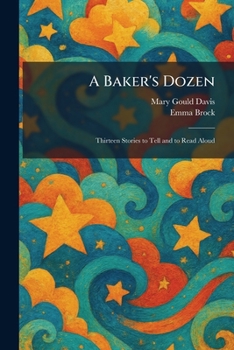
A Baker's Dozen: Thirteen Stories to Tell and to Read Aloud

Select Format
Select Condition 
Book Overview
"A Baker's Dozen: Thirteen Stories to Tell and to Read Aloud" is a thoughtfully curated anthology designed to celebrate and facilitate the art of oral storytelling. Selected by editors Mary Gould Davis and Emma Brock, this collection brings together thirteen diverse tales that have been specifically chosen for their narrative rhythm, engaging themes, and suitability for reading aloud to young audiences. Drawing from various traditions and styles, the stories within this volume are intended to captivate listeners and foster a deep appreciation for the spoken word.
This work serves as a practical and inspiring resource for librarians, teachers, and parents who seek high-quality material for story hours and shared reading sessions. Each inclusion highlights the power of narrative to transport an audience, emphasizing the timeless appeal of folk wisdom, whimsy, and adventure. "A Baker's Dozen" stands as a significant contribution to the field of children's literature, preserving the vital connection between the written text and the performative nature of storytelling. It remains a valuable guide for anyone looking to master the craft of narration while introducing classic themes to a new generation of listeners.
This work has been selected by scholars as being culturally important, and is part of the knowledge base of civilization as we know it. This work was reproduced from the original artifact, and remains as true to the original work as possible. Therefore, you may see the original copyright references, library stamps (as most of these works have been housed in our most important libraries around the world), and other notations in the work.
This work is in the public domain in the United States of America, and possibly other nations. Within the United States, you may freely copy and distribute this work, as no entity (individual or corporate) has a copyright on the body of the work.
As a reproduction of a historical artifact, this work may contain missing or blurred pages, poor pictures, errant marks, etc. Scholars believe, and we concur, that this work is important enough to be preserved, reproduced, and made generally available to the public. We appreciate your support of the preservation process, and thank you for being an important part of keeping this knowledge alive and relevant.
Customer Reviews
ThriftBooks ® and the ThriftBooks ® logo are registered trademarks of Thrift Books Global, LLC
