


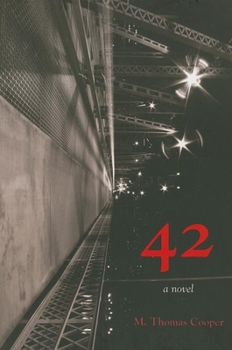
42


Set in Portland, Oregon, 42 follows George Olson as his life is thrown into chaos and his mind into a possible state of psychosis. On the 42nd day of his 42nd year, Georges wife and daughter disappear, his cat and dog run away, and his house burns down. When he is accused of murdering his wife and child, George sets off in search of his family, only to be caught up in a conspiracy of numbers and strange events. The number 42 becomes the meaning of Georges life. But does the conspiracy really exist or is it the product of a paranoid mind?
Format:Paperback
Language:English
ISBN:1932010246
ISBN13:9781932010244
Release Date:June 2008
Publisher:Ooligan Press
Length:325 Pages
Weight:1.25 lbs.
Dimensions:9.0" x 0.9" x 6.3"
Customer Reviews
4 ratings
strange days
Published by Thriftbooks.com User , 16 years ago
A strange, humorous, and at-times maddening work of fiction, "42" is a unique read. The story of George and his descent into delusion as he pursues the wife and daughter who left him is gripping and surreal. I heard the author wrote the manuscript during National Novel Writing Month, which is an impressive feat and enhances the reading of the book. As events get more frantic and chaotic for George, and the tension builds, you can almost see the author pounding furiously away at his keyboard as the month runs out. The storyline and the circumstances of writing it mirror each other. The design of the book itself also adds to the sense of paranoia that permeates it. What do the smalls squares in the margins mean, with their varying amount and coloring? Are they clues to upcoming events in the story, a code that we should work to crack while George wrestles with his own code involving the number 42? I would recommend this book to all who enjoy a dark and twisted tale.
A Challenge, But Worthwhile
Published by Thriftbooks.com User , 16 years ago
This novel is stylistically unique and although challenging at times to follow, is worth the effort that it takes to end up at the surprising and compelling conclusion. In writing 42, M. Thomas Cooper has embarked on a journey of mystery and puzzling challenges which are sometimes strange, but seemingly believable. George Olson, the main character, leads an ordinary life with his wife and daughter, until they both disappear. After this unexplained occurrence, he has inexplicable experiences at work, and then ultimately has to face accusations of murder and arson. Cooper weaves a tale that seems impossible to resolve, but George is able to confront the confusing path his life is taken while seeking for meaning in the number forty-two. One of the most engaging aspects of Cooper's writing is in his ability to craft dizzying imagery. Readers are able to seamlessly enter George's life through Cooper's descriptive language that encapsulates George's reality. The painstaking nature of his existence creates an anxious tone that invests readers in Cooper's universe. Another major strength of the novel is George's role as a likeable protagonist. His decisions are notably poor in the aftermath of his family's disappearance, but George remains an empathetic character. His seemingly delusional state is sometimes understandable, especially when he becomes preoccupied with the number forty-two. Cooper retains a sense of authenticity in George; as his behavior becomes stranger, he could have easily become more alienating. But Cooper offers the support of secondary characters, notably George's secretary Anne, to try and keep George grounded in the face of his mysterious circumstances. The design of this novel makes it a treat to read. The designers have made stylistic choices that are engaging, and represent the state of George's mind as he tries to decipher the meaning of his missing wife and child. The pages are riddled with the depictions of the sticky notes that George constantly writes on. In some ways, the book itself seems like a hand-edited memoir in which George makes certain words fade or a certain name consistently blacked out from view. This multi-faceted reading experience is representative of the complexity of George's own circumstances. Throughout the text, there is disjointedness in plot that is sometimes distracting. The pacing is very fast, and although that results in compelling plot delineation, George's mindset is at times confusing. Some of the pacing moves almost too quickly to actually comprehend the meaning of George's experience, as seen especially when he accidently hits his mother-in-law with his car. This type of absurdity calls for more attention to this scene, but George aimlessly passes by this incident as nonchalantly as he treats much of the mysteries of his life. Though this can sometimes lead to confusing passages, the pacing itself is consistent and lends to the anxious tone that permeates the entire novel. The e
Unique!
Published by Thriftbooks.com User , 16 years ago
The book is clever, unique and interesting. Other than the somewhat rushed ending and the over emphasis on the dog Zeus (got to be extremely annoying), the book was great. I can't say I have read many books similar to this one.
Catchy Title, Maddening Story
Published by Thriftbooks.com User , 17 years ago
Thanks to the legendary Douglas Adams and his Hitchhiker's Guide series, and to a lesser degree cult-TV phenomenon "Lost," the number 42 already has quite an impressive following. I'll admit right away that it is what drew me to this title, not knowing anything about what to expect of the book itself. I was happy to find that 42 is an introspective and ultimately maddening journey by protagonist George Thomas Olson, as he searches for his missing wife and child while battling a growing psychosis. Charged with their murder and a host of related crimes, Olson must piece together an infuriating array of what he believes are clues hidden throughout his life leading to the location of his family; clues that all lead inexplicably back to the number 42. Cooper's first novel is cleverly written as part memoir, part narrative. The first-person, present tense narration is poetic and thoughtful at one moment, sarcastic and witty at others, and utterly maddening in others. Olson's emotions are conveyed not only through the narrative, but by clever changes in the font of the written text as well. The reader lives inside Olson's head as he goes about a daily routine thrown into chaos by the series of events following his family's disappearance. We follow Olson's transition from typical suburbanite family man, through his personal bouts with fear, apathy, and obsession, until he is merely a shell of his former self, delusional, confused, and alone. One criticism is that the otherwise engaging story builds slowly, but finishes a little too quickly. The quick finish is arguably fitting given the narrator's deteriorating mindset as the story progresses, but still leaves the reader wanting more nonetheless. Overall, I was not overly disappointed by this minor detail, and found this thriller a fun (albeit vexing) read.
Copyright © 2026 Thriftbooks.com
Terms of Use | Privacy Policy | Do Not Sell/Share My Personal Information | Cookie Policy | Cookie Preferences | Accessibility Statement
ThriftBooks ® and the ThriftBooks ® logo are registered trademarks of Thrift Books Global, LLC
ThriftBooks ® and the ThriftBooks ® logo are registered trademarks of Thrift Books Global, LLC
