


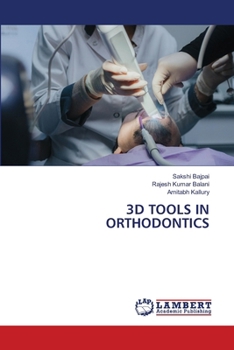
3D Tools in Orthodontics
No Customer Reviews

Three-dimensional (3D) imaging tools have brought significant advancements in orthodontic diagnosis, treatment planning, and evaluation of treatment outcomes. Traditionally, orthodontic records were based on two-dimensional (2D) methods such as cephalometric radiographs, panoramic radiographs, clinical photographs, and plaster models. Although these methods have been widely used, they possess inherent limitations, including image distortion, projection errors, inconsistent landmark identification, and difficulty in accurately evaluating complex craniofacial structures. The conversion of three-dimensional anatomical structures into two-dimensional images frequently results in the loss of important diagnostic information and may obscure asymmetries.The introduction of 3D imaging technologies has enabled clinicians to visualize craniofacial structures in their true anatomical dimensions, thereby improving diagnostic accuracy and treatment planning.
Format:Paperback
Language:English
ISBN:6209703852
ISBN13:9786209703850
Release Date:March 2026
Publisher:LAP Lambert Academic Publishing
Length:80 Pages
Weight:0.26 lbs.
Dimensions:0.2" x 6.0" x 9.0"
Customer Reviews
0 rating
Copyright © 2026 Thriftbooks.com
Terms of Use | Privacy Policy | Do Not Sell/Share My Personal Information | Cookie Policy | Cookie Preferences | Accessibility Statement
ThriftBooks ® and the ThriftBooks ® logo are registered trademarks of Thrift Books Global, LLC
ThriftBooks ® and the ThriftBooks ® logo are registered trademarks of Thrift Books Global, LLC
