


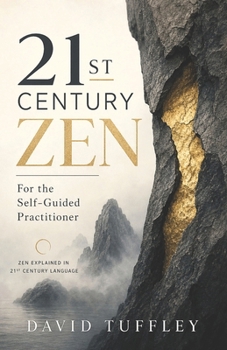
21st Century Zen: For The Self-Guided Practitioner
No Customer Reviews

Zen is a mind-set, a way of life rather than an ideology or religion in the conventional sense. It is a way of life that transcends dualistic everyday thinking to reach satori (enlightenment), a state of mind in which the oneness of all things is experienced.
The principles and practices underlying Zen are generally shrouded in the archaic language of long ago and far away. This book translates these ideas into modern language for a new generation of seekers after enlightenment. 21st Century Zen for the Self-Guided Practitioner takes this ancient insight and places it squarely in the hands of the modern reader, with no robes, no monastery, and no teacher required beyond your own honest attention. David Tuffley, PhD - scholar of comparative religion and Zen practitioner of more than forty years - has written the book he wished existed when he began: a complete, self-contained course in Zen for people who have no acquaintance with classical Chinese or Japanese forms, rendered in plain, elegant modern English. The premise is simple and quietly radical. The outward form a teaching takes was never the teaching. Zen itself crossed from Sanskrit dhyāna to Chinese ch n to Japanese Zen, shedding its shape at every border while carrying its essence intact. This book performs the same crossing into the twenty-first century. The journey begins where all Zen begins: on the cushion. A clear, practical guide to meditation strips the practice of mystique and shows you exactly how to sit, breathe, and meet the mind's resistance. From there the book builds the Zen mind-set - non-attachment, beginner's mind, excellence in small things, the recognition that you are not your thoughts - before laying out, with rare clarity, the essential architecture of Buddhism: the Four Noble Truths, the Eightfold Path, the Four Foundations of Mindfulness, and the Seven Factors of Enlightenment. But this is no narrow primer. Tuffley ranges across the whole contemplative landscape: a penetrating exploration of intuition and satori - those flashes of supreme insight that arrive unbidden - including reflections on synchronicity, the noosphere, and what it means to outsource our minds in an age of intelligent machines. A chapter on communing with nature recovers the felt connectedness that urban life has all but erased. The 37 practices of a Bodhisattva are presented as a workable ethical framework for daily living. The essence of Taoism, Zen's philosophical parent, is distilled into guidance on aligning with the subtle, cultivating oneself, and leading others. More than eighty classic Zen koans - the cup of tea, the sound of one hand, the muddy road - are gathered here with commentary, each a small charge of dynamite laid against the foundations of ordinary thinking. And in a final, courageous chapter, the book turns to the question every tradition must eventually face: what happens when I die? Drawing on the Tibetan Book of the Dead, it offers a map of the territory beyond - not as dogma, but as testimony to be weighed. Throughout, the tone is empirical rather than evangelical. The Buddha asked that nothing be taken on faith; everything here is offered to be tested in the laboratory of your own practice. Whether you hold a religious faith or none at all, the door stands open. The price of Zen, Tuffley admits frankly, is the ego - which does not go quietly. The reward is a clarity that gradually becomes your resting state of mind. If you have ever suspected that beneath the noise of modern life there is something simpler, stiller, and unmistakably you, this book will show you the way back to it.Format:Paperback
Language:English
ISBN:1539018350
ISBN13:9781539018353
Release Date:September 2016
Publisher:Createspace Independent Publishing Platform
Length:282 Pages
Weight:0.72 lbs.
Dimensions:0.6" x 5.5" x 8.5"
Related Subjects
Religion Religion & Spirituality Self Help Self-Help Self-Help & Psychology SpiritualityCustomer Reviews
0 rating
Copyright © 2026 Thriftbooks.com
Terms of Use | Privacy Policy | Do Not Sell/Share My Personal Information | Cookie Policy | Cookie Preferences | Accessibility Statement
ThriftBooks ® and the ThriftBooks ® logo are registered trademarks of Thrift Books Global, LLC
ThriftBooks ® and the ThriftBooks ® logo are registered trademarks of Thrift Books Global, LLC
