


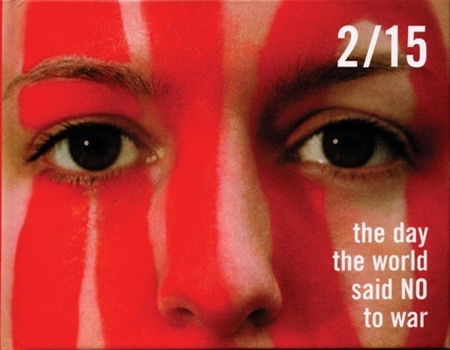
2/15: The Day the World Said No to War


Select Format
Select Condition 
Book Overview
February 15 marked the biggest global peace demonstration in history, when 30 million people around the globe protested against an imminent US-led war with Iraq. As international and diverse as the demonstrations themselves, the book's photos reveal opinions and questions beyond the war protest and expose some of the most compelling images of the day.
Format:Hardcover
Language:English
ISBN:1902593855
ISBN13:9781902593852
Release Date:November 2003
Publisher:AK Press
Length:211 Pages
Weight:1.35 lbs.
Dimensions:1.0" x 7.5" x 6.5"
Customer Reviews
5 ratings
The imagery of global protest
Published by Thriftbooks.com User , 17 years ago
The largest peace movement in the history of the world. More than twelve million people, on every continent. All before the war had begun -- pre-empting the pre-emptive war. It's easy to focus on these rather simplistic formulations of the events around Feb. 15, 2003 (and similar protests following the start of the war on Mar. 20), and for the most part, this book does not venture beyond them. The editors have amassed an impressive array of images from these demonstrations, many of them from independent and non-commercial photographers, and that is no small task. 2/15 is certainly a worthy book -- in many instances, an exceptionally beautiful one -- in the annals of the Iraq peace movement, but there is little contained that would lift it from the coffee table to the library shelf. While for the most part the editors let the images speak for themselves, there are enough snippets of text included -- from speeches given at the time to sympathetic essays and narratives written after the fact -- that a thesis does emerge from this collection. Through visual imagery the editors argue that, contrary to appearances, the peace movement succeeded. While the movement was not able to stop the United States and its allies from invading Iraq, it was able to mobilize millions of people around the single goal of peace. Robert Muller is quoted proclaiming: "Never before in the history of the world has there been a global, visible, public, viable, open dialogue and conversation about the very legitimacy of war. Shock and awe has found its riposte in courage and wonder" (130). It's true that around the globe people turned out for peace, but it was never clear what "peace" meant, exactly, and it is yet to be seen whether this mobilization created a viable method of change. A German journalist wrote of the movement, "In pop, fashion, and youth culture, being for peace is an attitude or a business, if not both" (47). The hip anti-Bush crowds in Europe were probably not motivated by the same forces as the Muslim throngs in Indonesia and Turkey. Protesters in the Philippines, South Africa and Northern Ireland likely had a different conception of the empire to which they were standing up than the Midwestern Democrats who had supported sanctions on Iraq throughout the 1990s. This may seem to be splitting hairs, and in some sense it is -- there is no doubt that the global movement against war in Iraq was a watershed moment, and one this book aptly captures. What it also conveys, however, is the movement's uncertainty for the future. "The fact that this effort could not prevent war reflects not the weaknesses of our movement," David Cortwright is quoted as saying, "but the failures of American democracy and the entrenched power of US militarism" (116). The reason this book falls short in reaching to explain the movement is precisely because of the mythologies from which it acquires its poise; that is, words like "peace" and "democracy" and "freedom." A somewhat meande
An international cry for peace!
Published by Thriftbooks.com User , 19 years ago
With stunning photos, "2/15: the Day the World Said No to War" powerfully documents the largest world-wide anti-war demonstration in history, exhibiting snapshots of marches in Japan, Chile, Antartica, South Africa, Denmark, Spain, the Netherlands, Iraq, Australia, Israel, Bangledesh, France, Argentina and the U.S.A, among other locales. This beautiful montage of inspirational pictures testifies to the diverse concerns, perspectives, strategies and dreams of an international movement for peace and global justice.
It's All About Impressions
Published by Thriftbooks.com User , 20 years ago
There are first impressions (we get only one chance at those) and lasting impressions. This book gives the reader both in case the reader missed the worldwide outpouring of anti-war sentiments and protests prior to the Iraq War. At quick glance, the reader can flip through the pages, getting a glimpse of how the world felt that day...yet on closer look, the reader can also read some poignant commentary that should leave a lasting impression. All in all, having witnessed that incredible day in history and documented it, I enjoyed reliving the vastness of that world protest, seeing people of all stripes in a show of peaceful solidarity. This is not meant to be a heavy tome about war and peace, but a way of gaining an impression or two about one day that will go down in history as the greatest outcry against war.
Visually stunning...
Published by Thriftbooks.com User , 21 years ago
This book is visually stunning... Very well photographed and nicely put together... It's a tribute to the power of the people when we all get together and what can happen... My favorite photograph is where someone is holding a sign that says "there's a village in Texas missing an idiot" - we all know who they're talking about... To me this book shows how many people strong the present day revolution really is, and that's scary to the government - to actually see it in visual - how many people are against their decision on the war/occupation of Iraq... Buy it, it's a visual document of anti-war protest history in making... Viva revolucion - Savannah Skye...
A moving tribute to the day we marched for peace
Published by Thriftbooks.com User , 22 years ago
2/15: THE DAY THE WORLD SAID NO TO WAR is a tribute to those of us who marched for peace on that historic day, as well as the following days before the illegal US-led invasion of Iraq. It is a moving tribute because it demonstrates that this was the largest protest for peace in world history. Estimates hold that around 30 million people marched. But the editors caution that since so many people marched and demonstrated in so many places, the true numbers are impossible to know - it's likely that far more than 30 million participated. All different forms of protests are depicted: from the more straightforward marches (some of them numbering in the thousands, giving a panoramic view), to sit-ins, "dead"-ins, nude-ins (yes, there is a small amount nudity in this book), mock-graveyards displayed in front of foreign US embassies to represent the potential casualties in the event of a US invasion, and avant-garde exhibits in art houses. There is roughly one picture on every other page, with a corresponding quote or passage by luminaries who opposed the war, politicians, political commentators, authors, etc. I found the introduction by Arun Gandhi, Grandson of Mahatma Gandhi and founder of the M. K. Gandhi Institute for Nonviolence headquartered in Memphis, TN, to be insightful. Arun instructs that peace is not only the absence of war, but the absence of hatred within the individual. Peace must grow outward from our own personal approach. Outrage certainly does come up for me when I see this book. It is outrageous to realize that we orchestrated a truly historic event, and the mainstream US media largely ignored it, or portrayed US participants as fringe and eccentric. When viewed from a global perspective, the perspective this book provides, one realizes that we were in fact in the majority. Those in favor of the war were in the fringe. That is why I believe that 2/15 THE DAY THE WORLD SAID NO TO WAR is so important. It helps those of us opposed to the war feel a sense of solidarity, forge a connection where the powers that be would like to dismantle it and create the illusion that we are enemies. A sign carried by an English protestor states it beautifully: "We are all French now"; another more graphic sign lampoons the ridiculous US policy that renamed all French fries sold in government cafeterias: "Freedom Fries and Baghdad Burns." As the editors point out, never before in history had so many citizens opposed something that their supposed representatives allowed. (In an open letter to "Governor Bush," Michael Moore reveals that virtually no one in the United States was gung-ho for war with Iraq.) Reading this book, I couldn't help but remember something Noam Chomsky recently said: there are now two super powers - the United States and world public opinion. It is Chomksy who provides this book's epilogue, saying that the governments of the world can handle it when we take part in one protest and then go home and go about our lives. What they can't h
Copyright © 2026 Thriftbooks.com Terms of Use
| Privacy Policy | Do Not
Sell/Share My Personal Information | Cookie Policy | Cookie Preferences | Accessibility Statement
ThriftBooks® and the ThriftBooks® logo are registered trademarks of Thrift Books Global, LLC
ThriftBooks® and the ThriftBooks® logo are registered trademarks of Thrift Books Global, LLC
