


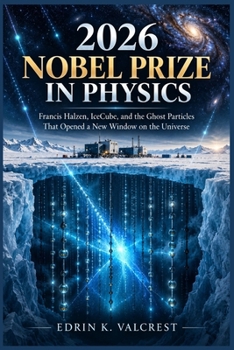
2026 Nobel Prize in Physics: Francis Halzen, IceCube, and the Ghost Particles That Opened a New Window on the Universe

For most of human history, the universe has been studied through light. Telescopes revealed stars, galaxies, exploding suns, and distant cosmic structures. But some of the most powerful events in nature remain partly hidden, buried behind gas, dust, extreme gravity, or the limits of ordinary observation. Then scientists learned to listen for something far more elusive: neutrinos, ghostlike particles that can cross enormous distances and even pass through Earth almost untouched.
This book tells the remarkable story of how a particle once thought nearly impossible to detect became a new messenger from the cosmos. From the first neutrino mystery to the construction of a vast detector beneath Antarctic ice, it follows the scientific persistence, engineering ambition, and breakthrough discoveries that opened a new way to study black holes, cosmic rays, active galaxies, and the high-energy universe.
Inside, you'll discover
How the neutrino went from a theoretical idea to one of physics' most important particlesWhy cosmic rays are so difficult to trace back to their sourcesHow high-energy neutrinos can reveal hidden particle accelerators in spaceWhy scientists turned deep Antarctic ice into a giant astronomical detectorHow faint flashes of light beneath the ice are used to reconstruct neutrino eventsWhat the first high-energy astrophysical neutrino detections changed about modern astronomyHow scientists began linking neutrinos with distant galaxies and extreme cosmic environmentsWhy multi-messenger astronomy combines neutrinos with gamma rays, X-rays, visible light, radio waves, and gravitational wavesWhat remains unknown about the sources of the highest-energy particles in the universeHow the next generation of neutrino observatories may deepen our understanding of the cosmosAt its heart, this is a story about patience. Scientific breakthroughs rarely appear all at once. They grow through failed experiments, bold ideas, difficult engineering, years of uncertainty, and the willingness to keep searching when the signal is faint and the answer is far away.
For readers who enjoy physics, astronomy, scientific discovery, and the human effort behind major breakthroughs, this book offers a clear and engaging journey into one of the newest ways humanity has learned to observe the universe.
Customer Reviews
ThriftBooks ® and the ThriftBooks ® logo are registered trademarks of Thrift Books Global, LLC
