


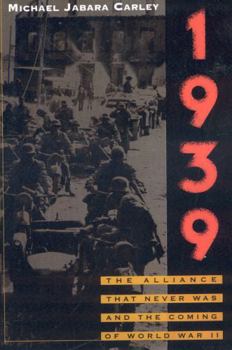
1939: The Alliance That Never Was and the Coming of World War II


Select Format
Select Condition 
Book Overview
At a crucial point in the twentieth century, as Nazi Germany prepared for war, negotiations between Britain, France, and the Soviet Union became the last chance to halt Hitler's aggression. Michael Carley's gripping account of these negotiations challenges prevailing interpretations by situating 1939 at the end of the early cold war between the Soviet Union, France, and Britain, and by showing how anti-communism was the major cause of the failure to form an alliance against Hitler.
Format:Paperback
Language:English
ISBN:1566637856
ISBN13:9781566637855
Release Date:February 2009
Publisher:Ivan R. Dee Publisher
Length:384 Pages
Weight:1.25 lbs.
Dimensions:0.8" x 6.0" x 9.0"
Customer Reviews
3 ratings
Great book!
Published by Thriftbooks.com User , 23 years ago
Other people have already written about this book. I simply want to add that this book is worth of reading.
Excellent Study Of The Year Leading To WWII!
Published by Thriftbooks.com User , 24 years ago
This excellent recent work by author Michael Jabara Carley adds more fuel to the continuing fire of controversy regarding relative responsibility for the outbreak of general war in the fall of 1939. Indeed, in this well-written and well-documented work, the author's main argument contends that it was the collective failure of the so-called allies to overcome their own fears about communism and the perceived threats associated with the rise of international socialism that were responsible for the failure to bring the Soviet Union into the Allied orbit in time to stave off Hitler's rush into Poland. Given the well-documented facts and figures marshaled in defense of this argument, it is difficult to fault this view. For example, Carley illustrates how the Soviet Union made attempt after attempt to solicit the support and agreement of the western allies to form an alliance against Germany, only to be slow-rolled and virtually ignored time after time. In this fashion, the Soviets were finally left with few obvious options other than to turn into the direction fo their greatest fear and accept terms with the Nazis, hoping that by cooperating them and acting as their key supplier in the face of growing intransigence on the part of the Allies, the Germans would leave them alone. The author masterfully shows how this consistent series of rebuffs of the Russians by the western Allies was related to a western phobia of the communism and its associated threats, and illustrates how these fears of all things socialistic blinded the Allies to the obvious dangers presented by the acts of the Nazi regime.Thus, despite the fact that the Russians regularly tested the waters for a broad alliance against the Nazis during the late thirties, it was the western Allies who spurned such efforts to create a united front that did so much to engender the conditions allowing it to break out in the fall of 1939. In fact, as the author so well illustrates, a particularly virulent form of anti-socialist fervor seemed to affect both the British ruling class as well as many in the higher reaches within the French political community during this period of time, and this attitude did much to limit the discussion of the possibilities for compromise and joint action with the Russians. Of course, there were a few hardy souls with the vision and perspective to understand how important an early alliance with the Soviet Union, including Winston Churchill in Britain and Robert Vansittart in France. But few others listened to their emotional pleas for action and union with the Russians or their reasoning for taking such common cause with the dreaded socialists.This is a carefully documented and painstakingly well-researched work that serves a much wider readership and appreciation for it as the work of careful scholarship that it is. I was especially impressed by the degree of information revealed from the archives of the former Soviet Union, which acts to shed a lot of light on the ef
Exposing the Cold War mentality of the 1930s
Published by Thriftbooks.com User , 25 years ago
Michael Carley's 1939: The Alliance That Never Was demolishes the Cold War-inspired revisionism regarding the diplomacy that led to World War 2. From the Cold War perspective, Stalin, the left-wing dictator, betrayed the Western democracies who were wooing him, to form a dictators' pact with Hitler, the right-wing dictator. This allowed Hitler to invade Poland, giving the Soviets the chance to steal eastern Poland, a forewarning of how they would behave after World War 2 once the Nazis were beaten.Wrong in every respect, argues Carley. The Soviets had been pressing for a front with the democracies to prevent Nazi rearmament and aggression since 1934. They still wanted this desperately in 1939, but after Munich, they did not think they would get it. Fanatic anti-communism on the part of most of the leadership of Britain and an important section of the French political class made such an alliance seem unlikely. Indeed the Western democracies appeared to prefer Nazi Germany to Communist Russia. While the Soviet Commissar of Foreign Affairs, Maxim Litvinov, worked tirelessly to press for collective security, and the Soviet Ambassador to London, Ivan Maiski, had an important network of friends in high places in Britain who trusted Soviet initiatives, the Soviet plans were always blocked by the "men of Munich." Led by Neville Chamberlain himself, they included key Cabinet members, members of the Foreign Affairs ministry, and the military. These men were impervious to pleas from Maiski, and from Winston Churchill, and Robert Vansittart for an alliance with the Soviets against the Nazis.Carley's book is the result of painstaking research in the foreign affairs documents of all the principal players. Particularly important here is his work in the archives of the old Soviet Union that began to open a variety of once-closed documents in the era of glasnost.While this book focuses almost exclusively on the events of 1939, it reinforces the views expressed in Clement Leibovitz and Alvin Finkel, In Our Time: The Chamberlain-Hitler Collusion, that in the years leading up to World War 2, the leaders of the Western democracies deliberately tried to build up Hitler's power in the hope that he would take on the hated Soviets. He could have all of eastern and central Europe as a reward if he could keep his hands off Britain and France, their empires, and their spheres of influence. Only when it became clear that Hitler would not do these things, did the Western countries reluctantly decide to fight him.
Copyright © 2026 Thriftbooks.com Terms of Use
| Privacy Policy | Do Not
Sell/Share My Personal Information | Cookie Policy | Cookie Preferences | Accessibility Statement
ThriftBooks® and the ThriftBooks® logo are registered trademarks of Thrift Books Global, LLC
ThriftBooks® and the ThriftBooks® logo are registered trademarks of Thrift Books Global, LLC
