


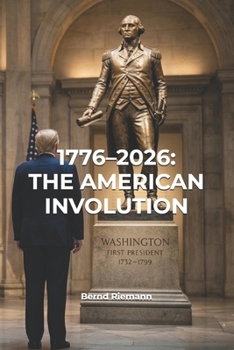
1776-2026: The American Involution

Why does the nation that invented modern revolution now seem capable only of repetition?
As the United States approaches its Semiquincentennial on July 4, 2026, it stands at a precipice not of collapse, but of involution-a state where increasing social, legal, and economic complexity fails to produce genuine structural change. In this provocative and meticulously researched work, Bernd Riemann challenges the dominant narratives of American history. Moving beyond the myth of progress and the specter of decline, the author reveals a system that has become a master of the closed loop, resolving its deepest contradictions through endless procedural layers rather than substantive transformation.
A Pathbreaking Framework for the 250th Anniversary
Drawing on the anthropological concept of involution-originally used to describe systems that grow more intricate internally while remaining stagnant externally-Riemann traces the American loop from the Revolutionary War to the gridlock of 2026. He argues that the US Constitution was designed as a rulebook for rule-making, a procedural engine that postponed foundational conflicts like slavery and federal sovereignty by transforming them into administrative exercises.
Inside The American Involution, you will explore:
The Expansionary Illusion (1776-1865): How early American statecraft utilized territorial acquisition not as a solution to foundational tensions, but as a geographic deferral. By pushing the irreconcilable contradictions of slavery and federal sovereignty into the Western frontier, the Republic substituted physical growth for political resolution. This outward expansion created a territorial gyre, where every new state added a layer of procedural complexity that eventually exhausted the map, forcing the loop to tighten into the cataclysm of the Civil War.
The Industrial Maelstrom (1866-1945): The rise of the corporation and the regulatory state-not as enemies, but as partners in a new, self-sealing bureaucratic organism.
The Thermostatic Trap (1946-2000): How suburbia, the Cold War, and the culture wars created a world of physical and ideological recursion, where every new conflict merely restored old patterns under revised language.
The Closed Loop (2001-2026): An analysis of our contemporary moment, exploring the final hardening of the American system. From the strategic inertia of "forever wars" to the social media ouroboros that consumes public discourse, the current era is defined by a "crisis without catharsis." Examining the period between the 2008 financial collapse and the 2024 election cycle, the work illustrates how technological complexity and institutional gridlock have merged to create a system that is technologically advanced yet politically frozen.
Riemann provides an empirical autopsy of the American state, citing everything from the 190,000-page Code of Federal Regulations to the algorithmic echo chambers of TikTok and Twitter. He demonstrates how the financialization of the economy, the professionalization of politics, and the "legitimacy spiral" of the Supreme Court have created a nation that celebrates its own fossilization while the underlying machinery hums with frantic, circular energy.
The American Involution is an essential read for anyone seeking to understand why America's most decisive moments fail to decide anything. It is a profound meditation on the distance between the revolutionary premise of 1776 and the contemporary reality of procedural recursion.
Will the republic survive? The author suggests that is the wrong question. The real question is: Can a political order organized around perpetual self-reference ever generate a future that isn't just a more complex version of the past?
Customer Reviews
ThriftBooks ® and the ThriftBooks ® logo are registered trademarks of Thrift Books Global, LLC
