


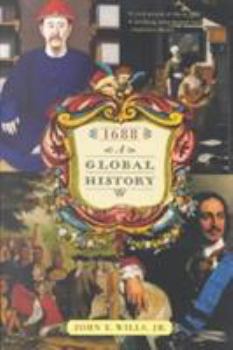
1688: A Global History

Select Format
Select Condition 
Book Overview
John E. Wills's masterful history ushers us into the worlds of 1688, from the suicidal exaltation of Russian Old Believers to the ravishing voice of the haiku poet Basho. Witness the splendor of the Chinese imperial court as the Kangxi emperor publicly mourns the death of his grandmother and shrewdly consolidates his power. Join the great caravans of Muslims on their annual pilgrimage from Damascus and Cairo to Mecca. Walk the pungent streets of Amsterdam and enter the Rasp House, where vagrants, beggars, and petty criminals labored to produce powdered brazilwood for the dyeworks. Through these stories and many others, Wills paints a detailed picture of how the global connections of power, money, and belief were beginning to lend the world its modern form. A vivid picture of life in 1688...filled with terrifying violence, frightening diseases...comfortingly familiar human kindnesses...and the intellectual achievements of Leibniz, Locke, and Newton.--Publishers Weekly
Format:Paperback
Language:English
ISBN:0393322785
ISBN13:9780393322781
Release Date:January 2002
Publisher:W. W. Norton & Company
Length:348 Pages
Weight:1.12 lbs.
Dimensions:0.8" x 5.5" x 8.2"
Customer Reviews
5 ratings
"the sketch and the anectdote" woven into world history
Published by Thriftbooks.com User , 22 years ago
John Wills takes a unique approach to writing global history by focusing on the world in a single year. More accurately, this is a history of the late 17th century in which the year 1688 serves as nexus, and justifies bringing together stories that he "stumbled across" while researching European-Chinese relations. The result is a somewhat personal and idiosyncratic, but very entertaining, book. He does not engage in extensive analysis, preferring the sketch and the anecdote to the Grand Narrative. The notions of fragmentation and serendipity, rather than system and analysis, guide the presentation: "The historian seeking to sketch a world tries not to be confined to any style, any set of questions but to follow hunches, to let one thing lead to another. Like Shitao letting the One Stroke appear in many forms, he hopes to avoid system and to put before his reader many pictures of a world, reflecting the unconfineable variety, splendor, and strangeness of the human condition" (P 112). The appeal of the book is that it is centered on the stories of real people, some of whom are well known and others obscure. In my judgment the strongest parts of the book focus on points of cross-cultural contacts, what might be considered the "boundary" areas rather than the traditional "centers" of civilization. Here the sense of a dynamic, living world emerges most vividly. Rather than a world of static, closed societies, the world in 1688 is one in which boundaries are not rigid. People move about and encounter each other in pursuit of commerce, adventure, and plunder. A variety of cross-cultural contacts appear in these pages: individuals adapting to foreign and alien settings, diaspora merchant communities prospering and struggling, communities resulting from the forcible transplanting of people brought about by slavery, Creole societies in the New World, frontier towns like Potosi that brought together fortune seekers from all over. One example of interconnectedness that affected people and communities in various parts of the world is the Atlantic slave trade. Portuguese activities left their cultural imprint on the Congo, where we see an African chief writing to a Capuchin Priest in Portuguese and calling himself "Dom Joao Manoel Grilho, who treads on the lion in his mother's belly" (P. 32). Across the Atlanta in Brazil, escaped slaves formed their own settlements called quilombos. They grew their own food, had they own smiths, and some grew as large as twenty thousand people. Eventually, leaders of coastal towns, suffering from raids by these quilombos, banded together with bandeirantes, Brazilian frontiersmen in the business of enslaving Indians, and in 1694 destroyed the largest of these communities, killing and enslaving those who remained. Meanwhile, back in London in 1688, a woman writer named Aphra Behn published Oroonoko: Or, The Royal Slave. This is the story of an escaped slave set in Surinam on the north coast of South America.
two thumbs up
Published by Thriftbooks.com User , 22 years ago
John E. Wills Jr. produced an amazing piece of work when he published 1688: A Global History in 2002. His retelling of the events that occurred 314 years before is astonishing in its detail and personalization. He does not give dull facts, but as he said he, "hoped to convey to [the] reader some of [the] astonishment at the voices I have heard." (5) I give the work "two thumbs up" because in my opinion it excels in the two major areas a history text should excel in. It is factual, detailed and accurate, but it is also highly enjoyable reading and draws the reader into itself. The approach used in the text is very interesting, and certainly has a place in a global history course. His non-Eurocentric viewpoint is refreshing and allows for a more accurate picture of the year 1688 to be developed. His ingenuity concerning the wide use of many different kinds of sources sharpens the image and gives us new perspective. The background information he gives to the different stories that appear is enough to allow us better understanding, but does not drown us in too many facts. His major focus on the basic shifts that we can see traces of in 1688 that will later create our own world allow for a degree of continuity throughout the work. Overall Wills creates a very good book, one that is both enjoyable and one that truly teaches us something in a way we may never have considered it before. As he calls it, the "baroque" quality of all the events going on in 1688, the intricacies and interconnectedness give us a perfect picture of life in that year. When it boils down to it, 1688: A Global History is a history text. In this way it surely is a good one. The facts contained within are all accurate, and all ready to be learned from. For a professor creating a curriculum for a global history course this would be a wonderful choice to either start the course off with or conclude with. It gives the reader or student a sense of a true global history. Wills tells us of events and people around the globe in one given year. This allows us to see the interconnectedness of the world, and how important it is to have a good understanding of global history. Clearly you cannot teach a global history course composed entirely with this type of manuscript, they simply do not exist. But this can be used to either introduce the importance of global understanding to a new student or tie a semester or a year's worth of teaching together at the end and remind the student of the importance of what was taught. Either way, 1688: A Global History truly is a global history and has its own place in global history curriculums. A student in a global history course may begrudge adding another 300 page book to their list of texts for the semester. It may seem like too much work for a trivial lesson they can be told rather than have to read for themselves as well. A student can be told the importance of global history without reading this book, but a true understanding ma
Fascinating Globalism
Published by Thriftbooks.com User , 24 years ago
1688 takes a look at the entire world as it existed in that year. When I took history courses in college the only thing that seemed to matter was European history, so 1688 to me means England's Glorious Revolution and not a whole lot else. This book is a fascinating look at as many global events as the author could clearly identify as happening in 1688. The most eye-opening result, for me, is the recognition that our present inter-connected world was already taking shape 300 years ago. This is an important book because it allows us to recognize that not only are we not "alone" today, we haven't been for a long, long time.
Take A World Cruise!
Published by Thriftbooks.com User , 24 years ago
This absorbing world history of the year 1688 allows you, minus the book price, to traverse the globe for free. Professor E. Willis, jr. has done all the work for you. All you need is his book, an atlas and the internet to check out each exotic tale and locale. This is rivetting history at its best!
Take A World Cruise!
Published by Thriftbooks.com User , 24 years ago
This absorbing world history of the year 1688 allows you, minus the book price, to traverse the globe for free. Professor E. Willis, jr. has done all the work for you. All you need is his book, an atlas and the internet to check out each exotic tale and locale. This is riveting history at its best!
Copyright © 2026 Thriftbooks.com Terms of Use
| Privacy Policy | Do Not
Sell/Share My Personal Information | Cookie Policy | Cookie Preferences | Accessibility Statement
ThriftBooks® and the ThriftBooks® logo are registered trademarks of Thrift Books Global, LLC
ThriftBooks® and the ThriftBooks® logo are registered trademarks of Thrift Books Global, LLC
