


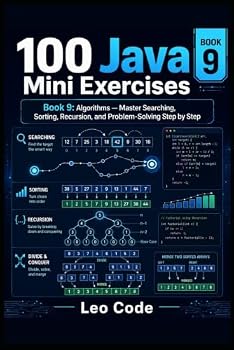
100 Java Mini Exercises –Book 9: Algorithms —: Master Searching, Sorting, Recursion, and Problem-Solving Step by Step

Take your Java skills beyond writing code that simply works.
In Book 9 of the 100 Java Mini Exercises series, you will learn how to analyze the steps a program follows, compare different solutions, and choose algorithms that are clear, reliable, and efficient.
Through 100 practical, progressive exercises, you will explore the essential algorithms every Java learner should understand. You will begin with traversals, accumulators, counters, maximums, minimums, and basic efficiency. From there, you will work with linear search, binary search, classic sorting methods, string algorithms, recursion, divide-and-conquer strategies, merge sort, quick sort, and complete applied challenges.
Each exercise includes:
a clear problem statement;a specific learning objective;complete and functional Java code;a step-by-step explanation;an algorithm note;an improvement challenge for further practice.Inside this book, you will learn how to:
count iterations, comparisons, swaps, and recursive calls;search arrays using linear and binary search;find first, last, and repeated appearances;sort numbers, strings, and objects;implement bubble sort, selection sort, and insertion sort;analyze palindromes, anagrams, frequencies, and repeated characters;understand base cases and recursive calls;build recursive binary search;implement merge sort and quick sort;compare O(n), O(log n), O(n ), and O(n log n) solutions;combine multiple algorithms in realistic console applications.The book uses clear American English, gradual explanations, and fully developed examples. It is designed for self-taught programmers, students, teachers, and anyone who wants to strengthen their algorithmic thinking without getting lost in excessive mathematical theory.
You do not need to memorize every solution.
The goal is to recognize the patterns behind each problem, understand why an algorithm works, and develop the ability to rebuild and adapt it when needed.
If you have already worked with Java fundamentals, arrays, methods, objects, collections, files, and exceptions, this book will help you take the next major step:
from writing code to understanding how that code solves problems.
Continue the journey and prepare for Book 10, where these algorithms will become practical tools inside complete Java console projects.
Customer Reviews
ThriftBooks ® and the ThriftBooks ® logo are registered trademarks of Thrift Books Global, LLC
