


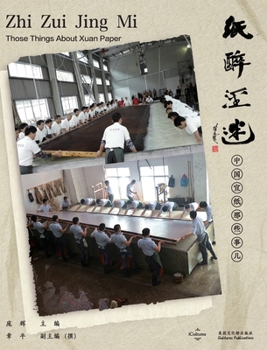
纸醉泾迷zhi Zui Jing Mi: 中国宣纸那些事儿Those Things About Xuan Paper [Chinese]

Chinese Xuan Paper, a Thousand-year Legend
In 2006, the State Council of the People's Republic of China issued the first batch of National Intangible Cultural Heritage lists. Among them, the "Xuan paper making skills" of Jingxian, Anhui Province, were listed, making this traditional handmade craft officially recognized as a national protected object. On September 30, 2009, the "Xuan paper-making skills" of China were affirmed by UNESCO and included in the List of Intangible Cultural Heritage of Humanity.
Having been a famous paper used for classical Chinese paintings and calligraphy, Xuan paper is one of the traditional Chinese papermaking crafts. Because Xuan paper is
easy to store, durable, and long-lasting, it earns the reputation of "paper longevity for thousands of years." The texture of Xuan paper is soft but tough, smooth and clean like jade, and rot and insect resistant. Used for paintings and calligraphy, the layers and strokes on Xuan paper are clear and distinct, bold and vigorous, saturated but not muddy, and light but not lackluster. Words and paintings are brilliant and vivid on paper.
According to the " History of the Early Tang Dynasty," paper and writing brush already appeared in the tribute presented by Xuancheng County to Chang'an during the reign of Tang Tianbao. The comprehensive and systematic use of green sandalwood bark to make Xuan paper began from the Cao family, represented by Cao Dasan, the ancestor of Xiaoling in Jingxian, in the late Song Dynasty and early Yuan Dynasty.
Why can Xuan's paper only come from Jingxian? How many magical legends are there in that place? Our original intention is to go into the introduction of "the mountain, the water, the people" with all those legends, and such is our purpose of passing on the well-documented history and mythology to future generations so that they reveal the truth through these historical facts.
Pang Hui, born in 1954 in Changzhou, China, is a researcher at the Sichuan Center for Zhang Daqian Studies, a consultant at the Jiangsu International Cultural Exchange Center, and a consultant at the Silicon Valley Asian Art Center in the United States. He has spent 38 years collecting and researching Chinese art, focusing on Chinese painting and calligraphy, Buddhist statues, Ming and Qing porcelain, and antique furniture, with special attention to the works of Chang Daichien and Fu Baoshi. Since 2019, he has curated and published a series of art books in North America on China's intangible cultural heritage. His English monograph Burning Passion: Fu Baoshi's Art and Life filled a gap in English-language Fu Baoshi scholarship.
Customer Reviews
ThriftBooks ® and the ThriftBooks ® logo are registered trademarks of Thrift Books Global, LLC
