


< Back to Search Results
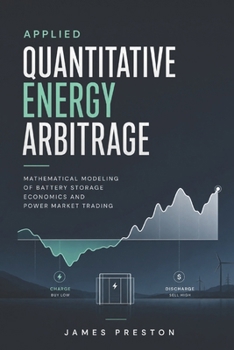
Applied Quantitative Energy Arbitrage: Mathematical Modeling of Battery Storage Economics and Power Market Trading

Master the Quantitative Foundations of Modern Power Grid Arbitrage
As battery energy storage systems (BESS) transform global electricity markets, the ability to accurately model, price, and execute grid-scale arbitrage has become a critical skill for quantitative analysts, energy traders, and storage developers.
Applied Quantitative Energy Arbitrage delivers a rigorous, mathematical framework for navigating the complex dynamics of modern power markets. Moving beyond surface-level economics, this guide bridges the gap between theoretical financial engineering and the physical constraints of real-world power grids.
Key Topics Covered:Battery Storage Economics: Formulate optimal dispatch strategies, account for degradation curves, and model state-of-charge (SoC) dynamics under uncertain market conditions.
Power Market Trading Algorithms: Develop quantitative strategies for day-ahead and real-time markets, co-optimizing energy arbitrage alongside ancillary service commitments.
Nodal Price Forecasting: Build statistical and machine learning models to analyze locational marginal pricing (LMP), congestion patterns, and basis risk across major ISOs (including ERCOT and PJM).
Risk & Revenue Stacking: Implement robust optimization methods to mitigate volume risk, price volatility, and operational constraints in volatile spot markets.
Whether you are designing automated trading strategies, evaluating storage asset valuations, or modeling grid integration, this book provides the practical mathematical toolkit needed to quantify risk and extract value from power grid inefficiencies.
Customer Reviews
ThriftBooks ® and the ThriftBooks ® logo are registered trademarks of Thrift Books Global, LLC
