


< Back to Search Results
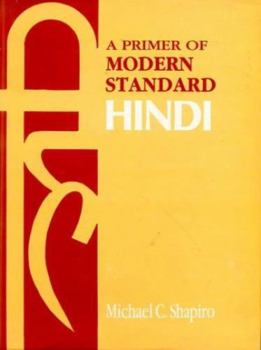
A Primer of Modern Standard Hindi


Select Format
Select Condition 
Book Overview
This work intended to provide the student with a thorough foundation in the grammatical structure of that variety of Hindi that is commonly tau This primer presents a systematic introduction to the... This description may be from another edition of this product.
Format:Hardcover
Language:English
ISBN:8120804759
ISBN13:9788120804753
Release Date:January 2008
Publisher:Motilal Banarsidass
Length:293 Pages
Weight:1.50 lbs.
Dimensions:10.0" x 0.8" x 7.8"
Customer Reviews
5 ratings
Great Textbook
Published by Thriftbooks.com User , 15 years ago
This is a great textbook for a serious Hindi learner. Basically, it explains everything from A to Z. It does use a lot of philological terms, but it does explains every term before using it, which might not be obvious if one never read the book sequentially. Also, it's very consistent, demonstrate every language construction by examples, and contains 4 exercises for each chapter -- 2 for E-H and H-E expressions and 2 for E-H and H-E sentences. And each of them uses both the current and previous chapter materials. Although there is no answers, the E-H and H-E exercises of the same chapter use similar expressions in most cases so the results can be verified indirectly. This is a fundamental book, and the author clearly follows the concept that any language is based on the verb and sentence structure so the vocabulary and most of the grammar reflect this concept with heavy emphasise on verbs. And it's great as a grammar reference. This is certainly not a book for a tourist, even if used as a reference. And one won't find any word lists, like parts of the body, food items, colors, shapes, etc., even though most common ones are given in different chapters. The same is true for verbs and adjectives, which could be listed more systematically. I would like to find some source of well organized Hindi vocabulary (word lists) myself. The introduction says that the book is not for learning conversational language, but it includes a great deal of conversational expressions and even specifies common differences between spelling and pronunciation. Maybe the approach of Usha Jain is more comprehensive as some reviewers recommended, but "Teach Yourself Hindi" is no match to this book in any respect, neither grammar, no vocabulary, no exercises. The only its advantage is audio CDs that give some verbal Hindi exposure. Actually, I found it more tolerable reviewing it the second time after reading the Primer. Using it as the first textbook was a nightmare. One disadvantage of this book (printed in India) is unclear font, especially Devanagari. It's readable, but smaller than English, and one does adjust to it after some time. Also, it contains only H-E glossary. Overall, it's a very worthwhile book for the intended reader.
You will speak better Hindi than most Indians...
Published by Thriftbooks.com User , 16 years ago
... if you use this book. This book ROCKS! in a word nerd kind of way. It truly is a grammar primer, but should be used in conjunction with a tutor, class or other live speaking, listening and interaction with other Hindi speakers. If you don't have classroom experience or a tutor, you probably are going to be overwhelmed by the material, and you will not pronounce consonants and vowels correctly. The reason I say that you will speak better Hindi than most Indians: the majority of Indians do not speak Hindi as their mother tongue (maatraa bhaashaa) and are usually given only the most cursory training in Hindi grammar. This book should be used in conjunction with live practice, vocabulary training and building (flashcards) and daily/weekly exposure to Hindi books, podcasts and video. If you use an integrated training approach, you will eventually become the envy of your Indian friends, because this book will give you a sounder knowledge of Hindi grammar than most Indians get (for example those from Andhra Pradesh, whose mother tongue is Telegu). My criticisms of the book (other than a few typos that a good copy editor would have caught): (1) answers are not provided for exercises at the end of each chapter. (2) I would also have liked an Index with page numbers, to make the book more useful for reference. (3) It would also be useful to pair the Hindi-English glossary with an English-Hindi glossary for the same vocabulary. I have almost finished the book and am developing an entire flashcard system for Supermemo using the vocabulary and grammar rules from the book. I have completed the first 20 chapters, and my flashcard database has about 1800 cards already. If want to achieve true fluency in Hindi, this book is an incredibly good start. Even for a less linguistically ambitious traveler, in India for a few months, or for an expat living and working in India, it may be all the Hindi grammar you will ever need. Vocabulary is another matter. You should supplement your vocabulary training with another more contemporary source. The lexicon in this book is sometimes dated, but all the foundation nouns, verbs, adverbs, adjectives and post-positions are here. Contact me if you're interested in my flashcards.
Great reference, but maybe a little advanced for a "primer"
Published by Thriftbooks.com User , 18 years ago
If this is your first language, then maybe this book would be a little too technical for the average beginner. But as a grammar reference this is second to none. I've heard that it is used as a reference even in Indian universities. The problem for the beginner is that it presumes a sophisticated knowledge of English grammar and terminology, beyond what my generation is being taught in (public) grade schools, but the advantage is that it leverages such knowledge to rigorously teach Hindi's *rules* instead of just listing examples. This has helped me gain a good technical understanding of the language, which has served as the foundation for further conversational practice. Reportedly the vocabulary introduced in the book is "scientifically designed" to cover the most commonly used Hindi words. However, I find myself wishing that it had more organized vocabulary sections, such as one chapter on body parts, another on colors, one for things in a kitchen... etc. This is something easily found in books for almost all other languages (like Spanish) but which I've not found satisfactorily in any Hindi books. One complaint is that it's published in India using outdated typography. If this is your first exposure to Devanagari then you'll likely have some trouble reading the symbols -- or even reading the English text -- because the characters run together or have ink splotches from the printing press. Dr. Shapiro: your book could really benefit from a new edition. Oh, and contrary to another reviewer's assertion, Shapiro's "Primer" *does* have many examples and exercises, but it does not give an answer key.
Great reference material, but would need Prof Shapiro to get the most out of it.
Published by Thriftbooks.com User , 18 years ago
This book is great. It has alot of grammatical points covered in a very dense and thorough book. The downfall is very few examples and no exercises whatsoever. A plus of the book is each section has a large vocabulary list at the end of some 40-60 words. If you have already been studying the grammar of the language and are familiar with alot of the basics this book would be excellent to use as a refresher or reference material to look something up you may have forgotten. Another plus to this book is there is a very thorough explanation of phonetics and pronunciation of the Hindi language, as well as other points about Devanagari that you won't find in other books of Hindi instruction. You definitely can learn from this book but with a bit of extra effort. However it is organized MUCH better than say "Teach Yourself Hindi" by Snell and Weightman. Overall though I'd recommend this as one of the must haves for studying the language, as Professor Shapiro also uses this book in his classes of Hindi at University of Washington. Again I would recommend Usha R. Jain's "Introduction to Hindi Grammar." to go along with it. I use the two books together with great success. I would like to say it was a book well done. Just be aware of the points I have made. :)
Excellent introduction to Hindi
Published by Thriftbooks.com User , 21 years ago
Professor Shapiro is a giant in the field of Indo-Aryan linguistics and his book is an excellent, if not essential, place to begin one's studies of Hindi. The virtue of the book is its rare ability to combine academic precision and detail with ease of use. With this in mind, I find this book provides the soundest overall introduction to Hindi - supplying both a complex beginner's understanding of the language and the best platform for further study. Other books that work especially well with this one, but would be incomplete without it, are Usha Jain's "Introduction to Hindi Grammar" (helpful for its very gradually approach) and "Teach Yourself Hindi" (excellent for its conversational emphasis and keyed exercises).
Copyright © 2025 Thriftbooks.com
Terms of Use | Privacy Policy | Do Not Sell/Share My Personal Information | Cookie Policy | Cookie Preferences | Accessibility Statement
ThriftBooks ® and the ThriftBooks ® logo are registered trademarks of Thrift Books Global, LLC
ThriftBooks ® and the ThriftBooks ® logo are registered trademarks of Thrift Books Global, LLC
