


< Back to Search Results
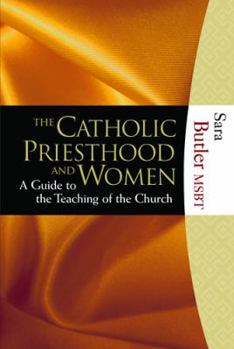
The Catholic Priesthood and Women: A Guide to the Teaching of the Church

Select Format
Select Condition 
Book Overview
In his letter Ordinatio Sacerdotalis, Pope John Paul II stated: "Wherefore, in order that all doubt may be removed regarding a matter of great importance, . . .I declare that the Church has no... This description may be from another edition of this product.
Format:Hardcover
Language:English
ISBN:1595250166
ISBN13:9781595250162
Release Date:March 2007
Publisher:Hillenbrand Books
Length:132 Pages
Weight:0.94 lbs.
Dimensions:9.3" x 0.8" x 6.3"
Customer Reviews
5 ratings
Women and the Catholic Priesthood
Published by Thriftbooks.com User , 17 years ago
At last... a complete discussion of the topic of ordination for women in the Catholic Church, presenting historical arguments as well as current. Butler is a knowledgeable and objective presenter of the church's reasoning.
Great book for anybody wanting to understand why the priesthood is reserved to males
Published by Thriftbooks.com User , 19 years ago
I recently finished reading Catholic Priesthood and Women: A Guide To The Teaching Of The Church by Sr. Sara Butler, MSBT. When I had first read about this book I was intrigued by both the subject and the author and ordered it. Despite Ordinatio Sacerdotalis the issue of women's ordination is still a hot button issue in the Church and it is still being discussed as if one day this doctrine will change. Thus I think it is an important issue to delve down deeper into and to understand more fully when discussing this topic with those who don't hold to Church teaching on it. In 1978 Sr. Butler chaired a task force on women's ordination for the Catholic Theological Society of America which favored women's ordination. It was only later when she worked with the Anglican-Roman Catholic Consultations and for the USCCB on a Pastoral letter for women's concern that she realized that the CTSA's previous critique was seriously flawed. In recent years she was appointed to the International Theological Commission and was involved in the recent document on the hope of salvation for infants who die with being baptized. That she had once held the opposite view makes this book even better since she is able to ably give the objections and then to give replies to them. She starts off by giving a history of this issue. For most of the history of the Church there has been little doctrinal development on this issue since it has really never been a point of contention within the Church. There have been Church fathers who have addressed this issue at times mainly in response to heretical sects such as the Gnostics ordaining women. It is only in recent times that the magisterium has had to seriously address this issue. The first response was by Pope Paul VI in 1975 in a letter to the Archbishop of Canterbury. Dr. Goggan the Archbishop of Canterbury at the time had asked for papal counsel. The following year the Pope had directed the Sacred Congregation for the Doctrine of the Faith to explain the tradition more fully which they did with Inter Insigniores. Up to the issuance of Ordinatio Sacerdotalis there were several references to women's ordination in a couple of papal addresses and letters. One of the major critiques of this doctrine has been that the tradition was greatly influenced by an outdated view of women and a flawed anthropology. The second chapter on the book addresses this and explains Church teaching on the status of women in society and the Church. There certainly has in the history of the Church been a flawed understanding of the role of women and there has been a lot of doctrinal development in this area, especially during and since Vatican II. In the 1917 code of Canon law there were some roles that male non-clergy could perform that women were barred from as designated in 33 canons. In the revised code there are now only three instances where the status of women and men is not precisely equal. Two concern rites and to which rite the child of a parent
Great Guide to the Teaching of the Church
Published by Thriftbooks.com User , 19 years ago
It would be very difficult to add to the reviewers below, so I won't try to. I will content myself to say that Sr. Sara's book is absolutely amazing in its clarity and precision. She treats the issue of women in the priesthood very fairly, and her treatment is very comprehensive for such a short book. It is a must-have for all priests and parish libraries.
A clear, scholarly, yet succinct and highly readable explanation
Published by Thriftbooks.com User , 19 years ago
Not only does Sr. Sarah Butler thoroughly explain the reasons why the Catholic Church calls only men to ordination as bishops and priests, but she does it in 112 pages. The presentation is not at all ponderous, but the careful, sequential presentation will require more than a casual read. In the process Sr. Butler gives her readers a brilliantly clear understanding of how the Roman Catholic Church understands the faith as the mind and will of Christ, recieved by the apostles and given expression in Tradition. The reader sees the process by which the Church reasons in this particular matter (and, by extention, in other theological matters). Sr. Butler provides careful explation of essential concepts in Catholic thinking such as "the Lord's manifest will", "the Apostle's way of acting" and "the settled doctine of the Catholic faith." Her distinction between Fundamental Reasons and Theological Arguements is enormously helpful. To date this is one of, if not "the," definitive books on the subject.
The Ordination of Women
Published by Thriftbooks.com User , 19 years ago
Sister Sara Butler, professor of dogmatic theology at St. Joseph's Seminary in New York, has written a well-researched, tightly reasoned, and cogently crafted study of what is, for Catholics, a settled issue: women cannot properly be ordained to the ministerial priesthood. Sister Butler's analysis is far more theologically persuasive than this--but, at its heart, her thesis is that one can examine the Catholic priesthood either socially or sacramentally. A merely "social" examination--which is based upon a manifestly defective understanding--sees the priesthood as an office of leadership, to which women have a claim equal to that of men. A Protestant view of the priesthood, in fact, may well confirm this understanding. Sister Butler, however, points out that the priesthood is not a social or leadership role (or a "career" [see p. 42]), but is, rather, a sacrament of apostolic ministry in which those who are ordained serve as "signs" or icons of Christ. The Church has no authority to change the priesthood by ordaining women, for the Church must be true to Christ's will (see pp. 2, 15, 46), and Christ chose for the priesthood "those whom He wanted" (Mark 3:13). Along the way, Sister Butler addresses the common objections to Church teaching, such as the notion that Jesus chose no women to be Apostles because of the culture in which He lived (but Jesus never compromised the Truth by conforming to societal constraints and surely would not have been intimidated as He established His Church [see p. 67]); that the Church is oppressing women (but the 1983 Code of Canon Law is clear that Catholic women have essentially the same juridical status as Catholic men [see pp. 31, 60]); and that--always offered in a somewhat tongue-in-cheek manner--the Church should ordain only Jewish males (but once it was clear that Gentiles could be admitted to Baptism and the community, there was, of course, no such controversy, tongue-in-cheek or not: "[W]hile there is no theological or canonical tradition concerning the admission or exclusion of Gentile converts from priestly functions, there is a tradition concerning the exclusion of women from priestly ordination" [p. 103]). Referring to a number of key Church documents, Sister Butler points out the four fundamental reasons barring women's ordination: the unbroken, universal tradition of ordaining men; the rootedness of this tradition in Christ's deeds and His apostolic selections; apostolic fidelity to Christ's choice of men to be Apostles; and the normative tradition of the Church. A particularly powerful passage in the book, referring to Cardinal Newman's concept of doctrinal development, contends that if an idea conforms to the Gospel, has been witnessed to and practiced by the Apostles (and the Church Fathers [on this, see Rod Bennett's book entitled Four Witnesses]), and has been preserved without interruption in the Catholic Church, it is a valid "development" and not a "corruption" (pp. 109-110). Those w
Copyright © 2026 Thriftbooks.com
Terms of Use | Privacy Policy | Do Not Sell/Share My Personal Information | Cookie Policy | Cookie Preferences | Accessibility Statement
ThriftBooks ® and the ThriftBooks ® logo are registered trademarks of Thrift Books Global, LLC
ThriftBooks ® and the ThriftBooks ® logo are registered trademarks of Thrift Books Global, LLC
