


< Back to Search Results
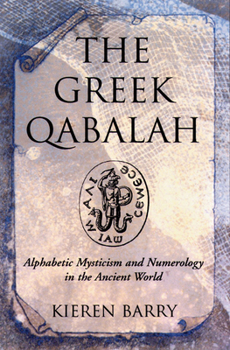
The Greek Qabalah: Alphabetical Mysticism and Numerology in the Ancient World


This book will be of interest to a wide range of readers, from students of Ancient History and early Christianity, to Qabalists and modern magicians. Extensive notes and citations from original sources will make this authoritative work an essentialreference for researchers and practitioners for years to come. Includes are appendices for tables of alphabetic symbolism, a list of authors, and a numeric dictionary of Greek words, which represents the largest collection of gematria in print. Index.
Format:Paperback
Language:English
ISBN:1578631106
ISBN13:9781578631100
Release Date:October 1999
Publisher:Weiser Books
Length:312 Pages
Weight:0.95 lbs.
Dimensions:0.8" x 5.5" x 8.3"
Customer Reviews
5 ratings
Greek comes into its own
Published by Thriftbooks.com User , 18 years ago
For too long the importance of the ancient greek contribution to modern magick has been ignored. The Ogdoadic tradition of Aurum Solis has made some effort to rectify this, but until now the main contribution was the excellent The Greek Magical Papyri in Translation: Including the Demotic Spells: Texts which is full of source material waiting for the discerning eye and hand. Bary has down a great service to the development of magick by bringing together all the significant sources and tracing the descent and development of the use of number and letter in ancient Greece, prior to its incorporation into other traditons. From the seven vowels (corresponding to the seven classical planets) to the different alphabets, this books is outstanding and deserves to be on the bookshelves of all magicians, pagans and just everybody! Buy this book, you won't regret it!
Definitive for it's Genre
Published by Thriftbooks.com User , 21 years ago
This book isn't so much about disproving the historical validity of the Hebrew Qabalah as it is about drawing the similarities, and differences, between the Greek Mysteries and many other ancient systems of science and mysticism. This book fills in a much needed niche. The system itself is as valid as that of Hebrew Qabalism, yet is sorely lacking from many modern occult and esoteric sciences. I myself have found the Greek systems much more relevant and logical in many situations than the Hebrew System (I suppose I've always had more of an affinity towards Greek/Roman culture than Biblical culture, though). My only complaint about the book is that it is a bit dry. The author is admittedly attempting to write a book for many audiences, not just occultists, so the book comes across as very scientific. Of course, this is not necessarily a bad thing when one considers the freedom of historical invention many occult authors are fond of. One thing I found especially useful was the 56 page Dictionary of Isopsephy which contains an extensive list of Greek words and phrases and their numerations. This is put in numerical order, not alphabetical, which makes it much more useful in my opinion. Used in conjunction with a couple websites (listed below) and a Greek dictionary one is provided with hours of mathematical fun for the whole heretical family. http://www.jwmt.org/v1n7/isop.html http://horusset.com/greek/
Great study!
Published by Thriftbooks.com User , 21 years ago
Yes, I will agree with almost all the reviewers, this is a great book to read, and a great way to understand a good deal of arithmos knowledge. I will have to disagree with the reader pointing that the author doesn't state written Hebrew evidence. Are there any at the time of Greek Pythagoras or even Plato, concerning this knowledge? Anything written in Hebrew I mean. That's the question! The common knowledge is that the Qabalah is the body of Egyptian mysteries transferred to priests and students of the mysteries (many of them being either Greek or Hebrew). The study of Pythagoras and Plato alone would astonish the Qabalh student (I suggest it!). So, it is neither Hebrew knowledge nor Greek. It's universal knowledge, transferred through the Egyptians to any adept! let's not go far from the evident of 'common sources'. The names of "Hebrew" qabalistic literature are 60% Greek. Even the Hexatefxon the reader mentions is a greek word meaning 'six volumes'!!! And we all know what Gematria means, don't we? Or maybe tetragrammaton (that's an interesting one, since it applies to the name of the 'Hebrew' god)...'Four lettered being/word' it means! And this greek word thing proves the known. The Hebrews and the Greeks have lived together (not in the best of terms, true! Hanuka proves it!), and Hebrew scholars would talk and even write in Greek at the time. Just like it happened with the so called Roman-Byzantine empire, that turned to be a Greek speaking/writing/creating empire! I don't understand why that's such a bad thing to admit! The Greeks admit that they use Turkish words in the everyday vocabulary nowdays... Doesn't make them less Greek or anything. All this attitude is racistic and only leads to further hatred and misunderstanding. So, if you're looking for part of the truth then...read this book, it's worth your time, your money, your studies... And then study Pythagoras and Plato... You'll even clear any confusions you many have from your original Qabalah studies! And of course don't give up on your Qabalah studies!
True Roots of the Tree of Life
Published by Thriftbooks.com User , 25 years ago
Barry's new book from Weiser is incredibly insightful and well researched in terms of tracing the historical roots of the practical forms of Qabalah (ie: isopsephy or gematria, notaricon, arithmology, alphabetic symbolsm, etc.) to the Pythagorean, Platonic, Hermetic, Gnostic and Alexandrain schools of Greece as opposed to the commonly held belief of it's classical roots within the Hebraic tradition. Though perhaps a bit dry at points due to it's academic approach, the book is well worth the cover price for the dictonary of Greek gematria (ala Sepher Sephiroth) alone, which provides the serious student of Qabalah with a wealth of material from which to start building upon in their own researches into the Greek language. Barry hits home time and time again with demonstrable examples of practical qabalistic exegesis from Aristotle to Zosimos, citing examples that range from classic biblical sources and Gnostic texts to Egyptian magical papyri and even common Roman graffiti. Besides excellent examples of dated sources, Barry also leads us along the paths and byways of language itself, giving us a scholarly view of the very nature of the power of the word and how these words and letters were viewed and utilized by the ancient world to literally command the forces and potencies of nature. Whether you're an armchair numerologist, practicing qabalistic magician, or just wish to get a clearer view into the common roots of language, Barry's "The Greek Qabalah" serves up all of it in spades. Probably one of the most comprehensive and concise books on the topic, that will undoubtedly become a classic for scholarly research in this field well into the future.
The definitive history of Qabalah
Published by Thriftbooks.com User , 26 years ago
Kieren Barry has done the entire religious world a great service with this volume. In it he presents in a very readable form the definitive history of Qabalah, with a particular emphasis on origins.While religious readers may take offense at his secular scholarly approach and certain conclusions he reaches based on that approach, they should not use that as a reason to set the book aside. When those conclusions, derived from pre-conceived notions of what can and cannot be with regard to true divinity, are ignored, we have a masterfully told drama of the origin of man's attempt to understand God by means of scientific exploration. The science in question is mathematics, and the results are predictable. God is created in man's image, and is discovered by man's knowledge, not be revelation. This is a fascinating story, and should not be overlooked, because it tells us more about ourselves than about God.At the same time, the serious student of the Qabalistic mysteries should not overlook this book, whether for understanding of the number of the Beast of Revelation 13:17-18, or for his own interest. Barry has conclusively shown all of the key elements of the techniques, and their origins, beginning with the Egyptians, Pythagoras, and eventually to Plato and the Gnostics. The Jews are not ignored, but are shown to be latecomers, with the first real activity in the 13th century AD.Definitely a work not to be ignored.
Copyright © 2026 Thriftbooks.com Terms of Use
| Privacy Policy | Do Not
Sell/Share My Personal Information | Cookie Policy | Cookie Preferences | Accessibility Statement
ThriftBooks® and the ThriftBooks® logo are registered trademarks of Thrift Books Global, LLC
ThriftBooks® and the ThriftBooks® logo are registered trademarks of Thrift Books Global, LLC
