


< Back to Search Results
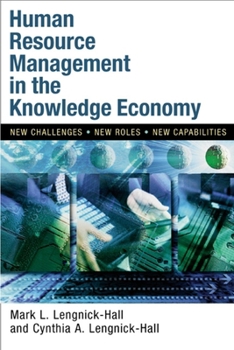
Human Resource Management in the Knowledge Economy: New Challenges, New Roles, New Capabilities


Synthesizes current thinking on knowledge management and intellectual capital and identifies how human resource management can make a value-added contribution As more organizations recognize the... This description may be from another edition of this product.
Format:Paperback
Language:English
ISBN:1576751597
ISBN13:9781576751596
Release Date:December 2002
Publisher:Berrett-Koehler Publishers
Length:224 Pages
Weight:0.70 lbs.
Dimensions:0.6" x 6.6" x 8.5"
Customer Reviews
3 ratings
Add this book to your required reading list
Published by Thriftbooks.com User , 20 years ago
Written for HR Professionals, this book will help you understand how the training industry is changing with the emergence of the knowledge economy and stay current in our rapidly changing economic environment. In the world of Human Resources, this book is timely and useful. This book is theoretical in orientation. The authors propose that, because of the shift to a knowledge economy and all its attendant disruptions (rapid change, fluidity, ambiguity), HRM professionals should construe HR's new responsibilities in terms of roles rather than functions and processes. They identify three basic capabilities necessary for success in the knowledge economy: Reconnaissance and discovery, Entrepreneurship and mobilization, and Efficiency and flexibility. To meet the challenges of the new economy the authors believe that HRM professionals must create value based on the firm's intangible assets, expand throughout the value chain to suppliers and distributors, and manage the new roles required of HR professionals.
Two rare feats for the strategic HR management literature
Published by Thriftbooks.com User , 22 years ago
In "Human Resource Management in the Knowledge Economy: New Challenges, New Roles, New Capabilities," the Lengnick-Halls accomplish two rare feats. First of all, this book provides a well-balanced view between researchers and practitioners, using terms that are both recognizable and actionable to both groups. Researchers will appreciate the text for the concept explorations that open doors to new research paths. Practitioners will appreciate the matter-of-fact language that describes how HR practices can be intertwined with strategic management practices to implement a truly strategic HR management program. Secondly, they provide one of the best integrations of human resource management and strategic management available in the form of full-length texts. The "practice" of human resource management has typically been too far removed from the "promise" of strategic human resource management offered by an integration of the two concepts. Practitioners of strategic HR management who have seen their best efforts to make human resource assets an essential component of their firm's strategies become token exercises in paperwork management will appreciate the practical advise contained in this text to reach that goal.
New perspectives
Published by Thriftbooks.com User , 22 years ago
Finally a book that is not all jargon as many of the books in this area. Perhaps this stems from the fact that both the authors are academicians with an eye on the industry. The book lays out the different roles HR needs to assume if it does not plan to become redundant in the new economy. I would have liked to see more in terms of translation into a sort of tool kit but given that this is a new area one hopes the next edition will carry the tool kit or perhaps other writers will get inspired to write one. As an ex-HR practitioner and now researcher in this area I feel this book is worth a read and for having on the shelf to see what the future could look like.
Copyright © 2026 Thriftbooks.com Terms of Use
| Privacy Policy | Do Not
Sell/Share My Personal Information | Cookie Policy | Cookie Preferences | Accessibility Statement
ThriftBooks® and the ThriftBooks® logo are registered trademarks of Thrift Books Global, LLC
ThriftBooks® and the ThriftBooks® logo are registered trademarks of Thrift Books Global, LLC
