


< Back to Search Results
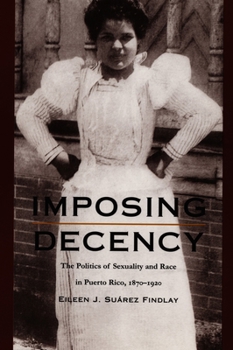
Imposing Decency: The Politics of Sexuality and Race in Puerto Rico, 1870-1920

Select Format
Select Condition 
Book Overview
Feminists, socialists, Afro-Puerto Rican activists, and elite politicians join laundresses, prostitutes, and dissatisfied wives in populating the pages of Imposing Decency. Through her analyses of Puerto Rican anti-prostitution campaigns, attempts at reforming marriage, and working-class ideas about free love, Eileen J. Su rez Findlay exposes the race-related double standards of sexual norms and practices in Puerto Rico between 1870 and 1920, the period that witnessed Puerto Rico's shift from Spanish to U.S. colonialism.
In showing how political projects and alliances in Puerto Rico were affected by racially contingent definitions of "decency" and "disreputability," Findlay argues that attempts at moral reform and the state's repression of "sexually dangerous" women were weapons used in batttles between elite and popular, American and Puerto Rican, and black and white. Based on a thorough analysis of popular and elite discourses found in both literature and official archives, Findlay contends that racialized sexual norms and practices were consistently a central component in the construction of social and political orders. The campaigns she analyzes include an attempt at moral reform by elite male liberals and a movement designed to enhance the family and cleanse urban space that ultimately translated into repression against symbollically darkened prostitutes. Findlay also explores how U.S. officials strove to construct a new colonial order by legalizing divorce and how feminist, labor, and Afro-Puerto Rican political demands escalated after World War I, often focusing on the rehabilitation and defense of prostitutes.
Imposing Decency forces us to rethink previous interpretations of political chronologies as well as reigning conceptualizations of both liberalism and the early working-class in Puerto Rico. Her work will appeal to scholars with an interest in Puerto Rican or Latin American studies, sexuality and national identity, women in Latin America, and general women's studies.
Format:Paperback
Language:English
ISBN:0822323966
ISBN13:9780822323969
Release Date:January 2000
Publisher:Duke University Press
Length:328 Pages
Weight:1.22 lbs.
Dimensions:1.0" x 5.9" x 9.2"
Customer Reviews
2 ratings
fascinating insights
Published by Thriftbooks.com User , 23 years ago
I am the grandchild of a Puerto Rican woman who lived on the island about the time this book was written. I was absolutely fascinated by the book and found it explained a lot about attitudes toward race and sexuality that prevailed in my own family that I'd always found contradictory and inexplicable.I generally avoid books written by academicians because their writing style is usually turgid, wordy and devoid of life. Not so this book. While it does carefully document its subject, the writing is lively and engaging.A must-read for anyone who wants insight into a fascinating aspect of Puerto Rican culture.
Accessible and well written
Published by Thriftbooks.com User , 26 years ago
Well researched and engaged with the scholarly discussion, yet readable and at times very elegantly argued. The book contributes to discussions of race and sexuality and should be of interest to many more than the few academics in Latin American history and women's studies. Those people, and many others interested in those and related fields, however, MUST read it!
Copyright © 2026 Thriftbooks.com
Terms of Use | Privacy Policy | Do Not Sell/Share My Personal Information | Cookie Notice | Cookie Preferences | Accessibility Statement
ThriftBooks ® and the ThriftBooks ® logo are registered trademarks of Thrift Books Global, LLC
ThriftBooks ® and the ThriftBooks ® logo are registered trademarks of Thrift Books Global, LLC
