


< Back to Search Results
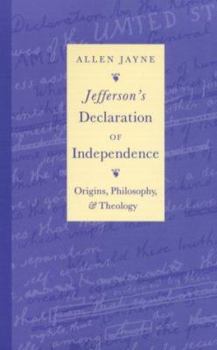
Jefferson's Declaration of Independence: Origins, Philosophy, and Theology
No Customer Reviews

Select Format
Select Condition 
Book Overview
Allen Jayne analyzes the ideology of the Declaration of Independence--and its implications--by going back to the sources of Jefferson's ideas: Bolingbroke, Kames, Reid, and Locke. He concludes that the Declaration must be read as an attack on two claims of absolute authority: that of government over its subjects and of religion over the minds of men. Today's world is more secular than Jefferson's, and the importance of philosophical theology in eighteenth-century critical thought must be recognized in order to understand fully and completely the Declaration's implications. Jayne addresses this need by putting religion back into the discussion.
Format:Paperback
Language:English
ISBN:0813190037
ISBN13:9780813190037
Release Date:November 2000
Publisher:University Press of Kentucky
Length:320 Pages
Weight:0.96 lbs.
Dimensions:0.6" x 6.0" x 9.0"
Grade Range:Postsecondary and higher
Related Subjects
Biographical Biographies Biographies & History Biography & History Christian Books & Bibles Christianity Democracy History Humanities Ideologies & Doctrines Modern (16th-21st Centuries) Philosophy Political Ideologies Political Science Politics & Government Politics & Social Sciences Religious Studies Revolution & Founding Social Sciences TheologyCustomer Reviews
0 rating
Copyright © 2026 Thriftbooks.com
Terms of Use | Privacy Policy | Do Not Sell/Share My Personal Information | Cookie Policy | Cookie Preferences | Accessibility Statement
ThriftBooks ® and the ThriftBooks ® logo are registered trademarks of Thrift Books Global, LLC
ThriftBooks ® and the ThriftBooks ® logo are registered trademarks of Thrift Books Global, LLC
