


< Back to Search Results
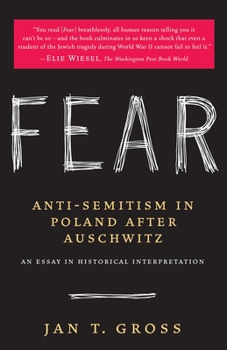
Fear: Anti-Semitism in Poland After Auschwitz: An Essay in Historical Interpretation

Select Format
Select Condition 
Book Overview
An astonishing and heartbreaking study of the Polish Holocaust survivors who returned home only to face continued violence and anti-Semitism at the hands of their neighbors " Fear ] culminates in so keen a shock that even a student of the Jewish tragedy during World War II cannot fail to feel it."--Elie Wiesel FINALIST FOR THE NATIONAL JEWISH BOOK AWARD - NAMED ONE OF THE BEST BOOKS OF THE YEAR BY THE WASHINGTON POST BOOK WORLD Poland suffered an exceedingly brutal Nazi occupation during the Second World War, in which 90 percent of the country's three and a half million Jews perished. Yet despite this unprecedented calamity, Jewish Holocaust survivors returning to their hometowns in Poland after the war were further subjected to terror and bloodshed. The deadliest peacetime pogrom in twentieth-century Europe took place in the Polish town of Kielce on July 4, 1946. In Fear, Jan T. Gross addresses a vexing question: How was this possible? At the center of his investigation is a detailed reconstruction of the Kielce pogrom and how ordinary Poles responded to the spectacle of Jews being murdered by their fellow citizens. Anti-Semitism, Gross argues, became a common currency between the Communist regime and a society in which many were complicit in the Nazi campaign of plunder and murder--and for whom the Jewish survivors were a standing reproach. For more than half a century, the fate of Jewish Holocaust survivors in Poland was cloaked in guilt and shame. Writing with passion, brilliance, and fierce clarity, Jan T. Gross brings to light a truth that must never be ignored. Praise for Fear "That a civilized nation could have descended so low . . . such behavior must be documented, remembered, discussed. This Gross does, intelligently and exhaustively." -- The New York Times Book Review "Gripping . . . an especially powerful and, yes, painful reading experience . . . illuminating and searing." -- Los Angeles Times Book Review "Gross tells a devastating story. . . . One can only hope that this important book will make a difference." -- Boston Sunday Globe "A masterful work that sheds necessary light on a tragic and often-ignored aspect of postwar history." -- Booklist (starred review) "Astonishing . . . Gross supplies impeccable documentation." --Baltimore Sun "Compelling . . . Gross builds a meticulous case." -- Publishers Weekly (starred review)
Format:Paperback
Language:English
ISBN:0812967461
ISBN13:9780812967463
Release Date:August 1970
Publisher:Random House Publishing Group
Length:336 Pages
Weight:0.58 lbs.
Dimensions:0.8" x 5.2" x 8.1"
Customer Reviews
3 ratings
Courage to face the truth of almost universal antisemitism
Published by Thriftbooks.com User , 18 years ago
Many of the reviews, and the responses to it are full of logical errors. Here is just one constantly repeated: "Poles could not have been so antisemitic, since so many Poles have risked their lives to save Jews." Indeed Poland leads the Righteous Among Nations with 6066 hero's! These heroic Poles bring tears to my eyes, many of them took much greater risk than their counterparts in Holland, France, of Belgium. There are two reasons for that: First of all, Germans killed the Poles, (and Ukrainians) and in some cases their whole family if they found them hiding Jews. Second reason is much more scary: The poles who hid the Jews, were in danger from their fellow Poles. The great majority of Poles were so intensely antisemitic, that these Polish hero's were ostracized, and often physically attacked by other Poles, if it was discovered that they helped the Jews. Pani Wykszykowska, who saved lives of several Jews from Jedwabne, had been beaten up by the Polish bandits after the war. As the harassment intensified, she moved to another town, where unfortunately people learned about her saving Jews and she had to move again, this time to a bigger town. This heroic and patriotic, woman, had eventually had to flee Poland into safety in Canada. This is example illustrates the superhuman integrity of the Just Poles. They stood up not only against the German occupier, but against the prevailing sentiment in their own country. Such integrity and courage is indeed rare. Tragically, for each of these 6066+ hero's, there have 6066 been between hundreds and thousands, Jew-hating antisemites, actively supporting, or passively approving the genocide, (while in the process benefiting from the stolen Jewish property). Based on my own experience of growing up in Poland shortly after the war (as a child of Polish-Jewish parents who returned from Russia), I testify that I have met with almost universal antisemitism, with only few noble exceptions. Antisemitism was intense in Poland all the time and my parents were finally forced to leave their motherland, Poland, in 1968-69.
Disturbing book, a noble effort which failed
Published by Thriftbooks.com User , 18 years ago
I have read "Fear" with much pain. As a Pole, each time Gross wrote about how my compatriots killed and robbed their Jewish neighbours, my heart ached. The facts presented in this book have not been unknown to historians, but they were not publicly discussed in Poland for decades. Learning the extent of brutal, murderous Polish anti-semitism during and after WW II was a huge shock for me. For this reason, this an important book. Many people have accused Gross of a "one-sided view". Well, it seems to be done on purpose. We Poles like to talk about Polish priests and nuns who hid Jews during the war, about who has the most trees in Yad Vashem, and so on. It is the public discourse on Holocaust in Poland which is one-sided -- a veil of silence is held over Polish anti-semitism and Polish murdering of Jews during and shortly after WW II. Gross aimed to break this silence, and I think he partially succeeded. The book is worth reading but is not an easy, nor a comfortable reading.
An extremely disturbing but important book to read
Published by Thriftbooks.com User , 19 years ago
This is a very depressing book to read, but is nevertheless worth the effort.If you are interested in Polish-Jewish relations during and after W.W. II, this book is for you. Gross documents various cases of Polish violence against Jews in the period immediately following W.W. II, including murderous pogroms in Krakow and other cities, as well as instances of anti-Jewish bias in local government administration, employment discrimination, and anti-Semitism in Polish schools. He discusses massacres of Jews by Poles during the war in eastern Poland, including the massacre in Jedwabne that became the basis for his earlier book Neighbors, as well as the widespread plunder of Jewish property that accompanied these massacres. He pays particular attention in the book to a 1946 pogrom in Kielce, Poland, in which 42 Jews were brutally murdered by Polish civilians, policemen, and soldiers. Some 30 additional murders were carried out at the Kielce train station and on the train route into and out of Kielce. The savagery of these murders is unbelievable. As Gross shows in his book, what makes this worse is the apparent involvement of nearly every sector of the Polish population in the killings, including women and children, and the indifferent attitude of most of the Polish Catholic clergy to the murders. What led to this awful pogrom? Some Poles claim that this was the result of a Communist secret police "provocation." However, Gross shows that claims of alleged Jewish ritual murder of Polish children incited the crowds to anti-Jewish violence, falsehoods that originated long before in the Middle Ages. It seems that Poles were prepared to employ any pretext to murder Jewish fellow citizens, no matter how seemingly absurd. Gross makes a convincing case that Polish society at that time allowed for the murder of Jews as an acceptable action. He argues that such murders would never have occurred after the war if Poles hadn't been murdering Jews during the war, as he documented they had in Jedwabne and other towns. He suggests that large sectors of Polish society were complicit in the Nazi extermination of Polish Jewry, that many Poles expressed approval for Nazi genocide even as they opposed other Nazi policies, and that many Poles benefited from the genocide by plundering Jewish property. In his view, returning Jewish survivors posed a threat to Poles by reminding them of what they had done to Jews during the war. Not surprisingly, many Poles find this hard to deal with, judging from some of the other reviews posted here. Some resort to anti-Jewish slander and stereotypes to discredit this book, its subject matter, and its well-founded conclusions. Take these reviews with a grain of salt and read the book yourself to reach your own conclusions.
Copyright © 2026 Thriftbooks.com
Terms of Use | Privacy Policy | Do Not Sell/Share My Personal Information | Cookie Policy | Cookie Preferences | Accessibility Statement
ThriftBooks ® and the ThriftBooks ® logo are registered trademarks of Thrift Books Global, LLC
ThriftBooks ® and the ThriftBooks ® logo are registered trademarks of Thrift Books Global, LLC
