


< Back to Search Results
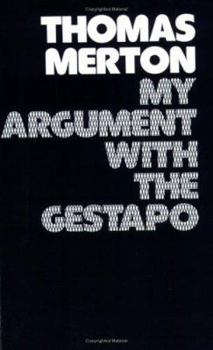
My Argument with the Gestapo: Autobiographical Novel


Select Format
Select Condition 
Book Overview
Although it first appeared after his death in 1968, he had arranged for its publication, written a foreword for it, and was delighted with the prospect of its at last becoming a part of his published works. My Argument with the Gestapo tells of the adventures of a young man, clearly identified by the name Thomas Merton, who travels from America to Europe to report on the war with Germany from the viewpoint of a poet. He hates the war, yet is driven to come to terms with it. There is a pervading sense of dreamworld or hallucination, heightened by the device of passages written in a macaronic language, invented from multilingual roots, to satirize and parody political propaganda speeches dealing with the war. A work of imagination (Merton did not in fact return to England after the start of World War II in Europe), it nevertheless contains much that is autobiographical and revealing of the young Merton. Most clearly visible are the seeds of his never-forsaken concern with peace and nonviolence and his abhorrence of war. Indeed, his outspoken criticism of Britain at a time when all the emphasis was on 'the brave little island standing alone' foreshadows his devotion to truth as he saw it, no matter what the cost. And students of Merton will find scenes in the book that are straight autobiography, amplifying and perhaps filling in gaps in what later was to be the beginning of Merton's great literary success, The Seven Storey Mountain (1948).
Format:Paperback
Language:English
ISBN:081120586X
ISBN13:9780811205863
Release Date:January 1975
Publisher:New Directions Publishing Corporation
Length:260 Pages
Weight:0.61 lbs.
Dimensions:0.7" x 5.2" x 8.0"
Customer Reviews
2 ratings
An Escape
Published by Thriftbooks.com User , 18 years ago
Orignally titled "Journal of My Escape from the Nazis", this work of Thomas Merton was not published during his lifetime. It remains his only published work of fiction. Written before the scope of World War II could truly be understood, Merton set himself as the main character. As a writer in Europe, Merton documents what he sees often digressing into code that is intended to hide messages from those that pry into his work. In truth, the writings really are not to be taken as literal text. Much of the macaronic writing is coded English which is meant to be taken humorously. In much of the book, the Merton spends his time hiding his work and intentions from prying and perhaps paranoid eyes. Do not mistake the coded text for symptoms of madness. Still, there remains a very serious message that does not have to be limited to any particular war. Merton avoids directly discussing the rights or wrongs of war to beg the question of whether war can be just. Avoiding the "rah-rah" of nationalism, war in itself is wrong. This must be kept in perspective. Similarly, all that we have and all that is dear to us is quite trivial in the scope of war. "My Argument with the Gestapo" is an early work of Merton that shows that seeds of a future talent developing. It also demonstrates a powerful message disguised in travelogue with elements of absurdity that Kafka fans could appreciate.
Gonzo Journalism of the '40s
Published by Thriftbooks.com User , 26 years ago
The jacket blurb and publisher's note call this a macaronic journal. The word "macaronic" sent me to the dictionary where I found that it refers to a mixture of languages usually to comic effect (now I finally understand the lyrics of "Yankee Doodle"). So if you read this novel, don't make the mistake of skipping over the French, Spanish, German and Italian passages. They're jumbled up with English phrases in a kind of comic patois so that you can get the gist.*My Argument With the Gestapo*, originally entitled, *My Escape from the Nazis* is about an imaginary trip to London and France when WW II was just getting started (before Pearl Harbor). The Nazi atrocities had not yet come to light when Merton wrote it, but the book was oddly prophetic. It is dreamlike and playful, sophisticated and airy, but the message is serious. We can't blame any one person or people for war. War is a condition in our own individual hearts. The book reminds me a bit of the French existentialists, Camus and Sartre, and reads at times like an avant garde play by Albee or Ionesco with its surreal dialogue. But it's too socially conscious to be Kafkaesque. It presages Merton's deep commitment to and involvement with the peace movement of the '60s. In fact, it must be the gonzo journalism of the '40s.Merton was so intelligent and talented that he could have written the score, lyrics and dialogue for a Broadway musical (and drawn the posters for it into the bargain - I've seen some of his drawings) but soon after he wrote this piece, he became a Trappist monk for 30 years. It's amazing that such a hip and sophisticated work could have come from the pen of a 26-year-old postulant.If you've ever read Merton's autobiography, *The Seven Storey Mountain*, you will recognize the autobiographical material here. In fact, the author names himself as the main protagonist.I doubt if I would have read this book were it not for the fact that Thomas Merton wrote it. As far as I know, this is his only published novel written before he entered the Abbey of Gethsemani in 1941 and only published after his death in 1968. Merton says it was "...a kind of sardonic meditation on the world in which I then found myself: an attempt to define its predicament and my own place in it."Maybe someday somebody will write an annotated version of *Gestapo*, but until then, the novel stands on its own merits and is, in my opinion, well worth reading.pamhan99@aol.com
Copyright © 2026 Thriftbooks.com
Terms of Use | Privacy Policy | Do Not Sell/Share My Personal Information | Cookie Notice | Cookie Preferences | Accessibility Statement
ThriftBooks ® and the ThriftBooks ® logo are registered trademarks of Thrift Books Global, LLC
ThriftBooks ® and the ThriftBooks ® logo are registered trademarks of Thrift Books Global, LLC
