


< Back to Search Results
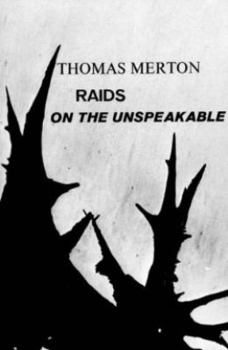
Raids on the Unspeakable


Select Format
Select Condition 
Book Overview
Here this concern finds expression in poetic irony and in meditations intentionally dour.
In these brief, challenging pieces, Father Merton does not offer consolation or easy remedies. He looks candidly and without illusions at the world of his time. Though he sees dark horizons, his ultimate answer is one of Christian hope. To vary the perspective, he writes in many forms, using parable and myth, the essay and the meditation, satire and manifesto, prose poetry and even adaptations from a medieval Arab mystic (Ibn Abbad) to humanize and dramatic his philosophical themes.
The themes of Raids on the Unspeakable are as old as the myths of Prometheus and Atlas, and as timely as the human evils of today. They range from the "Message" written for an international congress of poets to the beautiful yet disturbing Christmas meditation, "The Time of the End Is the Time of No Room." And there are essays inspired by the world of three significant contemporary writers: Flannery O'Connor, the French novelist Julien Green, and the playwright Eugene Ionesco. A number of Father Merton's own drawings are also included in the book--not as "illustrations," but as "signatures" or: "abstract writings," which stand in their own right as another personal statement.
In these brief, challenging pieces, Father Merton does not offer consolation or easy remedies. He looks candidly and without illusions at the world of his time. Though he sees dark horizons, his ultimate answer is one of Christian hope. To vary the perspective, he writes in many forms, using parable and myth, the essay and the meditation, satire and manifesto, prose poetry and even adaptations from a medieval Arab mystic (Ibn Abbad) to humanize and dramatic his philosophical themes.
The themes of Raids on the Unspeakable are as old as the myths of Prometheus and Atlas, and as timely as the human evils of today. They range from the "Message" written for an international congress of poets to the beautiful yet disturbing Christmas meditation, "The Time of the End Is the Time of No Room." And there are essays inspired by the world of three significant contemporary writers: Flannery O'Connor, the French novelist Julien Green, and the playwright Eugene Ionesco. A number of Father Merton's own drawings are also included in the book--not as "illustrations," but as "signatures" or: "abstract writings," which stand in their own right as another personal statement.
Format:Paperback
Language:English
ISBN:0811201015
ISBN13:9780811201018
Release Date:January 1966
Publisher:New Directions Publishing Corporation
Length:184 Pages
Weight:0.55 lbs.
Dimensions:0.5" x 5.0" x 8.3"
Customer Reviews
3 ratings
Fascinating, challenging, relevant
Published by Thriftbooks.com User , 18 years ago
This book is unexpected and unlike other Thomas Merton writings I'm familiar with. He wrote this collection of reflections on modernity late in his career, when, as he tells us, he had become a different man - "[People] demand that I remain forever the superficially pious, rather rigid and somewhat narrow-minded young monk I was twenty years ago, and at the same time they continually circulate the rumor that I have left my monastery. What has actually happened is that I have been simply living where I am and developing in my own way ..." (p 172) "Raids" is hard to classify. It is a collection of essays, poems, parables, and other forms. It is at turns blunt, scathing, poetic, mystical, obscure, inscrutable, and nearly incomprehensible. But always, as with all Merton writings, it is nakedly honest, penetrating, and challenging. The book contains 13 brief reflections - 1. Asks the question, what do we need? 2. Explores mercy versus determinism. 3. Interpretation of Flannery O'Conner's work, focusing on the idea of "respect". 4. Asks, upon reviewing the career of Adolf Eichmann, what is sanity? 5. Challenges us on the hazards of moral neutrality. 6. On the emptiness of modern society. 7. On Prometheus as hero and villain. 8. On the tension between myth and modern reality (I think). 9. Similar to #8. 10. "Notes for a cosmic meditation." 11. Exploration of the thought of a Sufi contemplative. 12. The modern poet's response to modern absurdity. 13. On what artistic freedom really means. Each of these, one way or another, forces us out of our comfort zone, to grapple with issues we'd prefer to ignore. Here, Merton seems far more concerned with what we are doing than what we are thinking or feeling. The spirit of the book is summed up well in this passage - "The true solutions are not those which we force upon life in accordance with our theories, but those which life itself provides for those who dispose themselves to receive the truth ... For since man has decided to occupy the place of God he has shown himself to be by far the blindest, and cruelest, and pettiest and most ridiculous of all the false gods. We can call ourselves innocent only if we refuse to forget this, and if we also do everything we can to make others realize it." (p 61) The modern world is what it is ... unless we rebel. "Raids" is calling on us to do just that, in just about every way possible. Uncomfortable, but hard to ignore.
Best book I ever read!
Published by Thriftbooks.com User , 24 years ago
This was Merton's favorite book (of his own writing), and my favorite book as well. He was a scholar and a poet, and his essays reflect that: he does not write down to his audience. Merton was that great rarity: an existential mystic. He had incredible insights; his writing had a profound influence on ME. These essays are meant to be disturbing. Written in the Sixties, they are as meaningful today as then.
Essential to the Christian Contemplative
Published by Thriftbooks.com User , 26 years ago
Merton is regarded as one of the few prophets of the 2oth century by the Catholic Church, and Raids makes it clear why. A series of essays and drawings, Raids on the Unspeakable provides valuable insight into the cultural phenomenon known as the 60s. While some of Mertons essays are hard to understnad, on a whole the book is well written and provides interesting philosophies on life. Merton's prophecies also seem to deal wiht many present day problems. Some highlights of the boke are Rain and the Rhinoceros', and Meditations in the Memory of Adolf Eichelman.
Copyright © 2026 Thriftbooks.com
Terms of Use | Privacy Policy | Do Not Sell/Share My Personal Information | Cookie Notice | Cookie Preferences | Accessibility Statement
ThriftBooks ® and the ThriftBooks ® logo are registered trademarks of Thrift Books Global, LLC
ThriftBooks ® and the ThriftBooks ® logo are registered trademarks of Thrift Books Global, LLC
