


< Back to Search Results
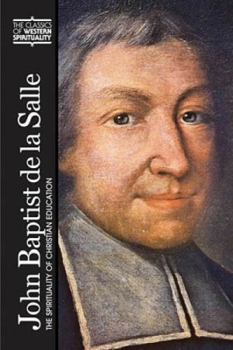
John Baptist de la Salle: The Spirituality of Christian Education

Select Format
Select Condition 
Book Overview
This volume in the Classics of Western Spirituality makes available to a broad readership a selection of the core writings of John Baptist de La Salle (1651-1719), a French priest and educator who changed the face of education in his time and whose reforms continue to influence the ways we educate our children today. Born to a wealthy family, de La Salle turned his attention early on to the education of the poor and the marginalized and, at the same time, unwittingly founded a new type of religious community: Brothers who were teachers and active religious. Through his dedication to the vocation of teaching, de La Salle instituted several procedures that are still in practice in public and parochial institutions. --student cooperative learning --tuition-free attendance --involvement of parents --student service and ownership De La Salle's spirituality for educators, which melds prayer and action, compassion and practicality, can be read afresh in every age: it transcends time and place. +
Format:Paperback
Language:English
ISBN:0809141620
ISBN13:9780809141623
Release Date:March 2004
Publisher:Paulist Press
Length:288 Pages
Weight:0.90 lbs.
Dimensions:0.7" x 6.1" x 8.9"
Customer Reviews
2 ratings
A resource for the Christian parent or Teacher
Published by Thriftbooks.com User , 21 years ago
What a wonderful little book! It gives excellent advice on classroom discipline. Of course corporal punishment is no longer permissible. Nevertheless, the aim of corporal punishment is clear from de la Salle -- indeed one could say it is far more humane that what is passed off for correction today, remarkable both in its restraint and gentlness. It is clear from de la Salle that moral discipline and an education on the Faith begin with a parent's or teacher's self-discipline and own example. Very short, easy to read. A life-long challenge to implement. (Of course, the section on comportment must be read keeping in mind that fashions change as de la Salle himself points out. Nevertheless, there is much to learn even here.)
Pray, Study, And Wash Behind Your Ears
Published by Thriftbooks.com User , 21 years ago
In 1878 the future presidential candidate Al Smith attended St. James parish school in New York City's Fourth Ward. In Smith's time the school enrolled 1,450 students, of which the Christian Brothers taught the 650 boys and the Sisters of Charity the girls. Today we might think of 1,450 students as a healthy enrollment for a Catholic secondary school in a large city. In 1878 and for years after the youngest Catholic students in massive numbers enjoyed the privilege of first rate education in a faith-based environment. It was truly a world of "no child left behind." The fuel for this educational dynamo was neither ecclesiastical fiat nor fiscal sufficiency. It was the vowed life and services of thousands of Catholic women and men religious who brought the religious vision and charism of their various orders and communities to school settings. The changes in Catholic education between 1878 and 2005-particularly the virtual disappearance of the religious classroom educator-are poorly understood and routinely understated. Today's Catholic elementary school faculty is lay and generally married with family. None have the rigorous training of religious formation and novitiate; few have anything amounting to college specialization in theology. While most would probably profess the Catholic faith, few have the comfort to teach as an unabashed apologist for the Catholic Tradition. "A prophet is not without honor...." One cannot read this recent compilation from the Paulist Press Western Spirituality series without a sense that the life and wisdom of St. John Baptist de la Salle is perhaps the publisher's most practical and useful release to date. La Salle [1651-1719], a wealthy priest and cathedral canon, fretted over issues of education facing France in the late seventeenth century. As with other volumes in this series, the introduction is extremely useful in briefly outlining the nature of the problems and La Salle's biographical attempts to meet them for the Church. The problem was simple enough and certainly one familiar to contemporary Americans: only the children of the rich were getting top-flight education. Because of the French marriage of church and state, there was no secular or public education system in place. And in this, the era of the Sun King, there was no great hurry to educate the unwashed masses anyway. French Catholicism unfortunately shared something of this view: education of upper echelon youths toward a clerical life, law, and diplomacy was useful to the Church and the state. Mass education smacked of the dreaded "D" word. Neither hierarchy nor monarchy had time for democracy. La Salle's marriage of faith formation, education, and equality is one of great achievements of the Post-Tridentine era. No one melded these goals into a spirituality of education as La Salle did. The primary task of a Catholic educator, he wrote, was his students' salvation, i.e., getting them into heaven. [Mention that at a diocesan school meeting to
Copyright © 2026 Thriftbooks.com
Terms of Use | Privacy Policy | Do Not Sell/Share My Personal Information | Cookie Notice | Cookie Preferences | Accessibility Statement
ThriftBooks ® and the ThriftBooks ® logo are registered trademarks of Thrift Books Global, LLC
ThriftBooks ® and the ThriftBooks ® logo are registered trademarks of Thrift Books Global, LLC
