


< Back to Search Results
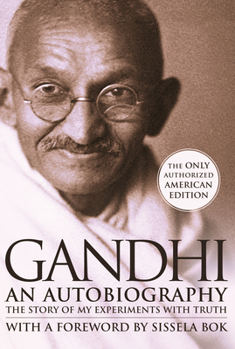
Gandhi an Autobiography: The Story of My Experiments with Truth


Select Format
Select Condition 
Book Overview
Mohandas K. Gandhi is one of the most inspiring figures of our time. In his classic autobiography he recounts the story of his life and how he developed his concept of active nonviolent resistance, which propelled the Indian struggle for independence and countless other nonviolent struggles of the twentieth century. In a new foreword, noted peace expert and teacher Sissela Bok urges us to adopt Gandhi's "attitude of experimenting, of tesing what will and will not bear close scrutiny, what can and cannot be adapted to new circumstances,"in order to bring about change in our own lives and communities. All royalties earned on this book are paid to the Navajivan Trust, founded by Gandhi, for use in carrying on his work.
Format:Paperback
Language:English
ISBN:0807059099
ISBN13:9780807059098
Release Date:November 1993
Publisher:Beacon Press
Length:560 Pages
Weight:1.44 lbs.
Dimensions:1.6" x 5.2" x 8.4"
Customer Reviews
3 ratings
My all-time favorite book
Published by Thriftbooks.com User , 25 years ago
I first read this book in the spring of 1998 when I was home with a cold and fever, and I can say that it is one of the best things that ever happened to me. The events described in the book are a hundred years old, but Gandhi has a way of describing their essence which is timeless, and will grip you in a way that makes them entirely relevant to today's world. It made me wonder how the world might have been if people today only followed his ideas. But this is no boring lecture on politics or nonviolence. In fact quite the opposite - it is the sparkling story of a very special man told in his own words. We learn about truth and non-violence in the best way possible, by observing Gandhi's actions as he goes about matters small and big. It brought Gandhi to life in a very special way. I always admired his principles, but now feel closer to Gandhi the man. This is a first-hand account that cannot be ignored. My only regret was that the book ended much too soon (mid 1920's) and there was nothing to cover the rest of his life. I can think of no person of any age who would not be greatly enriched by this book. For the interested, I found the companion book "Satyagraha in South Africa" (also by Gandhi) to be just as good.
Pure Gold!
Published by Thriftbooks.com User , 26 years ago
Well, we all follow "the experts" (although at 48, I am beginning to learn). We all follow the authorities. What would happen if one just kept a totally blank mind toward everything and learned from just plain LIVING. Gandhi makes it clear at the beginning of the book that this is the only way to gain truth. Not to be strongly influenced by others. His agreements and fondness of other theologians really only comes after his experiments. They have to agree with him first. As you begin to read this book, you are on a jouney. It's like being a Martian or being from another planet simply because Gandhi will simply not take anything as truth unless he has experimented with it himself. He was very much the spiritual scientist. This book is also very easy reading. The chapters are short enough to stop and come back to as well. And it is journey which Gandhi makes clear that anybody can follow. You can't really follow this man's experiments. He wants you to do your own experiments. So this book is really quite an adventure. Gandhi's politics, as he makes clear in this book, really stem from his experiments in truth. You can begin yourself. Wake up, tell your wife she is fat, and see what happens! Gandhi came to the conclusion of always practicing "ahimsa". He would practice it over and over again to see if it worked. And he came to the conclusion that it did. As he once said, "Ahimsa is heaven". Ahimsa means non-violence in thought, word, and deed. One can still defend oneself while loving one's enemy. He saw "satya", or truth as synonymous with non-violance. This man stole at one point, eat meat, was far from celibacy. Buy and read this fabulous scientific inquiry into "How to Live". Then start experimenting for yourself. Good luck on your journey. And please be careful! Gandhi nearly killed himself SMOKING!
Extraordinary Book Written by an Extraordinary Man
Published by Thriftbooks.com User , 26 years ago
I have always admired Mr. Gandhi, but really knew very little about him. This book tells of his early life, something most biographies skip choosing to focus on his life in India.Great historical detail of colonial India, living in England and South Africa. A must read for anyone interested in Mr. Gandhi or that period of history.The book has also influenced greatly the way I view life. A very spiritually uplifting book, even for non-Hindus.
An Autobiography or The Story of My Experiments with Truth Mentions in Our Blog

Die-hard Do-Gooders
Published by Ashly Moore Sheldon • December 30, 2020
This time of year has lots of us thinking about how we can help the world to be a better place. This post features six extraordinary heroes across the past century who haven’t been afraid to take on big challenges for change.
Copyright © 2026 Thriftbooks.com
Terms of Use | Privacy Policy | Do Not Sell/Share My Personal Information | Cookie Policy | Cookie Preferences | Accessibility Statement
ThriftBooks ® and the ThriftBooks ® logo are registered trademarks of Thrift Books Global, LLC
ThriftBooks ® and the ThriftBooks ® logo are registered trademarks of Thrift Books Global, LLC
