


< Back to Search Results
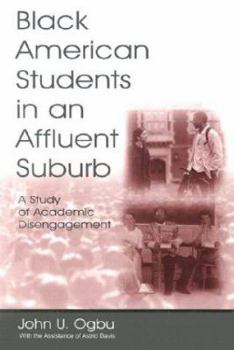
Black American Students in An Affluent Suburb: A Study of Academic Disengagement

Select Format
Select Condition 
Book Overview
Focuses on the role of community forces in academic disengagement among Black American Students at every social class level; the study extends Ogbu's ongoing research on minority education.
Format:Paperback
Language:English
ISBN:080584516X
ISBN13:9780805845167
Release Date:January 2003
Publisher:Routledge
Length:342 Pages
Weight:1.15 lbs.
Dimensions:0.8" x 6.0" x 9.1"
Customer Reviews
5 ratings
No Excuses
Published by Thriftbooks.com User , 17 years ago
I am a Shaker graduate and a minority who now has a child in the Shaker school system; Dr Ogbu's study is right on target. Certainly it does not help to be poor, discriminated against etc., but the telling factor in academic performance is the attitude and work ethic children bring to the classroom. This is of course shaped by parents and also pop culture. Now that more than 70% of African American children are born out of wedlock is symptomatic of the state of the African American home. Dr Ogbu's study caused a monstrous flap in our affluent, largely liberal community. For those that are curious, Shaker spends more than $13,600 per student in a medium cost of living area, and the mediam family income is over $63,000. Integration is not the issue, money spent per child is not the issue, attitude and academic performance is. Too bad, more minority parents have not heeded the warning.
Disengagement
Published by Thriftbooks.com User , 19 years ago
I found this book to be truly insightful. The author provided interesting information that was gained through observation, focus groups, and one-on-one interviews of just how disengaged affluent African American high school students are from the educational process. The author underscores the fact that the challenges facing African American and educations goes beyond economics.
An excellent analysis of Black student disengagement
Published by Thriftbooks.com User , 20 years ago
Prof. Ogbu has provided an excellent and very convincing (to me, at least) demonstration of black student disengagement as a major driver in causing the black/white education gap. It is unfortunate that his death prevents him from providing us with insights as to how our society might more effectively address the problem of disengagement. In one respect the Shaker Heights community he studied is fortunate in that it is not impacted by some of the other major drivers (poverty, teachers' expectations, disfunctional families, etc.) that tend to widen and complicate the black/white education gap in other communities that are not so high on the socio-economic scale.
An extremely accessible piece of social science scholarship
Published by Thriftbooks.com User , 21 years ago
This book manages to be comprehensible to a general reader while adhering to the rigorous demands of social science, that is to say, the formal structure of presenting and defending hypotheses and footnoting them endlessly. The book could have been better edited; too many errors of grammar, usage and even spelling slipped through. I tend to trust Black commentators on American race issues. John Ogbu, like Bill Cosby, Larry Elder and Thomas Sowell, has an intellectual stature that demands he be taken seriously and an immunity to charges of racism. Another author would not have gotten away with the phrase "academic disengagement." Yet at the end of the book one realizes how appropriate that two-word appraisal is. It is refreshing as well to read an author with an anthropologist's orientation. Ogbu's exhaustive study gave him an opportunity to repeat and reinforce earlier findings in Stockton and Oakland, California, and elsewhere and tailor findings to the Shaker Heights situation. Blacks are, like American Indians, non-voluntary minorities. To say the least, most of their ancestors did not exactly enlist for service in the United States. The fewer and more recent voluntary black immigrants such as Colin Powell are interesting in two respects. First, their children do better in school than native born blacks. Secondly, however, subsequent generations born in the United States tend to adopt the (dysfunctional) attitudes of the native-born. Ogbu's contention is that Blacks' profound distrust of the establishment and their conviction that they will not get a fair shake predisposes them not to give their full effort to schoolwork. Their defeatist attitudes start to emerge in the later primary years and are highly apparent by high school. Among the contributing factors are inappropriate role models -- sports and entertainment figures and various types of outlaws -- and a lack of parental involvement in the children's schooling. He describes a black expectation of a "beer mug" approach to teaching The teacher pours knowledge into the passive student. In this model the parents' job is to get the child to school, and the blame is on the teachers if he doesn't learn. He says also that parents are more attuned to whether teachers "care" than whether they are effective teachers. He surveys a range of attempts to find solutions in changes to the school model: vouchers, charters, merit pay and so on. None have been, by his assessment, markedly successful. His recommendation is to change the culture of the learners themselves. Reinforce positive study habits, recognize achievement, and arm the students against the inevitable attempts of their peers to drag them into mediocrity. I amend this review to refer the reader to "Crash Course" by Chris Whittle (and my review of the same). Whittle manages charter schools for underprivileged children in Baltimore, Washington, Philadelphia and elsewhere, and has quite a bit of success. He em
Objective Study
Published by Thriftbooks.com User , 23 years ago
Any open minded person that reads this book will quickly discover the obvious; The Black community in Shaker Heights, Ohio is in deep need of Dr. Phil McGraw's "Self Matters." Ogbu produces page upon page of community respondents culturally brainwashed to focus their intellect on a history they have not lived, and an available future that they cannot fathom. Ogbu's tone is harsh. His main argument: The Black community's cultural beliefs and practices are not conducive to success in academics. This is where the controversy lies. Because the book doesn't blame the testing gap on White racism, his analysis must be wrong. Simply read what students themselves are saying and draw your own conclusions.
Copyright © 2026 Thriftbooks.com
Terms of Use | Privacy Policy | Do Not Sell/Share My Personal Information | Cookie Notice | Cookie Preferences | Accessibility Statement
ThriftBooks ® and the ThriftBooks ® logo are registered trademarks of Thrift Books Global, LLC
ThriftBooks ® and the ThriftBooks ® logo are registered trademarks of Thrift Books Global, LLC
