


< Back to Search Results
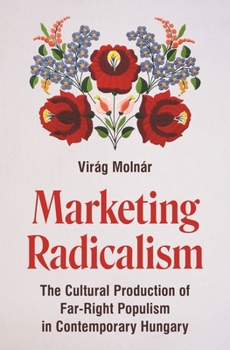
Marketing Radicalism: The Cultural Production of Far-Right Populism in Contemporary Hungary
No Customer Reviews

The commodification and marketing of nationalism in a populist-governed country
Most accounts of populist politics revolve around political parties, electoral politics, eroding democratic institutions, media, and political propaganda. In Marketing Radicalism, Vir g Moln r examines instead populism as a cultural process--one that reshapes cultural identities and meanings of cultural citizenship. Looking at such domains as fashion, publishing, and tourism, Moln r shows how identity politics, culture wars, culture industries, consumer markets, and popular culture contribute to the rise of far-right populism. The marketing of nationalism creates powerful narratives that reimagine the nation as a populist fantasyland, and these narratives are used by far-right governments in their efforts to topple liberal norms. Hungary under Viktor Orb n has provided an ideological blueprint for far-right populist politicians--and a cautionary tale for liberal democracies. Using Hungary's commodification of nationalism as a case study, Moln r explores the ways that cultural producers relied on consumer markets to promote traditionalism through folk-revivalist fashion; weaponized the public shredding of a children's book to disenfranchise LGBTQ+ communities; used tourism to neighboring Transylvania to envision a "Greater Hungary" that spilled over national borders; and packaged a mythic Orientalism in the form of horseback archery. Moln r's account offers important lessons on the mainstreaming of right-wing popular culture, the importance of markets in circulating and amplifying far-right identity narratives, and the political mobilization of cultural traditions for geopolitical reorientation.Format:Hardcover
Language:English
ISBN:0691290377
ISBN13:9780691290379
Release Date:October 2026
Publisher:Princeton University Press
Length:248 Pages
Weight:1.16 lbs.
Dimensions:0.7" x 6.1" x 9.2"
Customer Reviews
0 rating
Copyright © 2026 Thriftbooks.com
Terms of Use | Privacy Policy | Do Not Sell/Share My Personal Information | Cookie Notice | Cookie Preferences | Accessibility Statement
ThriftBooks ® and the ThriftBooks ® logo are registered trademarks of Thrift Books Global, LLC
ThriftBooks ® and the ThriftBooks ® logo are registered trademarks of Thrift Books Global, LLC
