Skip to content
Scan a barcode
Scan
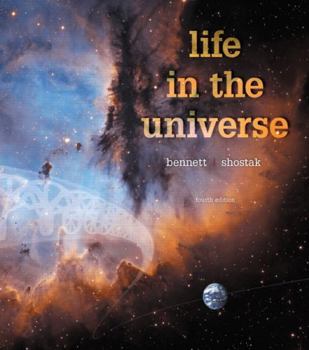
Paperback Life in the Universe Book

ISBN: 0134089081

ISBN13: 9780134089089

Life in the Universe

Select Format

Select Condition ThriftBooks Help Icon

Recommended

Format: Paperback

Condition: Very Good

$9.59
Save $11.35!
List Price $20.94
Almost Gone, Only 1 Left!
Save to List

Book Overview

For intro-level, one-semester multidisciplinary science and astronomy courses.

Encourage students to explore answers to questions about life beyond Earth and our solar system.

Life in the Universe provides an ideal starting point for non-science majors intrigued by the latest discoveries about life in the solar system and beyond. Rigorously researched and accessible to students of all backgrounds, the text introduces concepts drawn from astronomy, biology, and geology to explain natural phenomena and to explore profound scientific questions about astrobiology. The Fourth Edition has been thoroughly revised and updated to include the latest scientific discoveries and advancements, including new information regarding extrasolar planets, artificial life, and early life on Earth.

Designed for courses in astrobiology, Life in the Universe arouses students' natural curiosity by exploring fundamental questions such as: How did life begin on Earth? What are the most extreme forms of life currently known? What do we know about the possibility of life beyond Earth?

The text encourages non-science majors to develop an understanding of the process of science through its inherently compelling subject matter as well as its wealth of engaging features, including Learning Goals, Special Topics, and connections to popular culture. Sidebars provide optional mathematical material for courses that fulfill quantitative requirements.

Also available as a Pearson eText or packaged with Mastering Astronomy

Pearson eText is a simple-to-use, mobile-optimized, personalized reading experience that can be adopted on its own as the main course material. It lets students highlight, take notes, and review key vocabulary all in one place, even when offline. Seamlessly integrated videos and other rich media engage students and give them access to the help they need, when they need it. Educators can easily share their own notes with students so they see the connection between their eText and what they learn in class - motivating them to keep reading, and keep learning.

Mastering combines trusted author content with digital tools and a flexible platform to personalize the learning experience and improve results for each student.Built for, and directly tied to the text, Mastering Astronomy enables an extension of learning, allowing students a platform to practice, learn, and apply outside of the classroom.

Note: You are purchasing a standalone book; Pearson eText and Mastering Astronomy do not come packaged with this content. Students, ask your instructor for the correct package ISBN and Course ID. Instructors, contact your Pearson representative for more information.

If your instructor has assigned Pearson eText as your main course material, search for:

- 0135234204 / 9780135234204 Pearson eText Life in the Universe, 4/e -- Access Card
OR
- 013523445X / 9780135234457 Pearson eText Life in the Universe, 4/e -- Instant Access

If you would like to purchase both the physical text and Mastering Astronomy, search for:

0134068408 / 9780134068404 Life in the Universe Plus Mastering Astronomy with eText -- Access Card Package

Package consists of:

0134080017 / 9780134080017 Mastering Astronomy with Pearson eText -- ValuePack Access Card -- for Life in the Universe 0134089081 / 9780134089089 Life in the Universe 0321765184 / 9780321765185 SkyGazer 5.0 Student Access Code Card (Integrated component)

Customer Reviews

5 ratings

loved it

This is a great textbook. The information is up to date and it is very enjoyable to read.

Expensive, but worth it

This is a really expensive paperback, but it should have an honored place in your home, next to your dictionary, your atlas, your Roget's Thesaurus and your Holy Bible, Koran or any other book that is important to you. Its opening chapter, "A Universe of Life," is awe-inspiring, summoning up as it does the almost-endless, vast reaches of known creation and inviting us to consider how MUCH there is out there that might be home to any form of life --from the submicroscopic to beings, well, something like us (although not much of the book is given over to the latter possibillity). It tackles the place of religion, too, in all of this -- including Creationism and its offshoots -- and gives you some pretty good reasons for setting aside your feelings and just going along for the scientific ride in this 346-page stunner (plus appendixes). The artwork is superb. Worth the price of admission by itself. So, drag out the old credit card and put yourself even deeper into literary debt, because you will return to this book again and again over the years.

A good college text for non-science majors

This book seems to have two goals. One is to teach the reader something about astrobiology. The other is to be a text for a science course for college undergraduates (in most cases, underclassmen majoring in something other than science). The book begins by discussing how stars and planets are formed. And then comes a major point: biology may be common in the universe given evidence that organic molecules form fairly easily, life appears to have originated early in the Earth's history, and there's evidence that Earth life can survive under a wide range of conditions. Next, there's a section on the nature of science and the scientific method. And then some material on the definition and nature of life. From there we go to the Earth's geological record. And there's a useful discussion of greenhouse gases, possible high surface temperatures on Earth when life first developed, and a possible "Snowball Earth" much later. Now comes a key chapter: how did life get started? And when. The text shows that it was not all that long after the Earth emerged from forming and being heavily bombarded. And that hyperthermophiles may well have been the common ancestor of life on Earth today. The book speculates that the process was: synthesis of organic precursor molecules, development of replicators (RNA), development of protocells (enclosing membranes), primitive cells (the RNA world), and then DNA-based cells. It also addresses the question of whether life could have migrated to Earth from Mars or elsewhere. There's a discussion of the rise of oxygen in the atmosphere. And how primitive life evolved into the intelligent life that now exists. These are certainly the right topics to start with. But I wish this book, even with the constraint of being for non-science majors, had gone into just a little more detail on all of them. It does just that on the rest of the topics. The book continues with an excellent section about possibilities of life elsewhere in our planetary system, including the environmental requirements. We look at Mars (including evidence from Martian meteorites), Jovian moons, and Titan. And we see why Venus is too close to the Sun to be in the "habitable zone." I hope that the next edition of this book, due out in 2006, will mention the Saturnian moon Enceledus as well. After that, there is a discussion of extrasolar planets and the serach for extraterrestrial intelligence. If anything, there is an excess of material here, including speculations about the possible technology levels of an intelligent society and interstellar travel. But this does lead to a worthwhile discussion of the Fermi paradox: if there are relatively nearby extraterrestrials, why aren't they here by now? Writing an overview of this field for non-science majors is a daunting task, and I think the authors did a really good job. After reading such a book, I think one will find it much easier to understand any advances made in this field in the future.

A Very Delightful Book

This is the ONE Science Textbook I will keep forever and ever.

A good college text for non-science majors

This book seems to have two goals. One is to teach the reader something about astrobiology. The other is to be a text for a science course for college undergraduates (in most cases, underclassmen majoring in something other than science). The book begins by discussing how stars and planets are formed. And then comes a major point: biology may be common in the universe given evidence that organic molecules form fairly easily, life appears to have originated early in the Earth's history, and there's evidence that Earth life can survive under a wide range of conditions. Next, there's a section on the nature of science and the scientific method. And then some material on the definition and nature of life. From there we go to the Earth's geological record. And there's a useful discussion of greenhouse gases, possible high surface temperatures on Earth when life first developed, and a possible "Snowball Earth" much later. Now comes a key chapter: how did life get started? And when. The text shows that it was not all that long after the Earth emerged from forming and being heavily bombarded. And that hyperthermophiles may well have been the common ancestor of life on Earth today. The book speculates that the process was: synthesis of organic precursor molecules, development of replicators (RNA), development of protocells (enclosing membranes), primitive cells (the RNA world), and then DNA-based cells. It also addresses the question of whether life could have migrated to Earth from Mars or elsewhere. There's a discussion of the rise of oxygen in the atmosphere. And how primitive life evolved into the intelligent life that now exists. These are certainly the right topics to start with. But I wish this book, even with the constraint of being for non-science majors, had gone into just a little more detail on all of them. It does just that on the rest of the topics. The book continues with an excellent section about possibilities of life elsewhere in our planetary system, including the environmental requirements. We look at Mars (including evidence from Martian meteorites), Jovian moons, and Titan. And we see why Venus is too close to the Sun to be in the "habitable zone." After that, there is a discussion of extrasolar planets and the serach for extraterrestrial intelligence. If anything, there is an excess of material here, including speculations about the possible technology levels of an intelligent society and interstellar travel. But this does lead to a worthwhile discussion of the Fermi paradox: if there are relatively nearby extraterrestrials, why aren't they here by now? Writing an overview of this field for non-science majors is a daunting task, and I think the authors did a really good job. After reading such a book, I think one will find it much easier to understand any advances made in this field in the future.
Copyright © 2026 Thriftbooks.com Terms of Use | Privacy Policy | Do Not Sell/Share My Personal Information | Cookie Notice | Cookie Preferences | Accessibility Statement
ThriftBooks ® and the ThriftBooks ® logo are registered trademarks of Thrift Books Global, LLC

GoDaddy Verified and Secured