


< Back to Search Results
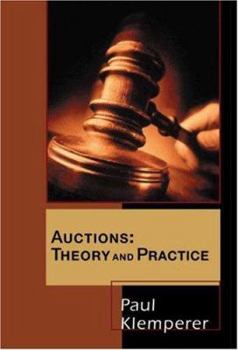
Auctions: Theory and Practice


Select Format
Select Condition 
Book Overview
Governments use them to sell everything from oilfields to pollution permits, and to privatize companies; consumers rely on them to buy baseball tickets and hotel rooms, and economic theorists employ them to explain booms and busts. Auctions make up many of the world's most important markets; and this book describes how auction theory has also become an invaluable tool for understanding economics.
Auctions: Theory and Practice provides a non-technical introduction to auction theory, and emphasises its practical application. Although there are many extremely successful auction markets, there have also been some notable fiascos, and Klemperer provides many examples. He discusses the successes and failures of the one-hundred-billion dollar "third-generation" mobile-phone license auctions; he, jointly with Ken Binmore, designed the first of these. Klemperer also demonstrates the surprising power of auction theory to explain seemingly unconnected issues such as the intensity of different forms of industrial competition, the costs of litigation, and even stock trading 'frenzies' and financial crashes. Engagingly written, the book makes the subject exciting not only to economics students but to anyone interested in auctions and their role in economics.
Format:Paperback
Language:English
ISBN:0691119252
ISBN13:9780691119250
Release Date:March 2004
Publisher:Princeton University Press
Length:264 Pages
Weight:0.85 lbs.
Dimensions:0.6" x 6.0" x 9.1"
Customer Reviews
1 rating
Brilliant explanation of real-world auction theory
Published by Thriftbooks.com User , 20 years ago
Paul Klemperer was the principal auction theorist advising the UK Government on the design of the 3G spectrum auction in 2000, which raised $34 billion, the biggest auction in history. In this book he reviews auction design both theoretically and in practice - the two perspectives turn out to be very different. Chapter 1 is a survey of auction theory. The author begins by identifying four types of auction: the English type of open ascending bids, the Dutch auction using descending bids where the first bidder wins, the first-price sealed-bid auction where the highest bidder wins and pays their own bid price, and the second-price sealed-bid auction (the Vickrey auction) where the highest bidder wins, but pays the amount bid by the second-highest bidder. If the latter seems counter-intuitive, note that in the English auction, the winner also pays an amount set by the second-highest bidder (the last person to drop out). Note also that the Dutch auction and the first-price sealed-bid auction are equivalent. Another important distinction is between private-value auctions, where each bidder has their own, invariant valuation of the object(s) being auctioned, and common-value auctions, where bidders might alter their valuations depending on signals (i.e. observed bids) made by other participants. The key result in auction theory is the Revenue Equivalence Theorem, which states that all the standard auction methods, under certain plausible conditions, generate the same revenues. This accounts for the fact that no one method of conducting auctions has displaced all the others. However, practical considerations often favor one kind of auction design over another, and this is analyzed extensively later in the book. Chapter 1 finishes with a mathematical appendix which proves some of the main results plus some questions (and answers) from the Oxford University MPhil economics examination. Chapter 2 is titled `why every economist should learn some auction theory' and extends application of the theory to economic issues such as litigation models, wars of attrition, market crashes and trading frenzies, and Internet sales models. Chapter 3 is a detailed guide to auction design. Auction theory is about mathematical models and their properties. Auctions in the real world are competitions where real money is at stake and any and all tactics will be employed to win. Critical tactics to `game' auctions include collusion between bidders to avoid bidding against each other therefore lowering prices for everyone, and predatory behavior, where weaker bidders are frightened off either before or during the auction, thereby clearing the field and closing the auction early. Examples are given of extraordinary behavior by bidders which succeeded in effectively wrecking auctions as revenue-generating vehicles. Klemperer analyses each of the four types of auction in the context of deterring such behavior and concludes that there is no one right answer: auction design is `
Copyright © 2026 Thriftbooks.com
Terms of Use | Privacy Policy | Do Not Sell/Share My Personal Information | Cookie Notice | Cookie Preferences | Accessibility Statement
ThriftBooks ® and the ThriftBooks ® logo are registered trademarks of Thrift Books Global, LLC
ThriftBooks ® and the ThriftBooks ® logo are registered trademarks of Thrift Books Global, LLC
