


< Back to Search Results
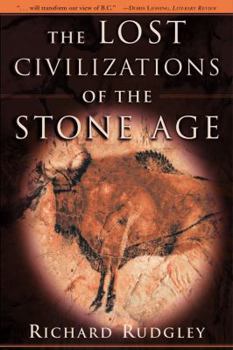
The Lost Civilizations of the Stone Age


Select Format
Select Condition 
Book Overview
An authoritative, eye-opening look at Stone Age civilizations that explodes traditional portrayals of prehistory The rise of historical civilization 5,000 years ago is often depicted as if those... This description may be from another edition of this product.
Format:Paperback
Language:English
ISBN:0684862700
ISBN13:9780684862705
Release Date:January 2000
Publisher:Touchstone Books
Length:320 Pages
Weight:1.00 lbs.
Dimensions:1.0" x 6.0" x 9.0"
Customer Reviews
4 ratings
Ancestors more advanced than previously thought
Published by Thriftbooks.com User , 19 years ago
By bringing together evidence from archaeology, ancient history, linguistics and anthropology, the author argues that the inventions, achievements and discoveries of prehistoric times have all but been edited out of popular accounts of human history. The work investigates art, language, symbolic activity, writing, musical instruments, astronomy, mathematics, artifacts & tools, surgery & medicine, ceramic technology and mining. Rudgley provides convincing evidence that the current division between history & prehistory is artificial and faulty. He describes how Stone Age explorers discovered all the world's land masses, presents strong evidence for writing before 5000 BC and for mathematical, medical and astronomical science as well as tool-making and mining long before the Sumerians. Much evidence of sophisticated cultures exists from the Neolithic (about 10 000 years ago), in Europe, the Near East & Japan. Tracing the human story from the cusp of history back to the earliest known artifacts, he shows that the making of rugs, dental drilling, mining, pyrotechnology and accountancy among others, were all known in this period. But not only that - the other "ideological wall" placed at about 40 000 BC is also being shown up to be highly dubious as many anomalous cases of earlier symbolic and artistic activities are coming to light. I found chapters 2 - 5, on language & writing, of particular interest as it deals with the work of inter alia Colin Renfrew, Dolgopolsky, Greenberg, Ruhlen & Starostin, including macrofamilies like Eurasiatic, Nostratic, Dene-Sino-Caucasian and the search for the mother tongue Proto-Human or Proto-World. I would like to refer interested readers to the books of long-range linguists like Dr. Joseph Greenberg (Language in the Americas, The Eurasiatic Language Family), Merritt Ruhlen (On the Origin of Languages: Studies In Linguistic Taxonomy), Alan Bomhard (Indo-European and the Nostratic Hypothesis) & Sprung From Some Common Source edited by Sydney M. Lamb. A widespread token system was used over a vast area for accounting purposes, starting in 8000 BC. A series of signs on objects discovered In the Balkans that predate Sumerian writing suggest there was an Old European Alphabet. At least 50 signs are common to it and Cretan Linear A. Rudgley often refers to the work of Marija Gimbutas - sometimes questioning her conclusions - in exploring the origins of script-like symbols in Europe. Various investigators of the cave art of the Upper Paleolithic, like Forbes & Crowder, Lartet, Jones, Piette and Viré, regarded certain symbols as examples of writing. There are similarities between sign inventories from the Ice Age to historical times & from China to Spain. Lost Civilisations Of The Stone Age is lavishly illustrated with figures, plates and a map of language families, and there's an extensive bibliography, lists of plates & figures and index where page numbers for illustrations are indicated by ital
Was writing invented by accountants?
Published by Thriftbooks.com User , 22 years ago
Some of the evidence presented in this book is sketchy, and ignores contrary evidence presented elsewhere. Nevertheless, Rudgley builds a solid case for considering whether ancient civilisations were quite a bit more advanced than we think.I was particularly taken with the idea that writing was invented by accountants. Apparently, clay tokens were made in the thousands to help people count how many cattle were being sold or transported. Later, they encased them in clay containers. Later still, they marked the outside before the container was fired, to show how many containers were inside it. This meant that they didn't need to break the container to count them.And hey presto, you have representational markings that later developed into written language.The book also covers things like knives, surgery, fire, mining, art, musical instruments, all existing in the Upper Paleolithic Period, way before the generally accepted periods for these developments.
Opens the doors of perception
Published by Thriftbooks.com User , 25 years ago
Read it and think! That's what this book is about. Forget about reviews by people who quibble with technical issues that are the subject of debates in professional archaeology. This book (like Guns, Germs and Steel-Buy it!) takes the reader on an exploration of one perception of how and when civilization came into being. It is outstanding in its depth and breadth, and allows the reader to come to his or her own conclusions. No one knows what really happened and we probably never will, but Rudgely sure gives us information to ponder.
A fine Survey of a logical next step in Archeology.
Published by Thriftbooks.com User , 27 years ago
I remember with pain my introduction in Grade School to Geography. My readings since then have given me much pleasure to learn of wider horizons. The more I learned the more I became convinced that Homo-Sapiens-Sapiens (as we now call them) didn't acquire intelligence in 4000 BC. Curiosity it seems to me (and as someone said "playfulness")is a characteristic of H-S-S. The FoxFire books of the American Apalachians showing the engenuity of people in a primitive environment was not a sudden flower- ing any more than that intelligance suddenly appeared 6000 years ago. It appears now that we may begin getting a more even consideration of the real beginnings of "Civilization".
Copyright © 2026 Thriftbooks.com
Terms of Use | Privacy Policy | Do Not Sell/Share My Personal Information | Cookie Policy | Cookie Preferences | Accessibility Statement
ThriftBooks ® and the ThriftBooks ® logo are registered trademarks of Thrift Books Global, LLC
ThriftBooks ® and the ThriftBooks ® logo are registered trademarks of Thrift Books Global, LLC
