


< Back to Search Results
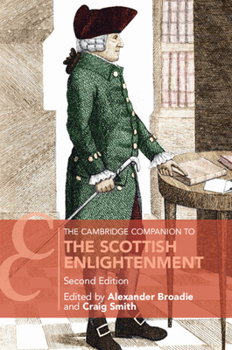
The Cambridge Companion to the Scottish Enlightenment

Select Format
Select Condition 
Book Overview
The second edition of this Companion presents a philosophical perspective on an eighteenth-century phenomenon that has had a profound influence on Western culture. A distinguished team of contributors examines the writings of David Hume, Adam Smith, Thomas Reid, Adam Ferguson and other Scottish thinkers. Their subjects range across philosophy, natural theology, economics, anthropology, natural science, and law and the arts, and in addition, they relate the Scottish Enlightenment to its historical context and assess its impact and legacy. The result is a comprehensive and accessible volume that illuminates the richness, the intellectual variety and the underlying unity of this important movement. This volume contains five entirely new chapters on morality, the human mind, aesthetics, sentimentalism and political economy, and eleven other chapters have been significantly revised and updated. The book will be of interest to a wide range of readers in philosophy, theology, literature and the history of ideas.
Format:Paperback
Language:English
ISBN:1108430783
ISBN13:9781108430784
Release Date:November 2019
Publisher:Cambridge University Press
Length:394 Pages
Weight:1.25 lbs.
Dimensions:0.8" x 6.0" x 9.0"
Customer Reviews
1 rating
One of the great cultural movements in the world
Published by Thriftbooks.com User , 20 years ago
The editor Alexander Broadie is Professor of Logic and Rhetoric at Glasgow University- a chair once occupied by Adam Smith author of "Wealth of Nations". This book, "The Scottish Enlightenment", written for the general reader, is a great treatise on a most astonishing period of Scottish history during the 18th century. Broadie writes; "that what gave the Scottish Enlightenment its character as a distinct historical movement was the complex set of relations with a group of geniuses and other immensely creative people living in each others intellectual pockets. Broadie and his colleagues write about the leading Scottish luminaries in the fields of science, philosophy, history, economics, and the arts. The ideas of Hume, Smith, Reid, Ferguson, Hutcheson, Kames, Turnbull, and others had an immense influence on the great thinkers of Europe as well as our founding fathers here in America. The term "Enlightenment" suggests emergence from darkness. There are two essential features of the enlightenment. First, a demand that people think for themselves. You do not take ideas on faith but you inquire study and observe for yourself. Second, social virtue of tolerance of ideas. The state and church cannot punish one for their ideas. This allows literati of men to meet and exchange ideas on a plethora of subjects and to spread these ideas through their writings so that other literati in Europe can comment and react to them. Thinking becomes a civil activity with ideas in the public domain. These men love liberty and are looking to build a better society for humanity. They believe that if morality is about anything it is about - protecting the civilized values vested in society. No wonder these men had a great influence on our founding fathers! The Scottish Enlightenment was Scotland's chief export to America. The consequences for the Scottish Enlightenment were much theorizing about society and social change and the nature of freedom. If you are truly interested in a classical education put this book on the top of your reading list! I recommend this book for anyone interested in philosophy, history, political science, and history of America's founding era.
Copyright © 2026 Thriftbooks.com Terms of Use
| Privacy Policy | Do Not
Sell/Share My Personal Information | Cookie Policy | Cookie Preferences | Accessibility Statement
ThriftBooks® and the ThriftBooks® logo are registered trademarks of Thrift Books Global, LLC
ThriftBooks® and the ThriftBooks® logo are registered trademarks of Thrift Books Global, LLC
