


< Back to Search Results
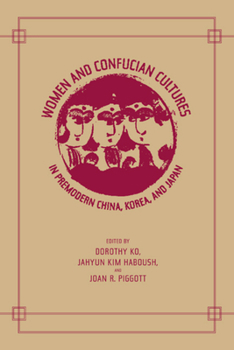
Women and Confucian Cultures in Premodern China, Korea, and Japan


Select Format
Select Condition 
Book Overview
Representing an unprecedented collaboration among international scholars from Asia, Europe, and the United States, this volume rewrites the history of East Asia by rethinking the contentious relationship between Confucianism and women. The authors discuss the absence of women in the Confucian canonical tradition and examine the presence of women in politics, family, education, and art in premodern China, Korea, and Japan. What emerges is a concept of Confucianism that is dynamic instead of monolithic in shaping the cultures of East Asian societies. As teachers, mothers, writers, and rulers, women were active agents in this process. Neither rebels nor victims, these women embraced aspects of official norms while resisting others. The essays present a powerful image of what it meant to be female and to live a woman's life in a variety of social settings and historical circumstances. Challenging the conventional notion of Confucianism as an oppressive tradition that victimized women, this provocative book reveals it as a modern construct that does not reflect the social and cultural histories of East Asia before the nineteenth century.
Format:Paperback
Language:English
ISBN:0520231384
ISBN13:9780520231382
Release Date:August 2003
Publisher:University of California Press
Length:350 Pages
Weight:1.10 lbs.
Dimensions:0.9" x 6.1" x 9.0"
Customer Reviews
1 rating
Revisionist theory.
Published by Thriftbooks.com User , 22 years ago
It is generally thought that Confucianism tends to subjugate women by promoting a patriarchal system and erasing them from official discourses and records. Revisionist Ko and collaborators attempt to show that women were "neither victims nor rebels within these Confucian societies (China, Japan, Korea) for they embraced aspects of official norms while resisting others." In other words, women were willing participants in the Confucian orthodoxy.While agreeing with some of these thoughts, it comes to my mind that there is no mention in their book about Vietnam, which was a full-fledged Confucian society as of the first century B.C. Whether this omission is related to a lack of or difficulty in locating experts in the field of Vietnamese Confucian society is not known.A cursory look at premodern Vietnam reveals that this brand of Confucianism had not only deprived women of their basic rights, but also promoted a strict Confucian patriarchal system that was not conducive to the recognition of their talents or dignity. The two best Vietnamese literary works "Luc Van Tien and Kim Van Kieu" were written by men who extolled the virtues of women faithful to Confucian norms. The patriarchal atmosphere was so overbearing that women had to embrace the norms in order to survive. Anyone who refused to comply with the rules could be dismissed as heretic or unfaithful and cast out of the society. Confucian Vietnamese women, therefore, cannot be described as willful participants of the Confucian system.Ko and al. throughout their book have not convincingly dispelled the notion that Confucian women, except for Japanese women, were not victims in their societies. On the contrary, their discourses have only showed that women were relegated and confined to an "inner-domestic sphere" in all these Confucian societies. The fact that women accepted their assigned roles does not mean they liked it. Being subdued by males, they did the best they could: they collaborated with men so that they could survive within the male dominated society.While disagreeing with the authors' conclusions, I believe their work is an important contribution to the study of Confucian women.
Copyright © 2026 Thriftbooks.com Terms of Use
| Privacy Policy | Do Not
Sell/Share My Personal Information | Cookie Policy | Cookie Preferences | Accessibility Statement
ThriftBooks® and the ThriftBooks® logo are registered trademarks of Thrift Books Global, LLC
ThriftBooks® and the ThriftBooks® logo are registered trademarks of Thrift Books Global, LLC
