


< Back to Search Results
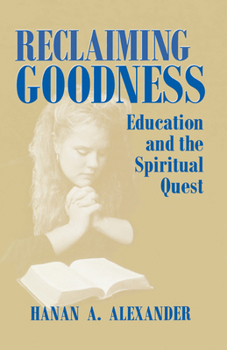
Reclaiming Goodness: Education and the Spiritual Quest


Select Format
Select Condition 
Book Overview
Reclaiming Goodness: Education and the Spiritual Quest begins with the premise that sound models for achieving both spiritual fulfillment and the "good life" are lacking in contemporary culture. Arguing that contemporary education is responsible for having abandoned spirituality and the cultivation of goodness in people, Hanan A. Alexander advances a definition of spirituality which acknowledges an integral connection to education. Reclaiming Goodness charts a way to reintegrate ethical and spiritual values with the values of critical thought and reason. Written in accessible and non-technical prose, it will be of interest to professional educators as well as to a wider audience.
Format:Hardcover
Language:English
ISBN:0268040036
ISBN13:9780268040031
Release Date:May 2001
Publisher:University of Notre Dame Press
Length:290 Pages
Weight:1.11 lbs.
Dimensions:1.0" x 5.9" x 8.8"
Customer Reviews
3 ratings
Educating for the Good Life
Published by Thriftbooks.com User , 22 years ago
Since I read the book To Know as we are Known by Parker Palmer, it has been hard for me to find a book on education that is as exciting. Nevertheless, Reclaiming Goodness: Education and the Spiritual Quest by Hanan Alexander has many good things to say. The premise of this book, which won the National Jewish Book Award, is that there needs to be a reconnection between education and spirituality in this country. Alexander begins by documenting the failure of modern thinking which up to now has not offered a compelling ethical vision, leading to the current crisis of spirituality. He posits that spirituality is achieved though education and that education should express the values that human beings cherish the most. He believes that the best education and educational programs are formed within "organic communities" linked to tradition and spirituality, but open interaction with competing ideals to stimulate thinking and criticism. Within these communities needs to be a flow of reciprocal ideas, principles, and practice from homes to places of worship to schools. He calls this a kind of spiritual hothouse in which all the members of communities learn and help educate one another; they create a good person for the "good life." I would take his thinking a bit further. Rather than only speak of education as a tool for good, I think education in all its facets ought to be a tool for healing. This should be the criterion we have in mind as we create educational opportunities and critique the ones that already exist. Perhaps educators should adopt the maxim that Hippocrates assigned to doctors: First do no harm. I enjoyed this book, and I plan to read it again. I think Alexander has an exciting vision, and I was very stimulated by his ideas.* * *
Reclaiming Goodness
Published by Thriftbooks.com User , 22 years ago
What is the primary aim of education? Supposing, as the author does, that it is to cultivate good people, how is this done? How can learning communities maintain commitment to a higher good in this increasingly secularized society? Anyone who is concerned with such questions would do well to begin with this book. Alexander writes from a Jewish perspective, but his call for a renewed ethical vision extends to people of all backgrounds.Making admirable use of the thoughts of philosophers from Plato and Aristotle to René Descartes and John Locke, Alexander identifies three important conceptions of spirituality (subjective, collective, and objective) and outlines the strengths and weaknesses of each. He laments the detrimental impact of the Enlightenment on spirituality, but does not advocate the abandonment of reason. Instead, he implores readers to integrate all three conceptions of spirituality and thus reclaim the "intelligent core of goodness."Perhaps the best aspect of Alexander's attitude toward the education of spirituality is his optimism. While he objects to pedagogies which rely on either indoctrination or extreme relativism, Alexander describes a way of education-indeed, a way of life-which incorporates both the acquirement of knowledge and the cultivation of one's own moral potential. In his own words, "Becoming educated is not about becoming rational for its own sake, but about becoming intelligent in order to be good" (p. 172). I commend this book to readers who are dissatisfied with the moral crisis of our day and are looking to direct a spiritually deprived society toward a higher good.
Intelligent spirituality
Published by Thriftbooks.com User , 24 years ago
Summarizing the content and dynamics of this book is a demanding task for the reviewer, because almost every page is filled with deep innovative thoughts on the moral and spiritual future of liberal education. The old dichotomies between rationality and emotionality, the self and the collective, the liberal and the communitarian, the instrumental and the spiritual should be transformed in new ways of intellectual behaviour. The key word is "intelligent spirituality" (139-169). The book contains seven chapters: two of analysis of the contemporary educational quest, specifically in the US, three systematic and historic chapters on subjective, collective and objective forms of spirituality, and two concluding chapters in which the author elaborates on moral and spiritual modelling of education in a post-Enlightenment society. According to Alexander's position, contemporary education suffers from excessive instrumentalism, fragmented goals and means. Parents and educators are relying on their own overstressed emotions or on the empty promises of sectarian movements. They lack the tools for a comprehensive evaluation of what is worth while in contemporary culture, when they present this to their children and students in its breadth (intercultural) and its depth (intergenerational). Critical thinking, free will and fallibility are three key concepts in post-modern education. Post-modernity refers for the author to a revitalized modernity in which emancipation has been re-evaluated on the basis of the emerging idea and praxis of inter-subjective and therefore fallible quest for truth. "Loving rationality" helps to overcome "uncaring determinism" (169) - which is the "old" instrumentalism of the "new" high tech education.The way in which Alexander succeeds in creating a transparent educational discours, relying on his huge "connoisseurship" (189) of the Torah, is fascinating. His internal-critical reading of the Jewish tradition is really challenging. For me the most inspiring pages were these in which he tells the stories and uses the metaphors of the Torah (e.g. Sabbath, Passover, Garden of Eden, Exodus, etc.) in order to re-capture his philosophical arguments (that are also well documented: from Plato to Rorty, from Maimonides to Taylor). In doing so he offers the reader an insight in the joy and fulfilment of being a spiritual educator. I would like to highly recommend this book as a reference work and even as a "frame of reference" for education in the future. It gives the reader not only a clear overview of the different positions (with an extensive index and list of notes for further reading) but it helps him/her to anticipate on authentic and communicative learning, rooted in the wisdom of religious traditions. The book can be a helpful text book in the classroom, in a course on the dynamics of education in general.
Copyright © 2026 Thriftbooks.com
Terms of Use | Privacy Policy | Do Not Sell/Share My Personal Information | Cookie Policy | Cookie Preferences | Accessibility Statement
ThriftBooks ® and the ThriftBooks ® logo are registered trademarks of Thrift Books Global, LLC
ThriftBooks ® and the ThriftBooks ® logo are registered trademarks of Thrift Books Global, LLC
