


< Back to Search Results
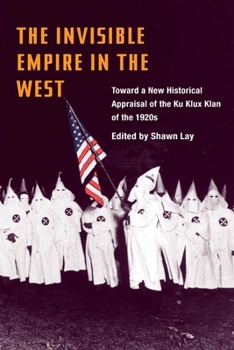
The Invisible Empire in West: Toward a New Historical Appraisal of the Ku Klux Klan of the 1920s
No Customer Reviews

Select Format
Select Condition 
Book Overview
This timely anthology describes how and why the Ku Klux Klan became one of the most influential social movements in modern American history. For decades historians have argued that the spectacular growth of the Ku Klux Klan in the 1920s was fueled by a postwar surge in racism, religious bigotry, and status anxiety among working-class white Americans. In recent years, however, a growing body of scholarship has complicated that appraisal, emphasizing the KKK's strong links to mainstream society and its role as a medium of corrective civic action. Addressing a set of common questions, Lay and six other contributors to this volume examine local Klan chapters in Denver, Salt Lake City, El Paso, Anaheim and, in Oregon, Eugene and La Grande. Far from being composed of marginal men prone to violence and irrationality, the Klan drew membership from a generally balanced cross-section of the white male, Protestant population. Overt racism and religious bigotry were major drawing cards for the Hooded Order, but intolerance frequently intertwined with community issues such as improved law enforcement, better public education, and municipal reform. The authors consolidate, focus, and expand upon new scholarship to provide insight into the complex reasons for the Klan's popularity.
Format:Paperback
Language:English
ISBN:0252071719
ISBN13:9780252071713
Release Date:December 2003
Publisher:University of Illinois Press
Length:248 Pages
Weight:3.50 lbs.
Dimensions:0.7" x 6.0" x 8.9"
Related Subjects
HistoryCustomer Reviews
0 rating
Copyright © 2026 Thriftbooks.com Terms of Use
| Privacy Policy | Do Not
Sell/Share My Personal Information | Cookie Policy | Cookie Preferences | Accessibility Statement
ThriftBooks® and the ThriftBooks® logo are registered trademarks of Thrift Books Global, LLC
ThriftBooks® and the ThriftBooks® logo are registered trademarks of Thrift Books Global, LLC
