


< Back to Search Results
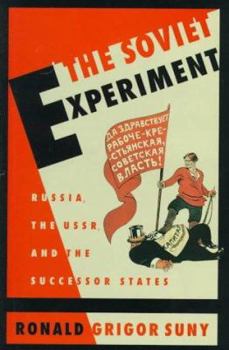
The Soviet Experiment: Russia, The USSR, and the Successor States

Select Format
Select Condition 
Book Overview
The West has always had difficulty understanding the Soviet Union. For decades, analyses of America's Cold War foe were clouded by ideological passions and a shear dearth of information. Then came the flood of dramatic revelations under glasnost, followed by the sudden, shocking collapse of the Communist empire. Today, with the stunning secrets of newly opened archives and the excitement of political revolution still fresh in our minds, and we can look back at this remarkable nation and see it whole, see Soviet history as a story with a beginning, a middle, and an end. In The Soviet Experiment, Ronald Grigor Suny does just that, in a landmark work that gives us the fullest account yet of the most remarkable story of our century.
With a clear-eyed mastery of the historical issues and literature, Suny combines gripping detail with insightful analysis in a narrative that propels the reader from the last tsar of the Russian empire to the first president of the Russian republic. He focuses in particular on four revolutions, each identified with a single individual: the tumultuous year of 1917, when Vladimir Lenin led the Bolshevik takeover of the tsarist empire; the 1930s, when Joseph Stalin refashioned the economy, the society, and the state; Mikhail Gorbachev's ambitious, and catastrophic, attempt at sweeping reform and revitalization; and the breakup of the Soviet Union led by Boris Yeltsin. Never have we had a more complete, nuanced, and crystal-clear examination of the complex themes running through Soviet history. Suny confidently moves from party debates and personal rivalries, to centuries-old ethnic tensions, to vast economic and social developments. He unravels tangled issues with ease, explaining "deeply contradictory" policies toward the various Soviet nationalities; Moscow's ambivalence over its own New Economic Policy of the 1920s; and the attempts at reform that followed Stalin's death. Suny's treatment of the Soviet break-up warrants particular attention, as he details precisely how Gorbachev's program unleashed forces that had built up during the previous decades--particularly the nationalism that had been shaped, ironically, by the Soviet structure of ethnically defined republics. Along the way, he offers a fresh telling of familiar as well as little-known events--capturing, for example, the movement of the crowds on the streets of St. Petersburg in the February revolution; Stalin's collapse into a near-catatonic state after Hitler's much-predicted invasion; or Yeltsin's political maneuvering and public grandstanding as he pushed the disintegration of the Soviet Union, and then faced down his rivals.
The Soviet Experiment provides a rich, multilayered, seamlessly woven account of one of the great forces of modern history. With dispassionate insight and human detail, Suny has constructed a masterful work.
With a clear-eyed mastery of the historical issues and literature, Suny combines gripping detail with insightful analysis in a narrative that propels the reader from the last tsar of the Russian empire to the first president of the Russian republic. He focuses in particular on four revolutions, each identified with a single individual: the tumultuous year of 1917, when Vladimir Lenin led the Bolshevik takeover of the tsarist empire; the 1930s, when Joseph Stalin refashioned the economy, the society, and the state; Mikhail Gorbachev's ambitious, and catastrophic, attempt at sweeping reform and revitalization; and the breakup of the Soviet Union led by Boris Yeltsin. Never have we had a more complete, nuanced, and crystal-clear examination of the complex themes running through Soviet history. Suny confidently moves from party debates and personal rivalries, to centuries-old ethnic tensions, to vast economic and social developments. He unravels tangled issues with ease, explaining "deeply contradictory" policies toward the various Soviet nationalities; Moscow's ambivalence over its own New Economic Policy of the 1920s; and the attempts at reform that followed Stalin's death. Suny's treatment of the Soviet break-up warrants particular attention, as he details precisely how Gorbachev's program unleashed forces that had built up during the previous decades--particularly the nationalism that had been shaped, ironically, by the Soviet structure of ethnically defined republics. Along the way, he offers a fresh telling of familiar as well as little-known events--capturing, for example, the movement of the crowds on the streets of St. Petersburg in the February revolution; Stalin's collapse into a near-catatonic state after Hitler's much-predicted invasion; or Yeltsin's political maneuvering and public grandstanding as he pushed the disintegration of the Soviet Union, and then faced down his rivals.
The Soviet Experiment provides a rich, multilayered, seamlessly woven account of one of the great forces of modern history. With dispassionate insight and human detail, Suny has constructed a masterful work.
Format:Hardcover
Language:English
ISBN:0195081048
ISBN13:9780195081046
Release Date:November 1997
Publisher:Oxford University Press
Length:560 Pages
Weight:2.04 lbs.
Dimensions:9.2" x 1.6" x 6.1"
Customer Reviews
4 ratings
Fine Survey; 4.5 Stars
Published by Thriftbooks.com User , 17 years ago
This is a very fine survey of Soviet history from the Russian Revolution to the collapse of the Soviet state. While this is a chronologically arranged account, Suny divides Soviet history into a set of sensibly selected periods. These are the Russian Revolution and establishment of the Soviet state in the Civil War, the period of modest relaxation of state efforts at control that was the New Economic Policy (NEP), the Stalinist revolution from above and WWII, the efforts at reform after Stalin, the stagnation of the Brezhnev decades, and the final effort at reform that led to the fall of the Soviet state. Major political, social, economic, and to a lesser extent, intellectual developments are discussed for each period. Suny makes a very successful effort to balance narrative and analysis. Controversial issues are described as such and references given to appropriate further reading. The balance between sufficient detail and maintaining a good narrative flow within the limits of a moderate sized survey is excellent. Consistent themes are the discrepancies between Marxist doctrine and the social realities of Imperial Russia and the Soviet Union, the enormous transformation of Soviet society that took place under the leadership of the Communist party, the brutality of Stalin, and the consistent Soviet suppression of civil society and democratic impulses. The bibliography is excellent. This book is an excellent entry into the complicated literature on the Soviet Union and recommended strongly.
Magnificent Book
Published by Thriftbooks.com User , 17 years ago
Splendid overview of Russian history, particularly in the Soviet years. Suny is very balanced, steering a course between hardline interpreters Right and Left. He gives a broad background of Russian history, and then concentrates on the specific conditions that shaped the Soviet effort at socialism--which, under Stalin, became the totalitarian antithesis of its egalitarian and democratic roots. He has the gift of summarizing enormous trends briefly and clearly, and giving telling vignettes that keep up interest. A clear, thoughtful writer. It's only a pity the book was written in the late 90s, and so is not able to follow up on some of the later post-Yeltsin developments. The account of the early Yeltsin years briefly but completely supports Naomi Klein's much longer account in The Shock Doctrine: free-market gospeleers running amok and driving the economy to near-ruin.
A good read
Published by Thriftbooks.com User , 21 years ago
This is a good book for people just trying to get a grasp on what's going on. There are some "generalizations" as someone mentioned in an earlier review, but they are less unsubstantiated than they are just not always elaborated upon. I think it's a blessing, since Suny's other book on Soviet Essays & Documents is a lot more precise and, consequently, hard to get through. It's good information though, and especially in the Soviet Experiment his style of writing makes for an easy, fair-minded, fascinating read.
Thoughtful Overview of the Soviet Union
Published by Thriftbooks.com User , 25 years ago
Suny writes in an interesting, story-telling style that is easy to read. At the same time, he tackles a complex subject with the authority you would expect from a historian of his calibre. A first rate book!
Copyright © 2026 Thriftbooks.com Terms of Use
| Privacy Policy | Do Not
Sell/Share My Personal Information | Cookie Policy | Cookie Preferences | Accessibility Statement
ThriftBooks® and the ThriftBooks® logo are registered trademarks of Thrift Books Global, LLC
ThriftBooks® and the ThriftBooks® logo are registered trademarks of Thrift Books Global, LLC
