


< Back to Search Results
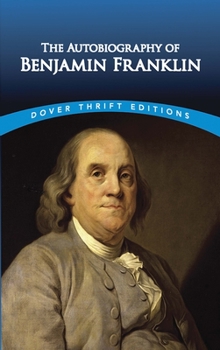
The Autobiography of Benjamin Franklin


Select Format
Select Condition 
Book Overview
Blessed with enormous talents and the energy and ambition to go with them, Franklin was a statesman, author, inventor, printer, and scientist. He helped draft the Declaration of Independence and later was involved in negotiating the peace treaty with Britain that ended the Revolutionary War. He also invented bifocals, a stove that is still manufactured, a water-harmonica, and the lightning rod.
Franklin's extraordinary range of interests and accomplishments are brilliantly recorded in his Autobiography, considered one of the classics of the genre. Covering his life up to his prewar stay in London as representative of the Pennsylvania Assembly, this charming self-portrait recalls Franklin's boyhood, his determination to achieve high moral standards, his work as a printer, experiments with electricity, political career, experiences during the French and Indian War, and more. Related in an honest, open, unaffected style, this highly readable account offers a wonderfully intimate glimpse of the Founding Father sometimes called "the wisest American."
Franklin's extraordinary range of interests and accomplishments are brilliantly recorded in his Autobiography, considered one of the classics of the genre. Covering his life up to his prewar stay in London as representative of the Pennsylvania Assembly, this charming self-portrait recalls Franklin's boyhood, his determination to achieve high moral standards, his work as a printer, experiments with electricity, political career, experiences during the French and Indian War, and more. Related in an honest, open, unaffected style, this highly readable account offers a wonderfully intimate glimpse of the Founding Father sometimes called "the wisest American."
Format:Paperback
Language:English
ISBN:0486290735
ISBN13:9780486290737
Release Date:June 2016
Publisher:Dover Publications
Length:144 Pages
Weight:0.73 lbs.
Dimensions:0.3" x 5.2" x 8.2"
Age Range:11 years and up
Grade Range:Grade 6 and higher
Customer Reviews
5 ratings
Insight into One of History's Brilliant Thinkers
Published by Matthew Clark , 5 months ago
One of the most influential autobiographies of all time, "The Autobiography of Benjamin Franklin" is an interesting read by one of the Founding Fathers of the United States. Do not expect a vivid account of the signing of the Declaration of Independence or anything, but insight into the mind of one of history's most brilliant thinkers. There are some great quotes in here, which you may or may not have heard, that you will certainly want to take with you.
Great man but not a great read
Published by Chelsey J , 1 year ago
Extremely hard to read, keep in mind when buying this book this man was born in the 1700's. I gave up even when I tried with an audiobook.
Exactly what i wanted
Published by Thriftbooks.com User , 17 years ago
This book came in excellent condition and arrived on time. it was more than i expected and just what i could hope for. i am very glad i purchased this.
Good Read for Everyone
Published by Thriftbooks.com User , 18 years ago
The autobiography of Franklin was a worthwhile book to read. I suggest ignoring the footnotes as you read his autobiography since it distracts you from reading Franklin's work. It was a good book that details how industriousness results in a wonderful, useful public life at an older age. Franklin is the type of public servant that we are lacking today.
An Incomplete American Life
Published by Thriftbooks.com User , 21 years ago
Well, Ben Franklin's life was not incomplete, but his autobiography is. This is partly because Franklin never intended his book for publication. He was writing it for the benefit of his son - partly as a guide for life, and partly as a family history. Indeed, on the first page, Franklin writes that he has always enjoyed hearing stories about his ancestors, and hopes his son will be as interested to learn of his father's life. However, after Franklin's break with his son, he continues to write, but now it is for the benefit of all of his ancestors. Franklin's disagreement with his son William is just one of many details that are missing from this book. I was always interested in Franklin and it had long been a goal of mine to read his autobiography. Had I known that the years 1758-1790 were not covered, which were probably the most important and influential of his life, I might not have read it. And that would have been a mistake. For although the major events of the 1770s and 1780s are missing, like the American Revolution, the Treaty of Paris, and the Constitutional Convention, there is so much material about the early years of Franklin's life here that it is still a worthwhile book. Who knew Franklin was practically a champion swimmer, for example? We often think of Franklin as the elder statesman of the Founding Fathers, as indeed he was. Franklin was born 26 years before George Washington. But in this book we see Franklin as a boy and then a young man, whole periods of his life that are forgotten when one thinks of his later, great contributions. Thankfully, Franklin documents much of it, and it makes for terrific reading. His battles with his brother, his early struggles with established religion, his bold jump to Philadelphia, and then to London, when he was still so young. He even mentions that he was a regular patron of the local prostitutes in Philadelphia! This is not something you'd see in Poor Richard's Almanac, of that I am sure. Even though the book is lacking the major events of Franklin's later life, it is still rich in anecdotes and instruction. There is much to be learned from Ben, whether he was founding the first fire department or library, or making monetary contributions to every religious denomination in Philadelphia, or his attempts at achieving "moral perfection" - actions that demonstrated his industriousness, his tolerance, his wisdom. Franklin was an incredibly fascinating character and he remains one of the giants of American history. You wouldn't know it from reading this autobiography, but it doesn't matter; the historians have safely documented his legacy in other books. In these pages, in his own words, you learn what made Franklin tick, what he believed in, and why. And that's more than enough. Five stars.
Copyright © 2026 Thriftbooks.com
Terms of Use | Privacy Policy | Do Not Sell/Share My Personal Information | Cookie Policy | Cookie Preferences | Accessibility Statement
ThriftBooks ® and the ThriftBooks ® logo are registered trademarks of Thrift Books Global, LLC
ThriftBooks ® and the ThriftBooks ® logo are registered trademarks of Thrift Books Global, LLC
