


< Back to Search Results
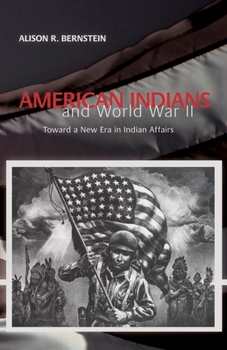
American Indians and World War II: Toward a New Era in Indian Affairs

Select Format
Select Condition 
Book Overview
The impact of World War II on Indian affairs was more profound and lasting than that of any other event or policy--including Roosevelt's Indian New Deal and efforts to terminate federal responsibility for tribes under Eisenhower. Focusing on the period from 1941 to 1947, Alison R. Bernstein explains why termination and tribal self-determination were logical results of the Indians' World War II experiences in battle and on the home front.
Format:Paperback
Language:English
ISBN:0806131845
ISBN13:9780806131849
Release Date:September 1999
Publisher:University of Oklahoma Press
Length:264 Pages
Weight:0.78 lbs.
Dimensions:1.9" x 5.4" x 8.5"
Customer Reviews
1 rating
A solid look at a critical era in American Indian history
Published by Thriftbooks.com User , 19 years ago
"American Indians and World War II: Toward a New Era in Indian Affairs," by Alison Bernstein, is an engrossing work of history. Bernstein looks at both combat zone and homefront, and she covers many important topics: the draft, the Indian quest for full voting rights, stereotypes that Indians in the military had to deal with, Indian participation in the war bonds program, the role of the Bureau of Indian Affairs, the founding of the National Congress of American Indians, the postwar crisis faced by the Navajos, and more. She discusses the service of American Indians in the Army, Navy, Marine Corps, and Army Air Corps, taking note of Indian heroism in combat. She also covers the employment of Indians in defense-related industries on the homefront, and discusses "the emergence of a newly-forged pan-Indian identity." Some of the most noteworthy sections of the book include her look at the Navajo code talkers and her review of the service of Ira Hayes, an Indian Marine who was one of the participants in the iconic flag-raising on Iwo Jima. Also fascinating is her account of the internment of Japanese-Americans on Indian land. She discusses differing tribal attitudes towards returning war veterans. A key figure in the book is John Collier, commissioner of Indian affairs from 1933 to 1945. The book includes many excellent black-and-white photographs that help bring the story to life. Bernstein amply documents the text with a lengthy set of endnotes (pages 177-223) and an extensive bibliography (pages 225-237), thus offering plenty of avenues for readers who want to research further. Her many sources include archival and manuscript collections, U.S. government documents, legal cases, books, and more. She also cites articles from a broad range of different periodicals. Overall, this is a fascinating and richly detailed look at this era in American Indian history. Written in a straightforward tone and full of compelling facts, this book is a valuable addition to both World War II studies and Native American studies.
Copyright © 2025 Thriftbooks.com
Terms of Use | Privacy Policy | Do Not Sell/Share My Personal Information | Cookie Policy | Cookie Preferences | Accessibility Statement
ThriftBooks ® and the ThriftBooks ® logo are registered trademarks of Thrift Books Global, LLC
ThriftBooks ® and the ThriftBooks ® logo are registered trademarks of Thrift Books Global, LLC
