


< Back to Search Results
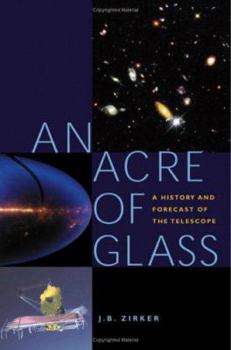
An Acre of Glass: A History and Forecast of the Telescope

Select Format
Select Condition 
Book Overview
Ever since Galileo glimpsed the moons of Jupiter through his tiny telescope, astronomers have striven to understand how the universe is constructed and how it evolves. Every increase in the size and power of telescopes has led to new discoveries. Within the last century, telescopes have enabled us to learn about pulsars, quasars, gamma ray bursters, black holes, and the acceleration of the universe's expansion. An Acre of Glass describes how recent innovations in telescope technology have led to the construction of giant, ground-based observatories and to an explosive development of the science. Today, telescopes with mirrors 30, 50, and even 100 meters in diameter are being built. Optical interferometers that cover an acre of ground are observing every night. J. B. Zirker shows us how telescopes past, present, and future are built and describes the exciting science they reveal - from planets beyond our solar system to supermassive black holes at the core of distant galaxies. For every striking image revealed through these enormous telescopes, technicians and scientists must overcome unique and incredible challenges. mountain? How do you make the shape of a 6-foot-wide mirror accurate to within a 1,000th the thickness of a human hair? In clear and accessible language, Zirker answers these questions and more, providing fascinating technical detail about how a telescope is made and what the next generation can hope to see.
Format:Hardcover
Language:English
ISBN:0801882346
ISBN13:9780801882340
Release Date:October 2005
Publisher:Johns Hopkins University Press
Length:368 Pages
Weight:1.46 lbs.
Dimensions:9.0" x 1.2" x 6.0"
Age Range:18 years and up
Grade Range:Postsecondary and higher
Customer Reviews
3 ratings
An interesting book for a telescope aficionado
Published by Thriftbooks.com User , 19 years ago
As the title "An Acre of Glass" suggests, this book is primarily about the building of ever-larger optical telescopes around the world. The author does a credible job with the story, with accurate discussions and generally good writing. If anything detracts from the reader's experience it is the author's diversions into other stories. He breaks the central story between Palomar and the next generation of observatories with a chapter on radio astronomy and an assortment of other astronomy achievements. All important stuff, but just a distraction in this book. It would have been better to have spread the material through the book, or have placed it in an appendix. The chapter on the Hubble space telescope seems similarly perfunctory. I think the book would have been stronger if the author had remained focused on his real story and resisted the urge to pretend to cover a larger subject. But people interested in the development of ever larger optical telescopes will still enjoy this book.
Modern astronomy pushed by telescope technology!
Published by Thriftbooks.com User , 20 years ago
Astronomers have long endeavored to understand the universe and its construction by using telescopes to make new discovers. AN ACRE OF GLASS describes the history of telescope technology and how recent innovations have led to a leap forward in astronomical discovery. AN ACRE OF GLASS: A HISTORY AND FORECAST OF THE TELESCOPE reveals how telescope technology lead directly to these new findings - and new questions. Chapters often read with the drama of fiction, documenting the discoveries and endeavors of individuals involved in astronomical science and research. An excellent guide to how modern astronomy has been pushed by telescope advancement.
A Comprehensive Exploration of the Tools of Astronomy
Published by Thriftbooks.com User , 20 years ago
In this relatively detailed work, the author discusses the history of the telescope. This history is heavily slanted towards the past century, with much detail provided on developments in recent decades; forecasts for the foreseeable future are also presented. Although optical telescopes, and related apparatus, take center stage, radio telescopes are also discussed. A set of short notes in the back of the book provides clear and concise explanations of some of the items presented in the main text. The author writes very clearly and in an engaging style; he succeeds admirably in conveying the excitement of both furthering the technology as well as using it to deepen our knowledge in the fascinating field of astronomy. Plenty of photos and diagrams complement this excellent work. I believe that this book can be of great interest to a wide range of readers, but it will be most easily accessible to science buffs, especially those already acquainted with the basic physical principles that are central to astronomy and astronomical observation.
Copyright © 2026 Thriftbooks.com Terms of Use
| Privacy Policy | Do Not
Sell/Share My Personal Information | Cookie Policy | Cookie Preferences | Accessibility Statement
ThriftBooks® and the ThriftBooks® logo are registered trademarks of Thrift Books Global, LLC
ThriftBooks® and the ThriftBooks® logo are registered trademarks of Thrift Books Global, LLC
