


< Back to Search Results
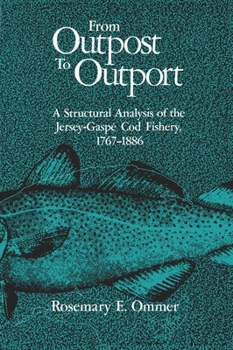
From Outpost to Outport: A Structural Analysis of the Jersey-Gaspé Cod Fishery, 1767-1886
No Customer Reviews

Select Format
Select Condition 
Book Overview
In 1766 Gasp became an outpost of the Jersey metropole; in 1886 the Channel island of Jersey abandoned the region, reducing Gasp , on Quebec's Atlantic coast, to Canadian outport status. From Outpost to Outport provides a structural and theoretical examination of the economic relationship between Jersey and Gasp , explaining the development of codfish as a staple which, under merchant capital, secured success for Jersey at the expense of underdevelopment in Gasp .
Using the extensive papers of the firm Charles Robin and Company of Jersey and Paspebiac, and the records of the Jersey mercantile establishment, Rosemary Ommer presents a detailed case study of commodity trade, uncovering the development, function, and strengths and weaknesses of all aspects of the fishery. Her analysis clearly reveals a functional three-point trading system: production in Gasp , management in Jersey, and markets in the Mediterranean, the West Indies, and Brazil. Employing a new set of methodologies developed for this study, Ommer is able to escape the myopic perspective of works which assume that staple-based development comprises only "good" and "bad" staples that inevitably lead to development and underdevelopment respectively. She has instead produced a rich and complex analysis which broadens our understanding of colonial staple development and commodity trade and introduces new insights on regional development.Format:Hardcover
Language:English
ISBN:0773507302
ISBN13:9780773507302
Release Date:December 1990
Publisher:McGill-Queen's University Press
Length:264 Pages
Weight:1.30 lbs.
Customer Reviews
0 rating
Copyright © 2026 Thriftbooks.com
Terms of Use | Privacy Policy | Do Not Sell/Share My Personal Information | Cookie Policy | Cookie Preferences | Accessibility Statement
ThriftBooks ® and the ThriftBooks ® logo are registered trademarks of Thrift Books Global, LLC
ThriftBooks ® and the ThriftBooks ® logo are registered trademarks of Thrift Books Global, LLC
