


< Back to Search Results
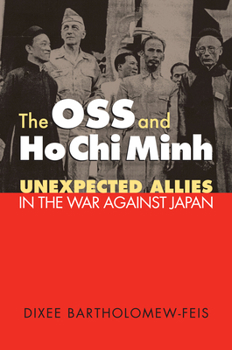
The OSS and Ho CHI Minh: Unexpected Allies in the War Against Japan

Select Format
Select Condition 
Book Overview
Some will be shocked to find out that the United States and Ho Chi Minh, our nemesis for much of the Vietnam War, were once allies. Indeed, during the last year of World War II, American spies in Indochina found themselves working closely with Ho Chi Minh and other anti-colonial factions--compelled by circumstances to fight together against the Japanese. Dixee Bartholomew-Feis reveals how this relationship emerged and operated and how it impacted Vietnam's struggle for independence. The men of General William Donovan's newly-formed Office of Strategic Services closely collaborated with communist groups in both Europe and Asia against the Axis enemies. In Vietnam, this meant that OSS officers worked with Ho Chi Minh and the Viet Minh, whose ultimate aim was to rid the region of all imperialist powers, not just the Japanese. Ho, for his part, did whatever he could to encourage the OSS's negative view of the French, who were desperate to regain their colony. Revealing details not previously known about their covert operations, Bartholomew-Feis chronicles the exploits of these allies as they developed their network of informants, sabotaged the Japanese occupation's infrastructure, conducted guerrilla operations, and searched for downed American fliers and Allied POWs. Although the OSS did not bring Ho Chi Minh to power, Bartholomew-Feis shows that its apparent support for the Viet Minh played a significant symbolic role in helping them fill the power vacuum left in the wake of Japan's surrender. Her study also hints that, had America continued to champion the anti-colonials and their quest for independence, rather than caving in to the French, we might have been spared our long and very lethal war in Vietnam. Based partly on interviews with surviving OSS agents who served in Vietnam, Bartholomew-Feis's engaging narrative and compelling insights speak to the yearnings of an oppressed people--and remind us that history does indeed make strange bedfellows.
Format:Paperback
Language:English
ISBN:0700616527
ISBN13:9780700616527
Release Date:May 2006
Publisher:University Press of Kansas
Length:446 Pages
Weight:1.25 lbs.
Dimensions:0.9" x 5.9" x 9.0"
Related Subjects
Americas Asia History Japan Military Southeast Asia Strategy Vietnam War World War IICustomer Reviews
4 ratings
An Important, Often Overlooked Time in US Foreign and Defense Policy
Published by Thriftbooks.com User , 16 years ago
This is a very well written and researched book about a short time at the end of WWII when Ho Chi Minh and the Viet Minh were allies with the US against the Imperial Japanese. The author explores the relationships between OSS personnel and the Viet Minh very well. I recommend this book to those who have an interest in US Foreign and Defense Policy during World War II concerning French Indochina (especially intelligence), what lead up to the later French (1950s) and US (1960s and 1970s) conflicts in Viet Nam, and in the history of Viet Nam in general. This book raised several questions in my mind: Was Ho Chi Minh: - using the US to achieve his political goals? - naive about the incompatibility of communism with US civil society? - sincere about his admiration of the United States? I came away from this book with the conclusion that the answer to all three is, yes. However, the author makes it clear that Ho Chi Minh was a true communist, and that independence from foreign rule was his supreme goal in whatever he did. Also, reading about the US OSS training the Viet Minh reminded me of the US CIA later training the mujahideen in the USSR-Afghan war. In both cases, the US ended up fighting their former allies in a different time and different political context. I also found it interesting that some Japanese soldiers may have deserted and help train the Viet Minh after Japan surrendered. There are other interested facts about this time that makes reading this book worthwhile.
Should be among first book's read
Published by Thriftbooks.com User , 17 years ago
There is very little to add to M. Pitcavage's review above other than to recommend that this should be among the very first books read by anyone interested in Vietnam. While Professor Bartholomew-Feis' initial chapters appear to treat Ho Chi Minh as a "nationalist", she presents enough evidence from those who met him that they may judge for themselves. Particularly valuable are the evaluations from Chinese, American, and French sources noting Ho's exceptional charisma, and his unfailing ability to detect what his listeners wanted to hear, and tell them exactly that. And while she does appear to buy into the "French colonialism as unspeakable suffering" school of thought, I would have liked to see at least some statistics to paint a more accurate picture of what it was the French did or failed to do in developing Indochina up until 1940. Likewise, she repeatedly refers to "100 years of colonialism", when in fact it dated from 1864 in Cochinchina, 1884 in Annam (as a protectorate) and from 1884 (protectorate) 1886 (protectorate in highlands, colony in Red River Delta)in Tonkin.
Well written -what might have been
Published by Thriftbooks.com User , 19 years ago
A well-written account of the early years of US involvement with Ho Chi Minh in the second world war. It is a sad commentary on what might have been. Had the US not abandoned their ally to cruel colonialism, the US and Vietnam may never have suffered the long costly and unnecessary war they did. It seems an all too common tale of strange cold war bed-fellows and betrayel. This book goes far to provide the background to the recent history of Vietnam and the United States. Ho Chi Minh is not portrayed as a saint but neither is French colonialism. In the portrayal, the nationalist rather than communist undercurrents of the Vietnam war are expounded and explained. A worthy addition to the history of twentieth century Vietnam-US relations.
A Minh for all Seasons
Published by Thriftbooks.com User , 19 years ago
The OSS and Ho Chi Minh, by Dixee Bartholomew-Feis, was an unexpected pleasure. Books written on the OSS or the British equivalent in World War II, SOE, so frequently fall headfirst into a muddy miasma of internal politics, blame and counter-blame, and a fixation on minutiae that they often obscure more than they illuminate. Thankfully, Bartholomew-Feis gives a well-written and lucid account of the OSS in Viet Nam on the cusp between war and peace in 1945. She steps neither into the "Ho was a nationalist and if only they had listened to the OSS then the Vietnam war never would have happened" camp nor into the "Those naive fools helped Ho get to power and brought communism to Southeast Asia" camp, for which every reader should be grateful. At first, her book gives one pause. She starts off with dual mini-biographies of Ho Chi Minh and F.D.R. and one wonders where on earth she will go with those. However, once she actually gets from contextual background to Vietnam itself, and begins to display the depth of her research and understanding, the book is on much firmer footing. The OSS encountered the Viet Minh in an intelligence-gathering context, so she focuses first on the intelligence networks in Vietnam and how the Allies used them (introducing the reader to a fascinating "free-lance" intelligence network that gave intel to the British, US and Chinese), then shows how the OSS gradually was introduced into this intelligence context. In the process, she illuminates the tensions between the French in Vietnam and the Vietnamese Communists, between north and south Vietnam, and between the Japanese occupiers and both the French and Vietnamese. Bartholomew-Feis does a good job describing the various OSS missions into Vietnam at the end of the war and the personalities behind them. What is perhaps most striking is how few, how young, and how junior most of these American personnel were, yet the great responsibilities they had in representing their country in matters relating from intelligence to strategy to policy and diplomacy. Almost as fascinating is how, virtually without exception, all of the Americans (conservative and liberal alike) were impressed with Ho Chi Minh, who must positively have oozed charisma. It is quite interesting to compare the personal relationships between the American OSS representatives and Ho and his close collaborators on one hand with the much more bitter, taxing, and dysfunction relations between the British and Tito (see Dedjier's diaries on his views of the British, for example) or the British and the Albanian communists or the British and the Greek communists. Perhaps the only real comparison is with Mao Zedong who managed to win over a bevy of Westerners from left-wing reporters like Edgar Snow and Agnes Smedley to Marine officers like Evans Carlson. In any case, it is quite interesting to see how genuinely friendly the Vietnamese were towards the Americans, more so than almost all of the other communist
Copyright © 2026 Thriftbooks.com Terms of Use
| Privacy Policy | Do Not
Sell/Share My Personal Information | Cookie Policy | Cookie Preferences | Accessibility Statement
ThriftBooks® and the ThriftBooks® logo are registered trademarks of Thrift Books Global, LLC
ThriftBooks® and the ThriftBooks® logo are registered trademarks of Thrift Books Global, LLC
