


< Back to Search Results
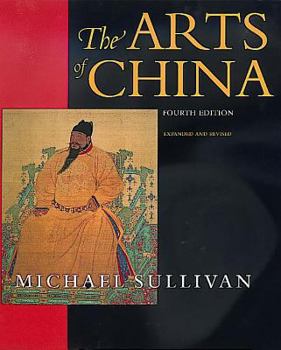
The Arts of China, Fourth edition. Expanded and Revised (An Ahmanson Murphy Fine Arts Book)


Select Format
Select Condition 
Book Overview
For the fourth edition of his much-heralded The Arts of China, last published in 1984, Michael Sullivan has thoroughly revised and expanded this classic history of Chinese art from the Neolithic period to the 1990s. He draws on archaeological discoveries in the last two decades of the twentieth century that have enriched scholars' understanding of both prehistoric and ancient Chinese civilizations. At the same time, research on more recent dynasties has led to fresh interpretations of well-documented historical events and artworks. Also, China's dramatic opening to the outside world since the 1980s has triggered an explosion of contemporary Chinese art, on which Sullivan is the foremost Western authority.
Written in the engaging and lucid style that is Sullivan's hallmark, The Arts of China is readily accessible to general readers as well as serious students of art history. Discussing more than three millennia of Chinese artistic endeavor, Sullivan introduces not only artworks, but also the social, political, religious, and philosophical contexts in which they were created.
This fourth edition has more than 380 illustrations; many are new and nearly half are in color. With this edition Sullivan has abandoned the Wade-Giles system of romanization in favor of the official Chinese Pinyin, now widely accepted by Western readers. These improvements assure that The Arts of China will remain the most comprehensive and widely read introduction to the history of Chinese art.
Written in the engaging and lucid style that is Sullivan's hallmark, The Arts of China is readily accessible to general readers as well as serious students of art history. Discussing more than three millennia of Chinese artistic endeavor, Sullivan introduces not only artworks, but also the social, political, religious, and philosophical contexts in which they were created.
This fourth edition has more than 380 illustrations; many are new and nearly half are in color. With this edition Sullivan has abandoned the Wade-Giles system of romanization in favor of the official Chinese Pinyin, now widely accepted by Western readers. These improvements assure that The Arts of China will remain the most comprehensive and widely read introduction to the history of Chinese art.
Format:Hardcover
Language:English
ISBN:0520218760
ISBN13:9780520218765
Release Date:February 2000
Publisher:University of California Press
Length:342 Pages
Weight:2.77 lbs.
Dimensions:10.5" x 1.0" x 8.8"
Customer Reviews
5 ratings
Still one of the best textbooks on the subject
Published by Thriftbooks.com User , 17 years ago
The fourth edition of Michael Sullivan's lucid survey of the arts of China is still one of the best textbooks on the subject to be found in the English language. Within its chronological arrangement of chapters it covers major historical, religious, and cultural events from each period/dynasty in Chinese history before examining developments in the visual arts. Major masters and works of art are given careful attention, as are important stylistic changes from period to period. This book has been used by many institutions of higher learning as assigned reading for undergraduate courses on Chinese art, and rightly so. Although some of the photographs could be better, reproducing every object in color would necessitate a rise in price, and most college students have enough to deal with, financially, as it is. Highly recommended!
Excellent
Published by Thriftbooks.com User , 18 years ago
Cannot go wrong with the art book about Chinese art. It's an excellent one, used a lot as a textbook both by university art teachers as well as teachers of Chinese culture and history.
a long, distinguished history
Published by Thriftbooks.com User , 19 years ago
The colour illustrations in this book are lovely to behold. Many show restored artifacts from China's long history. Vases, stoneware, flasks, paintings, handscrolls and much more. From the paintings, you can see where the traditional misty style of Chinese landscape paintings arose. There are even genres, like bamboo painting. Just like the Europeans developed portraits of horses and landed gentry. Naturally, there is also extensive coverage of porcelain plates and containers. Beautifully decorated. The items that the Europeans would call "china"; so close was the identification of the objects with China itself. But more than just objects, the narrative also gives insight into the various Chinese dynasties from which these arose. And also the provinces, like Jiangsu and Anhui, that were artistic centers.
Useful and Knowledgable
Published by Thriftbooks.com User , 19 years ago
The book, The Arts of China, was book I needed to purchase for a college level Asian Art History class focused on China. Each chapter was divided into dynasties and within each chapter sections were written on: background history, ceramics, paintings, sculpture, and other various topics. There are lovely color pictures with high resolution, which are an essential to any student or scholar studying this art. The writing is clear and even enjoyable. I'd highly reccommend this book!
Lucid Style attracts me.
Published by Thriftbooks.com User , 25 years ago
It is difficult to write "Short History of Chinese Arts". Suppose that an honest scholar start preparing his lecture note of " Chinese Arts", he shall struggle with selecting subjects and plates. Moreover, for example, he feels that he be an expert on ancient bronzes, and a beginner of export wares in 17th century. Leaving the purgatory, he would want help to a standard textbook. Among English books, this noted book may have used in many college courses. 1st edition(1967) and The revised edition(1973) were welcomed by many students and scholars. Even a japanese translation had been popular for many years. In this 4th edition, 84 old respectable scholar still attracts me with lucid style.For beginners, this should be a good introduction. Appreciating artifacts in Museum, finding something in antique shop, or reading books/papers/articles about a particular subject, it needs some elementary background knowledge for chinese arts and history. This offers such COMMON SENSE.For experienced scholars, this is an interesting reading. This might look a mean textbook for them. Before reading, I minded I become tired for many facts already learned, but I enjoy this book even in commute train, although this edition format is too large. Because not only this is Readable for a japanese, but also gives many (sometimes implicit) skeptical suggestions. At 258p, about Wan Hui (1632-1677, painter), "The Palace Museum collection also contains a number of clever pastiches of tenth-century and Northen Song landscapes that are almost certainly his work"; keen insight!.I should regretfully notice that some illustrations/items might be inadequate, blurred, or damaged. I hope that they will be changed at next chance.
Copyright © 2025 Thriftbooks.com
Terms of Use | Privacy Policy | Do Not Sell/Share My Personal Information | Cookie Policy | Cookie Preferences | Accessibility Statement
ThriftBooks ® and the ThriftBooks ® logo are registered trademarks of Thrift Books Global, LLC
ThriftBooks ® and the ThriftBooks ® logo are registered trademarks of Thrift Books Global, LLC
