


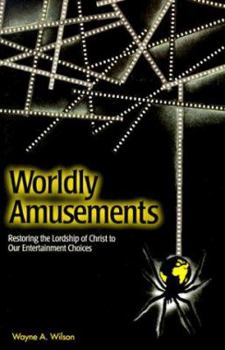
Worldly Amusements: Restoring the Lordship of Christ to Our Entertainment Choices


Do we love movies more than God? Have we compromised God's standard by letting Hollywood assault our minds and hearts with sensuality? Blessed are the pure in heart, for they will see God. Matthew 5:8 This description may be from another edition of this product.
Format:Paperback
Language:English
ISBN:1579212131
ISBN13:9781579212131
Release Date:January 1999
Publisher:Winepress Pub
Length:297 Pages
Weight:0.95 lbs.
Dimensions:8.0" x 0.8" x 5.3"
Customer Reviews
5 ratings
Good, solid thinker
Published by Thriftbooks.com User , 17 years ago
Pastor Wilson is a good solid thinker. He sets forth questions and answers in a thorough, logical manner. His first hand knowledge of Hollywood and the movie industry lends much credibility to his book and he is an articulate writer. He does not address other forms of worldly entertainment. The Contents: Wilson clearly delineates the necessity of this book in the first chapter: "My contention is that we have grown too close to the world...The decadence prevails because it is largely funded by Christian dollars, viewed in Christian homes, and welcomed by Christian hearts. Somehow we have grown fond of the world. Christians have always been tempted by the world, but this is, I believe, the first generation of Bible-believing Christians ever to have embraced evil amusements so completely." (p. 9-10) In chapter two, Pastor Wilson defines worldly amusements. "They are amusements, or entertainment, that do at least one (or both) of the following: 1. They promote an evil message...by celebrating sins. Sin is presented in an attractive way. 2. They use evil methods. Regardless of the point of the story, the performers are made to behave in ways that are shameless and immoral." (p. 19-20) See 1 John 2:16. He also describes "the shifting standard," which Christians must be quick to identify and avoid. "It is a mistake to define `mild' evils by comparison with our culture's greatest deficiencies. When the church does that, Christian standards also decline. We live to a lower standard than previous generations because we measure ourselves by the bottom, and the bottom keeps sinking lower." (p. 21) The third chapter is most excellent as he wisely answers the question, "What does the Church say? Because we have centuries of wisdom and experience behind us, we are fools to ignore those voices...." (p. 25) He quotes church leaders from the early church to modern eras unequivocally denouncing movies and the precursor of the movie, the stage, as worldly entertainment to be avoided by the body of Christ. "The capacity of the arts to touch the soul has made art's influence a concern for the church and rightly so. The church is the shepherd of the soul." (p. 56) Chapter Four is titled, "The Movies: Four Views." Here Pastor Wilson carefully leads the reader through 4 basic positions a Christian can take, including possible objections to each position. 1. Avoidance--an outright ban on all movies. He presents 4 arguments in favor of this stance and 5 objections, although three of the objections are weak (in my estimation). 2. Silence--pastors simply don't talk about movies, positively or negatively. This approach is "cowardly and negligent." (p. 61) 3. Engagement--Christians should immerse themselves in the culture of the world, always seeking good artistic standards and ignoring vulgar elements in films, looking for a higher good. 4. High Standards--"Christians should hold the arts to a clear standard of morality in order to justify Christian pa
Very good advice for families
Published by Thriftbooks.com User , 19 years ago
If Christians enjoys watching movies, then the question is whether "Christians are guilty of collaboration" (p. 13). Does a Christian who pays ten dollars in order to enjoy a good movie work jointly with "a glamorous, global, ubiquitous force for the corruption of souls"? (p. 12) Wayne Wilson, a pastor of a Faith Bible Church in Southern California with a television degree from Columbia media college in Chicago, addresses the above problem and presents "four basic positions" (p. 57) and offers historical support for each position. Wilson writes, "The first view is the oldest: don't go... Period" (p. 58). Tertullian (160-230 A.D.) supports the first solution, Avoidance, and writes, "You have the theater forbidden, then, in the forbidding of immodesty" (p. 27); modesty demands the boycott of movies. The second position, Silence, "is the easiest: don't talk about it" (p. 60). John Wesley (1703-91) states, "I am not obliged to pass any sentence on those that are otherwise minded. I leave them to their own Master" (p. 40); let the Lord do the talking. Engagement is the third view which commands us to "immerse ourselves in the experience of those around us" (p. 61). Christians in the Middle Age (800-1200) "developed mystery plays and morality plays which sought to communicate Christian morals through a rough-and-tumble style" (p. 33); watch movies and make better ones. The fourth and last position, High Standards, where "Christians should hold the arts to a clear standard of morality in order to justify Christian patronage" (p. 64). For example, Postmaster Will Hayes "published a movie code, endorsed by film producers in March 1930, which stated, 'No picture shall be produced that will lower the moral standards of those who see it'" (p. 44). The author then presents very clear examples of how a Christian might navigate his or her way through the movie industry. Wilson clarifies his reasons for supporting the fourth position, High Standards: "people obviously have had to confront the entertainment question" (p. 66). He shows why there is "bad language" in movies even though no one likes it (pp. 147-52). And he teaches us how to examine movies by telling us to watch out for "an evil message" delivered by "evil methods" (p. 171). An evil message is known to Christians as "idolatry" (p. 178) and clever, evil methods deliver the message "as a big lie... wrapped up in a beautiful package" (p. 182). Thus, worldly amusements show us artificial, man-made things with bright lights, crisp sounds systems, smooth acting, and revealing costumes. In "Worldly Amusements" Wilson examines a set of movies (chapters 10-14), gives expert advice to parents, men, women, young people and ministers (c. 16), and makes an excellent suggestion for the folks in Hollywood: "Why not produce 5 to 10 percent of your movies under the old code?" (p. 282). I know that I would go to those movies. Worldly Amusements has very good information for Christians who enjoy movies, a movie in
Worldly Amusements
Published by Thriftbooks.com User , 20 years ago
Wayne Wilson has provided a useful tool for Christians who desire to please God in every area of their lives. Wilson does not merely rant and rave against the Hollywood entertainment industry. He gives Biblical principles, helpful examples and well-reasoned arguments that will help believers to determine the kinds of entertainment that will prove beneficial for the spiritual welfare of their family. Good job Mr. Wilson!
Rage against the machine!!
Published by Thriftbooks.com User , 22 years ago
The media is not a gray area as many Christians want to believe. There is a verse in 1 John which calls us to "not love the world". This book beckons us in a definite way to heed this call. There are in fact standards that need to be maintained. We are willing though, to compromise those standards and dig through the filth of most of the entertainment industry to find the one grain of truth. As the author, Wayne Wilson says, "Christian groups lavish praise on and even hand out awards to films that give any kind of approving nod to Christian beliefs, even if the film grossly violates any sense of decency in telling the story. That's how pitiful we have become. We are dogs begging crumbs of acceptance from the wrong table. I don't believe we need to be quite so desperate for the praise of the world that we forsake our Master's standards..." (pg 281) Another reviewer wrote that the author wrote too much about Franky Schaeffer. There are two chapters where Pastor Wilson does write quite a bit about and against Schaeffer (son of Francis). This is because Shaeffer comes from the "anything goes if you can toss a 'redeeming' feature into the story somewhere" point of view(pg 250). Many Christians have this view. But what would Christ say? "Question: what do you think Jesus would say on the set of ___ ___ when the director tells the actors to disrobe? My guess is He would not say: 'It has a moral theme ladies, really.' I doubt He would compliment the director for his 'unblinking' portrayal of real life." (pg 224) He also uses the movie the Titanic a lot as an example. This is because it was the most popular movie at the time that this book was written. He breaks it down and shows why a follower of Christ should not see this movie. Many Christians did and did not see anything wrong with it. There were movies that we used to watch that we thought were ok because we thought we could "handle" it. But we realized that our thinking was all wrong. We should not say, "that doesn't bother me" but "should this bother me?" Does it bother God? You would think Mr. Wilson is just "cursing the darkness" and he is on one hand. But at the same time he is not against all movie watching. Neither is he just for poorly made "Christian" movies. He is all for good quality movies as long as they do not offend the One we say we love more than those films . This is a book about changing the standards that we have come up with via our own deceitful heart, and forming standards that come from God's word. "The heart is deceitful above all things..... " (Jer. 17:9). It's so easy to love the world. You are thought of as a legalistic fundamentalist pietistic if you do not. Aren't we as Christians called to be different? Instead of loving ourselves and the things of the world we love Christ who bought us at a price. We will be different and look odd if we begin to evaluate movies and television with a standard that God has s
A must for every family with children
Published by Thriftbooks.com User , 26 years ago
This book helps parents choose the right movies for their kids to see. It gives them biblical background to support their positions. It takes Hollywood to task for the type of films they make.
Copyright © 2025 Thriftbooks.com
Terms of Use | Privacy Policy | Do Not Sell/Share My Personal Information | Cookie Policy | Cookie Preferences | Accessibility Statement
ThriftBooks ® and the ThriftBooks ® logo are registered trademarks of Thrift Books Global, LLC
ThriftBooks ® and the ThriftBooks ® logo are registered trademarks of Thrift Books Global, LLC
