


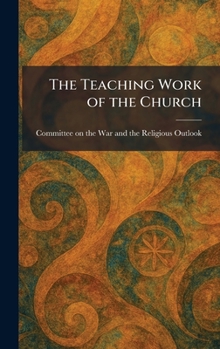
The Teaching Work of the Church

"The Teaching Work of the Church" is an insightful and comprehensive analysis of the educational responsibilities of Christian institutions during a transformative period in religious history. Prepared by the Committee on the War and the Religious Outlook, this volume examines the fundamental role that teaching plays in the spiritual and social vitality of the church. It provides a systematic overview of how religious instruction can be integrated into the life of the congregation, addressing the needs of children, adolescents, and adults alike.
The work explores the pedagogical methods and organizational structures necessary for effective religious training, emphasizing the importance of well-trained leadership and a structured curriculum. By navigating the complexities of modern education and its intersection with faith, the text offers historical perspectives on the development of Sunday schools and the intellectual growth of believers. This study serves as an essential resource for understanding the evolution of pastoral work and the enduring significance of education as a cornerstone of religious practice. It highlights the church's mission to foster a deeper understanding of doctrine while responding to the social and psychological challenges of the era, making it a valuable document for scholars of religious education and church history.
This work has been selected by scholars as being culturally important, and is part of the knowledge base of civilization as we know it. This work was reproduced from the original artifact, and remains as true to the original work as possible. Therefore, you may see the original copyright references, library stamps (as most of these works have been housed in our most important libraries around the world), and other notations in the work.
This work is in the public domain in the United States of America, and possibly other nations. Within the United States, you may freely copy and distribute this work, as no entity (individual or corporate) has a copyright on the body of the work.
As a reproduction of a historical artifact, this work may contain missing or blurred pages, poor pictures, errant marks, etc. Scholars believe, and we concur, that this work is important enough to be preserved, reproduced, and made generally available to the public. We appreciate your support of the preservation process, and thank you for being an important part of keeping this knowledge alive and relevant.
Customer Reviews
ThriftBooks ® and the ThriftBooks ® logo are registered trademarks of Thrift Books Global, LLC
