


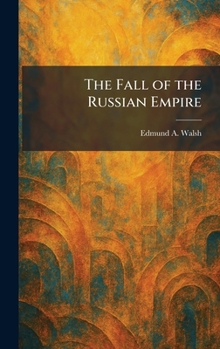
The Fall of the Russian Empire

"The Fall of the Russian Empire" provides a comprehensive and gripping historical analysis of one of the most transformative periods in modern history. Written by Edmund A. Walsh, a distinguished scholar and expert on international affairs, this work delves into the complex socio-political factors that led to the collapse of the Romanov dynasty and the subsequent rise of the Bolsheviks. Walsh masterfully explores the internal decay of the Tsarist system, the devastating impact of World War I, and the revolutionary fervor that swept through Russia in 1917.
This volume offers a detailed examination of the key figures who shaped the era, including Emperor Nicholas II, Empress Alexandra, and the enigmatic Rasputin, while also analyzing the ideological shifts that fundamentally altered the global political landscape. Through a narrative that combines academic rigor with compelling storytelling, "The Fall of the Russian Empire" chronicles the tragic end of an imperial era and the birth of the Soviet state. It remains a significant resource for readers interested in Russian history, political science, and the origins of the twentieth century's greatest geopolitical conflicts. This account serves as both a historical record and a profound meditation on the fragility of power and the consequences of systemic failure.
This work has been selected by scholars as being culturally important, and is part of the knowledge base of civilization as we know it. This work was reproduced from the original artifact, and remains as true to the original work as possible. Therefore, you may see the original copyright references, library stamps (as most of these works have been housed in our most important libraries around the world), and other notations in the work.
This work is in the public domain in the United States of America, and possibly other nations. Within the United States, you may freely copy and distribute this work, as no entity (individual or corporate) has a copyright on the body of the work.
As a reproduction of a historical artifact, this work may contain missing or blurred pages, poor pictures, errant marks, etc. Scholars believe, and we concur, that this work is important enough to be preserved, reproduced, and made generally available to the public. We appreciate your support of the preservation process, and thank you for being an important part of keeping this knowledge alive and relevant.
Customer Reviews
ThriftBooks ® and the ThriftBooks ® logo are registered trademarks of Thrift Books Global, LLC
