


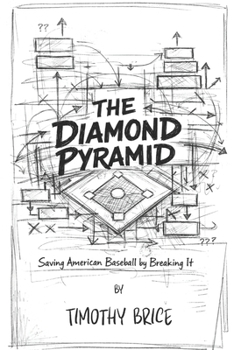
The Diamond Pyramid: Saving American Baseball By Breaking It

In 1922, the Supreme Court gave baseball something no other American industry has: a legal exemption from antitrust law. A pass. A permanent get-out-of-competition-free card.
One hundred years later, that exemption has done exactly what you'd expect. It created a closed system that rewards owners for losing on purpose, holds cities hostage for stadiums they can't afford, pays minor league players poverty wages for careers that last an average of three years, and suppresses competition so thoroughly that the same franchises have been terrible for decades without consequence.
The market isn't fixing this. It was designed not to.
The Diamond Pyramid makes the case for breaking the system entirely, and replacing it with something that works. A five-tier open structure built on promotion and relegation, where earned success is rewarded, inherited status means nothing, and owners who field losing teams on purpose face real consequences. One hundred and fifty teams. Real accountability. A sport that finally reflects the values it claims to represent.
But this is not just a baseball book.
Baseball is the clearest case study in America of what happens when a closed system is protected from competition by law. Once you see how the exemption shapes behavior at every level, from billion-dollar franchise valuations to a twenty-three-year-old pitcher sleeping four to a hotel room in Double-A, you start seeing the same architecture everywhere. In healthcare. In housing. In food. In labor.
The Diamond Pyramid is not a prediction. It is a proof. The promotion and relegation model exists not because it is inevitable but because it makes the current system's choices impossible to ignore. Once you see what baseball chose, you cannot unsee it.The Diamond Pyramid is where the pattern becomes visible. Everything else follows from here.
Customer Reviews
ThriftBooks ® and the ThriftBooks ® logo are registered trademarks of Thrift Books Global, LLC
