


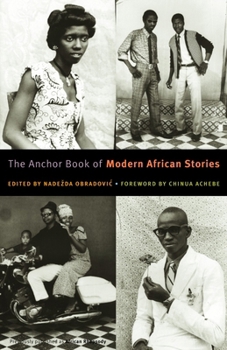
The Anchor Book of Modern African Stories


Select Format
Select Condition 
Book Overview
The Anchor Book of Modern African Stories showcases the most innovative writing to arise from the continent. From internationally recognized authors such as Nigeria's Ben Okri, to newcomer Leila Aboulela from Sudan, together the contributors offer compelling testimonies of life in the midst of historic upheaval. Rich, dense, and topical, this collection is an indispensable guide to the emerging canon of contemporary African fiction. Contributors: Tayeb Salih, Henri Lop s, Luis Bernardo Honwana, Njabulo S. Ndebele, Olympe Bhely-Quenum, Sindiwe Magona, Charles Mungoshi, William (Bloke) Modisane, William Saidi, Abdulrazak Gurnah, Tololwa Marti Mollel, Nnadzie F. Inyama, Sembne Ousmane, Mohammed Berrada, Ali Deb, Mohamed Moulessehoul, I.N.C. Aniebo, Dambudzo Marechera, Ken Lipenga, Ibrahim Abdel Megid, Ndeley Mokoso, Ken Saro-Wiwa, Alifa Rifaat, Leila Aboulela, Milly Jafta, Ben Okri, Funso Aiyejina, Farida Karodia, Salwa Bakr, Gaele Sobott-Mogwe, Makuchi, Hama Tuma, Ossie O. Enekwe, Adewale Maja-Pearce.
Format:Paperback
Language:English
ISBN:0385722400
ISBN13:9780385722407
Release Date:December 2002
Publisher:Anchor Books
Length:400 Pages
Weight:0.70 lbs.
Dimensions:0.9" x 5.3" x 7.8"
Customer Reviews
3 ratings
Recommended
Published by Thriftbooks.com User , 19 years ago
This collection, published in 2002, was the revised edition of a book that came out in 1994 under the title African Rhapsody: Short Stories from the Contemporary African Experience. It contained 34 short stories by as many writers from 19 African countries. The major regions of east, west, north and south were represented, broadly speaking, and Nigeria, Egypt and South Africa had a handful of stories each. Ethiopia, Congo (Dem. Rep.), Kenya, Uganda and Ghana were the most populous countries whose writers weren't included. The works were written between approximately 1951 and 1999, and most were from the 1980s and 90s. Two-thirds were published originally in English, with the remainder translated from Arabic, French and Portuguese. Nothing translated from indigenous Sub-Saharan languages was included, but that seems to be the norm in anthologies for this region read so far. About half of the writers in the book were born after World War II. The earlier writers included Sembene Ousmane, Henri Lopes, William Modisane, Olympe Bhely-Quenum, Tayeb Salih, Alifa Rifaat, Mohammed Berrada, I. N. C. Aniebo, Ken Saro-Wiwa and Ali Deb. The book didn't include short stories by writers such as Diop, Tutuola, Mphahlele, Ekwensi, Camara, Gordimer, Achebe, Nwapa, Djebar, Amadi, Head, Breytenbach, Ngugi, Aidoo, Iyayi, Wicomb or Vassanji, or excerpts by novelists such as Emecheta or Coetzee. The editor, Nadezda Obradovic, selected mainly pieces that portrayed daily life, family relations, culture, tradition, religious beliefs, marital customs and people's behavior in crises such as war. Most of the stories reflected "shared situations of conflict" related to the inherited past or the new era: the transition from childhood into maturity or from rural to urban environments, the encounter with foreign or Western cultures, the rebellion against colonialism, disappointment with indigenous political movements, the struggle against corruption, poverty, unemployment and the oppression of women, and the loss of values and honor. In a foreword, Chinua Achebe wrote that the stories shared a pervasive atmosphere of pain and life's injustice, and that many depicted the betrayal of innocence. Most of the pieces were straightforward and realistic, focused usually on the personal, occasionally probing deeply the psychology of their characters. For me, one of the most interesting was "The Museum," by Leila Aboulela (b. 1964), among the youngest writers in the collection, about a young Sudanese woman from a high social class who was studying in Scotland and taking the first steps beyond her own prejudices to befriend a bright but awkward local student. The differences in culture, customs, history and class were described well, as was the description of attempts to bridge those barriers. Other stories were "Her Three Days," by Sembene Ousmane, in which a frail woman who was a husband's third wife awaited his visit, and which described sensitively the wife's problems and social
Another great compilation of short stories.
Published by Thriftbooks.com User , 19 years ago
This book is great. I bought it for a class requirement, but had I known this book existed I would have purchased it long before. I would highly recommend this book to increase one's awareness and sensitivity to the African culture.
Powerful slices of African lives
Published by Thriftbooks.com User , 20 years ago
"The Anchor Book of Modern African Stories," edited by Nadezda Obradovic, brings together 34 stories from many parts of the continent. The copyright page notes that an earlier edition of the book was published under the title "African Rhapsody: Short Stories from the Contemporary African Experience" in 1994. The stories take up 369 pages of text, making for an average length of about 11 pages each; the longest story, Charles Mungoshi's "The Brother," is only 26 pages long. An illuminating foreword by Chinua Achebe gives some literary and historic context for the short story genre in Africa. This is a rich, diverse collection. There are several selections by women writers. The editor has included both stories written in English and stories translated into English. The writers represent many African nations: Sudan, Mozambique, South Africa, Benin, Nigeria, Morocco, Ethiopia, and more. Among the many topics covered by the stories are economics, the supernatural, family ties across generations, sex, addiction, the role of domestic workers, language, race relations, marriage, capital punishment, AIDS, education, and war. I was particularly intrigued by the stories showing the role of Islam in African lives. There are many noteworthy selections in this anthology. "The Prophetess," by Njabulo S. Ndebele, is about a boy on a mission to acquire holy water from the title character. "It Was Easter Sunday the Day I Went to Netreg," by Sindiwe Magona, shows three generations of women in an African family as they confront a serious family crisis. "Hot Days, Long Nights," by Nnadozie F. Inyama, offers intriguing glimpses of both the marketplace and the nightlife of the city of Akassa. "Her Three Days," by Sembene Ousmane, is a disturbing look at the wife of a polygamist. "The Three-Piece Suit," by Ali Deb, is a compact but biting satire of conspicuous consumerism. "The Wicked Tongue," by Mohammed Moulessehoul, is a parable-like tale of justice; this story is also noteworthy for its Islamic setting. "God of Meme," by Ndeley Mokoso, looks at the conflict between a crocodile cult and local officials. "Africa Kills Her Sun," by Ken Saro-Wiwa, is written in the form of a letter from a death-row inmate. In "The Waldiba Story," by Hama Tuma, a monk tells his story to a doctor serving with guerrilla forces. But my favorite story in the collection is "The Museum," by Leila Aboulela, which looks at the experiences of a Sudanese woman studying abroad in Scotland; this is a wonderful, vividly written piece that left me wanting to continue following the characters. My only complaint about the anthology involves the editor's "Introduction to the Second Edition" (pages xi-xii). She ruins a number of the stories by revealing the endings--in my opinion, this is one of the worst offenses an anthology editor can commit. So I recommend that readers refrain from reading this introduction until after they have read all the stories. Overall, this is a powerful
Copyright © 2026 Thriftbooks.com
Terms of Use | Privacy Policy | Do Not Sell/Share My Personal Information | Cookie Policy | Cookie Preferences | Accessibility Statement
ThriftBooks ® and the ThriftBooks ® logo are registered trademarks of Thrift Books Global, LLC
ThriftBooks ® and the ThriftBooks ® logo are registered trademarks of Thrift Books Global, LLC
