


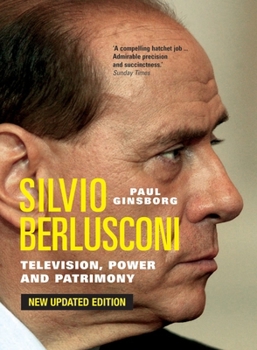
Silvio Berlusconi: Television, Power and Patrimony


Select Format
Select Condition 
Book Overview
Silvio Berlusconi, a self-made man with a taste for luxurious living, owner of a huge television empire and the politician who likened a German MEP to a Nazi concentration camp guard--small wonder that much of democratic Europe and America has responded with considerable dismay and disdain to his governance of Italy. Paul Ginsborg, contemporary Italy's foremost historian, explains here why we should take Berlusconi seriously. His new book combines historical narrative-Berlusconi's childhood in the dynamic and paternalist Milanese bourgeoisie, his strict religious schooling, a working life which has encompassed crooning, large construction projects and the creation of a commercial television empire-with careful analysis of Berlusconi's political development. While highlighting the particular italianita of Berlusconi's trajectory, Ginsborg also finds international tendencies, such as the distorted relationship between the media system and politics. Throughout, Ginsborg suggests that Berlusconi has gotten as far as he has thanks to the wide-open space left by the strategic weaknesses of modern left-wing politics.
Format:Paperback
Language:English
ISBN:1844675416
ISBN13:9781844675418
Release Date:November 2005
Publisher:Verso
Length:224 Pages
Weight:0.45 lbs.
Dimensions:0.5" x 5.1" x 7.8"
Related Subjects
Arts & Literature Biographical Biographies Biographies & History Biography & History Business Communication & Media Studies Communications Europe Historical Humor & Entertainment Italy Leaders & Notable People Modern (16th-21st Centuries) Political Science Politics & Government Politics & Social Sciences Presidents & Heads of State Professionals & Academics Skills Social SciencesCustomer Reviews
5 ratings
Decent, but Biased
Published by Thriftbooks.com User , 16 years ago
There are not enough books about Silvio Berlusconi in English! Basically, I found two. This one, and one called The Sack of Rome: How a Beautiful European Country with a Fabled History and a Storied Culture Was Taken Over by a Man Named Silvio Berlusconi. I was hoping to find an objective biography (ha!) and of the two, I settled on the Ginsborg one thinking that The Sack of Rome, in its title, pretty clearly indicated its bias. Upon receiving the Ginsborg book, I noticed that it was published by Verso Press, a subdivision of New Left Books. Realizing this, I did some research and it turns out that this one was going to be anti-Berlusconi as well. I was grateful, however, that the author never really tries to hide his bias and does, in fact, give Berlusconi praise where praise is due. Overall, I think this is a decent book to get a basic picture of who Berlusconi is. While slightly outdated (it was published in 2004, well before Berlusconi's loss in the 2006 Italian elections and his subsequent reclamation of the prime minister's seat in 2008), the book gives a decent recounting of where Berlusconi has come from and what motivates him. Reading it knowing the leftist stance, I found myself asking "Well, why is that so bad?" or saying "Yeah, I agree with Berlusconi here." Even though I disagreed with the author on many points, it was not so overbearingly liberal to make it unenjoyable to read. I was able to parse through the pieces that I needed to in order to pull out something of a sketch of Berlusconi. One point of agreement I have with Ginsborg lies in the power of television and mass media. Through his companies like Fininvest and Mediaset, Berlusconi has essentially duopolized the Italian TV market (with Rupert Murdoch and the Italian government). Italians watch a lot of television and as such, greatly inform their worldview based on what they see there. The proliferation of television advertising, which led to the bulk of Berlusconi's wealth, also helps inform people and promotes a sense of hyperconsumerism among Italians, even more so than in other Western nations. Ginsborg has a big problem with this, and so do I. I have more an issue with the hyperconsumerism while Ginsborg extends the argument out to include the image television presents of Berlusconi himself. On the negative side, I wish it had been a little more in depth. It was a great survey across Berlusconi's life and his business and political career. The book was definitely written as a warning, though, to Italy's left (along with the left of the rest of the world) about Berlusconi. The author says as much in his introduction. Since that was the case, the author did not feel a need to be overly biographical. What I mean by this is that Ginsborg only added pieces of information crucial to his overall thesis, which is this: Berlusconi presents a sort-of soft fascism and Italians need to become aware of this. I'm hoping that if Berlusconi stays in power for a while longer, more
Well written but biased
Published by Thriftbooks.com User , 18 years ago
This book is well written and really tells the story of berlusconis rise, but it is biased against Berlusconi.
Master
Published by Thriftbooks.com User , 19 years ago
Ginsborg is truly a master of italian history, society, and politics. I am not at all surprised with the overwhelming expertise displayed is this book, seeing as all Ginsborg's works display the extent of his knowledge and literary skill. A great "riassunto" of Berlusconi from youth to today, and fairly non-partisan.
Italy is very close to home
Published by Thriftbooks.com User , 20 years ago
The author of this book knows how to dramatizize politics. "...something important is happening in Italy, potentially quite sinister, and the seeming normality of life serves to mask it very well." If only it were just a fiction. "Silvio Berlsconi" is a great book on the current state of democracy in Italy, the kind of "modern democracy" heralded by Berlusconi's media empire. If the dictators of the early 20th century have been characterizes as "charismatic leaders" pied pipering away their cults of personality, then today's dictator can be thought of as the sort of highly tailored, well edited "iconic leader," the guy who just LOOKS RIGHT for the job. (Paul Ginsbourg includes a hilarious anecdote in the post-script about Berlusconi who, at a recent press conference, showed up with a face lift he had gotten over Christmas and then proceeds to make the most unfortunate analogy: "The communists...tried to have a face lift in order to hide their real identity, but theirs failed.") As relentlessly critical as Ginsbourg is to Berlusconi, it is hard to ignore the facts of his presidency, both rise to and the policies to follow. It is also hard to ignore the remarkable similarity between the current state of Italian politics and those of the U.S. As Ginsbourg writes, "All this will have a familiar ring in Anglo-Saxon ears." Democracy is becoming increasingly about television and leadership about being televised. What happens to "freedom" in a community connected only by cable? Ginsbourg makes a couple claims of his own, but the exciting aspect of the book is the fact that it raises such questions at all.
The Tale is Told of You
Published by Thriftbooks.com User , 21 years ago
Italian politics since 1945 has often seemed too unstable and esoteric for most Americans. Paul Ginsborg's short polemic about Silvio Berlusconi shows why people should pay attention. The Berlusconi phenomenon is an amazing, and quite appalling, one. From 1992 to 1994, it was revealed that the conservative Christian Democratic party, which had held uninterrupted power since the war, was deeply, deeply corrupt. So corrupt in fact, that the revelation caused its disintergration. But instead of the Right losing the next elections, a wealthy businessman came along and simply bought a new political party. Silvio Berlusconi's "Forza Italia" was not a party devoted to political debate and discussion. It was staffed by his cronies and devoted to his political cult. With it he won the elections of 1994, even though he was himself deeply compromised by the old regime. Serious allegations of corruption soon led to his loss of power and his electoral defeated in 1996. But he returned to power in 2001. Now in point of fact, the charges against him are more than just "allegations", as that infamous left-wing rag, The Economist, has pointed out. Berlusconi has perjured himself about his membership in a conspiratorial, anti-democratic, quasi-fascist masonic lodge. (He benefited from an amnesty). In the seventies his keeper of one his (one-horse) stables was a notorious mafioso. His personal lawyer, Cesare Preveti, has been convicted of 11 year and 5 year sentences for corrupting judges, though he remains free on appeal. Berlusconi delays his trials to run up against the limitations laws. He amends the limitations laws to render himself immune. He changes the rules of evidence so that trials will be further delayed. And when all that fails, he passes laws giving himself immunity, while seeking to undermine the independence of the magistrates. This is bad. And it gets worse. For as Ginsborg notes Berlusconi is still backed by more than 40% of Italians. His defeat in 2006 is by no means a sure thing. Indeed he plans to become a powerful President of the Republic. This despite his judical troubles, an anaemic economy, and support for a massively unpopular war. This despite his failure to simplify administrative procedures, or start promised infrastructure projects, though he has reduced the penalties for accounting fraud. Ginsborg himself is one of the leading historians of modern Italy, and he points out Berlusconi's origins in the Milan building trade. He points out how Berlusconi benefited from the intervention of the infamously corrupt Bettino Craxi, who in 1984 ignored the courts and constitutional mandates for a proper broadcasting law to pass a decree without which Berlusconi could not maintain his broadcasting monopoly. (He also points out how Craxi was the godfather of Berlusconi's child out of wedlock, and how Berlusconi comically elides his adultery in discussing the end of his first marriage.) Although Ginsborg tries to be f
Copyright © 2025 Thriftbooks.com
Terms of Use | Privacy Policy | Do Not Sell/Share My Personal Information | Cookie Policy | Cookie Preferences | Accessibility Statement
ThriftBooks ® and the ThriftBooks ® logo are registered trademarks of Thrift Books Global, LLC
ThriftBooks ® and the ThriftBooks ® logo are registered trademarks of Thrift Books Global, LLC
