


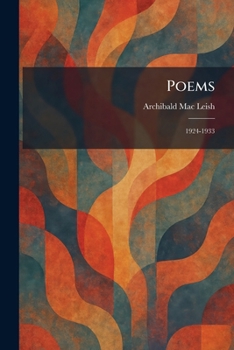
Poems: 1924-1933

Select Format
Select Condition 
Book Overview
"Poems, 1924-1933" is a vital collection of verse by one of the most influential figures in American letters, Archibald MacLeish. This volume captures a transformative period in the poet's career, documenting his mastery of language and his evolution within the Modernist movement. The collection spans nearly a decade of creative output, showcasing MacLeish's ability to blend lyrical beauty with profound intellectual inquiry.
The work explores a wide variety of themes, ranging from personal explorations of time, loss, and memory to broader contemplations of the American landscape and the role of the poet in modern society. MacLeish's style is noted for its rhythmic innovation and striking imagery, reflecting a deep engagement with both the traditions of the past and the avant-garde experiments of his contemporaries. As a writer who would go on to receive multiple Pulitzer Prizes, the pieces included here represent the foundational strength of his poetic voice.
"Poems, 1924-1933" serves as an essential record of a major literary talent at the height of his early powers. It remains a significant contribution to 20th-century poetry, offering readers a window into the evolution of American Modernism through poems that are as thought-provoking today as they were upon their first appearance.
This work has been selected by scholars as being culturally important, and is part of the knowledge base of civilization as we know it. This work was reproduced from the original artifact, and remains as true to the original work as possible. Therefore, you may see the original copyright references, library stamps (as most of these works have been housed in our most important libraries around the world), and other notations in the work.
This work is in the public domain in the United States of America, and possibly other nations. Within the United States, you may freely copy and distribute this work, as no entity (individual or corporate) has a copyright on the body of the work.
As a reproduction of a historical artifact, this work may contain missing or blurred pages, poor pictures, errant marks, etc. Scholars believe, and we concur, that this work is important enough to be preserved, reproduced, and made generally available to the public. We appreciate your support of the preservation process, and thank you for being an important part of keeping this knowledge alive and relevant.
Customer Reviews
ThriftBooks ® and the ThriftBooks ® logo are registered trademarks of Thrift Books Global, LLC
