


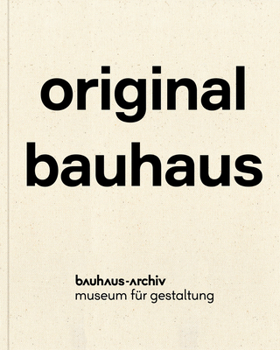
Original Bauhaus Catalogue
No Customer Reviews

One hundred years after the founding of the Bauhaus school, this book takes a deeper look at some of this design movement's most recognizable objects. Even though it existed for a mere fourteen years, the Bauhaus was one of the most influential art schools of the 20th century. But what defines Bauhaus? And why, a century later, are its ideas still being imitated, and its original products relaunched and further developed? This fascinating series of case studies introduces readers to fourteen objects that exemplify the characteristics of the Bauhaus school. Among these objects are Marcel Breuer's tubular steel chair, inspired by his bicycle; Georg Muche's Haus am Horn in Weimar, the first building based on Bauhaus design principles; Marianne Brandt's tea infuser, which, although intended to be a prototype for industrial production, was virtually never reproduced; and, conversely, William Wagenfield's table lamp which is widely manufactured even today. By exploring the origins and legacies of works by Oskar Schlemer, L szl Moholy-Nagy, Walter Gropius, Mies van Der Rohe, and others, this book illuminates the ways that Bauhaus artists viewed art, craft, and technology as complimentary rather than opposing forces. It highlights the technical innovations that created exceptional works of art, and it shows how the idea of serial production was fundamental to the drafting of these designs. Most importantly, it shows how, one hundred years after its founding, the Bauhaus school continues to inform the way we design and build the objects we use every day.
Format:Hardcover
Language:English
ISBN:3791359045
ISBN13:9783791359045
Release Date:November 2019
Publisher:Prestel Publishing
Length:224 Pages
Weight:3.00 lbs.
Dimensions:0.9" x 9.6" x 12.4"
Customer Reviews
0 rating
Copyright © 2026 Thriftbooks.com
Terms of Use | Privacy Policy | Do Not Sell/Share My Personal Information | Cookie Policy | Cookie Preferences | Accessibility Statement
ThriftBooks ® and the ThriftBooks ® logo are registered trademarks of Thrift Books Global, LLC
ThriftBooks ® and the ThriftBooks ® logo are registered trademarks of Thrift Books Global, LLC
