
Skip to content
Scan a barcode
Scan
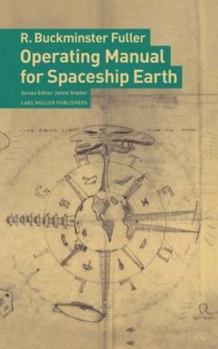
Paperback Operating Manual for Spaceship Earth Book

ISBN: 3037781262

ISBN13: 9783037781265

Operating Manual for Spaceship Earth

Select Format

Select Condition ThriftBooks Help Icon

Recommended

Format: Paperback

Condition: Like New

$15.29
Save $4.66!
List Price $19.95
Almost Gone, Only 1 Left!

Book Overview

In this accessible volume, first published in 1969, Fuller offers advice on how to guide "spaceship earth" toward a sustainable future

Buckminster Fuller (1895-1983) was an architect, engineer, geometrician, cartographer, philosopher, futurist, inventor of the famous geodesic dome, and one of the most brilliant thinkers of his time. For more than five decades, he set forth his comprehensive perspective on the world's problems in numerous essays, which offer an illuminating insight into the intellectual universe of this renaissance man. These texts remain surprisingly topical even today, decades after their initial publication. While Fuller wrote the works in the 1960's and 1970's, they could not be more timely: like desperately needed time-capsules of wisdom for the critical moment he foresaw, and in which we find ourselves. Long out of print, they are now being published again, together with commentary by Jaime Snyder, the grandson of Buckminster Fuller. Designed for a new generation of readers, Snyder prepared these editions with supplementary material providing background on the texts, factual updates, and interpretation of his visionary ideas.

Initially published in 1969, and one of Fuller's most popular works, Operating Manual for Spaceship Earth is a brilliant synthesis of his world view. In this very accessible volume, Fuller investigates the great challenges facing humanity, and the principles for avoiding extinction and "exercising our option to make it." How will humanity survive? How does automation influence individualization? How can we utilize our resources more effectively to realize our potential to end poverty in this generation? He questions the concept of specialization, calls for a design revolution of innovation, and offers advice on how to guide "spaceship earth" toward a sustainable future.And it Came to Pass - Not to Stay brings together Buckminster Fuller's lyrical and philosophical best, including seven "essays" in a form he called his "ventilated prose", and as always addressing the current global crisis and his predictions for the future. These essays, including "How Little I Know", "What I am Trying to Do", "Soft Revolution", and "Ethics", put the task of ushering in a new era of humanity in the context of "always starting with the universe." In rare form, Fuller elegantly weaves the personal, the playful, the simple, and the profound.

Customer Reviews

5 ratings

A Clairvoyant Work

Buckminster Fuller was a remarkable genius whose works are absolutely unique. This book is a good introduction to his transcendent way of thinking. It describes for the first time, the concept that our little planet has finite resources, and since it was written, we have seen that he sensed very well the direction that society was taking. Though his thoughts may seem outdated now in certain ways, this book, and his other works, continue to provide inspired reading within the framework of the quest to understand human life on this planet, and related philosophical ideas.

system enginnering for idiots

The "manual" is not philosophy. Its system engineering. Its operand is not Truth, Good, Love,...System engineering can be reduced to one word: efficiency. During the reader I kept thinking this is the stuff that generals read, and I am only a lieutenant. Which is not to say generals are better. It's just that lieutenant's deal with more human problems. While the generals deal with the big picture. For example, when discussing Einstein's Relativity Fuller keeps invoking the equation E=MC^2. This is the over arching general relation between energy and matter. It's the great answer. But to me what is wonderful about Relativity is the equation distance=sqrt(x^2+y^2+z^2+(it)^2). Here time is in the imaginary direction. What is that? We often say we have 4 dimensions. But that is not quite right with this equation. In the small pictures I find delight. In some ways Fuller reminds me of Marx in its grand scheme. Marx has his historical materialism. Fuller has its metaphor of the "manual". But of course Fuller will have nothing of Marxism. For him Marxism will be dead dogmatic metaphysics to be avoided.

Control, Operate and Plan Your Spaceship

R. Buckminster Fuller's (Bucky hereout), designer of the geodesic dome (one can see at EPCOT), lays down the thought patterns of a successful world in this short and concise book based on his discoveries (probably more appropriate than inventions, as he said "I am not tryingto imitate nature, I'm trying to find the principles she uses"). It is in this book that Bucky gives the reader insight into how he thinks, and how to change ones thinking entirely, to see the Earth as a Spaceship. To feel yourself riding the Earth as a Spaceship. Demonstrating from the anceint "pirates" and how evolution is changed through specialization. How a wealthy nation, such as ours, cannot afford to make economical mishaps or delays on such life-giving elements as water. Moving our modes of consciousness into Einsteinian, omni-directional thinking, we can then turn to everyone to "co-operate." To help others, and not gain at the expense of others. Certainly a classic in its own right, this book will change the way you think, not about life or the world, just that you change your thinking, making every action a universal consequence. There is only one Earth, and we are all living in it. Reccomended!

You need to read this book!

I really mean it. This book makes much more sense than any government plan that I know of. We all need to read this book.

Must reading for todays 30 something generation.

Our forefathers, parents and their peers have delivered us a drastically (wonderfully) complex society with ever increasing difficulties, and opportunities. RBF does an uncommonly fine job of explaining some of the underlying drives that brought us here. Maybe also sheds light on a usefull path to the future.
Copyright © 2025 Thriftbooks.com Terms of Use | Privacy Policy | Do Not Sell/Share My Personal Information | Cookie Policy | Cookie Preferences | Accessibility Statement
ThriftBooks ® and the ThriftBooks ® logo are registered trademarks of Thrift Books Global, LLC

GoDaddy Verified and Secured