


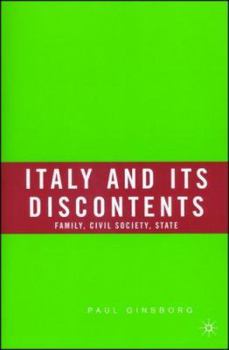
Italy and Its Discontents: Family, Civil Society, State


Select Format
Select Condition 
Book Overview
A major bestseller in Italy, Paul Ginsborg's account of this most recent and dynamic period in Italy's history is essential reading for anyone wishing to understand contemoprary Italy. Ginsborg... This description may be from another edition of this product.
Format:Hardcover
Language:English
ISBN:1403961522
ISBN13:9781403961525
Release Date:January 2003
Publisher:Palgrave Macmillan
Length:544 Pages
Weight:1.90 lbs.
Dimensions:9.5" x 1.5" x 6.5"
Customer Reviews
2 ratings
Excellent detailed history of contemporary Italy
Published by Thriftbooks.com User , 21 years ago
This book by professor P. Ginsborg is an excellent, detailed history of contemporary Italy. Starting with the post-war period, it goes all the way to the end of the '80s, taking into account all the changes made in the italian politics, but mostly in the italian society . The analysis of the attitudes, the way of thinking and the way that the italian society operated during that period is particularly interesting.
Italy: the ABC Murders
Published by Thriftbooks.com User , 22 years ago
Paul Ginsborg's previous book, "A History of Contemporary Italy 1943-1988" is perhaps the best history of the postwar period of any country. It benefited not only from thorough research and fine organization but from a coherent and compelling thesis. Despite the many signs of vitality and progress in the Italian Republic, it faced severe problems in government and society which required urgent and farlasting reform. However, Italian political life was structured in such a way to make sure that reform never happened."Italy and Its Discontents" is the sequel. Although at times Ginsborg is somewhat cheery and optimistic, this is a depressing tale. In many ways it is a complex and nuanced tale, as Ginsborg discusses with enviable nuance the strengths and weaknesses of the Italian economy, the decline of the industrial working class and the plague of youth employment, the always persistent "Southern" problem, the clash between mass culture and a rising "civil society," and the many weaknesses of the Italian bureaucracy. He pays particular attention to the changes in the family, the rise of secularism, and the decline of Catholic and Communist cultures. He also discusses the strengths and weaknesses of Italian politics, the complexities of corruption and the mafia, the less than impartial judiciary, and the complexities and failures of political ideologies. And yet in some crucial ways Ginsborg's tale is very simple. Italian democracy in the 1980s was severely flawed both by corruption and by the success of vested interests in preventing, delaying or diluting vital reforms. The most honest and thoughtful party were the Communists, so much of the energy of its political class was dedicated to making sure they never had power. Italian politics in the eighties and nineties would be dominated by three people: Andreotti, Berlusconi, and Craxi. Andreotti was a "Christian Democrat" and deeply complicit in its corruption, patronage and ties with the mafia. Craxi was a "Socialist" who drapped himself in fashionable "Anti-Marxist" rhetoric while taking shakedowns and bribery to new heights. It was a politics of secret anti-communist forces (the Gladio), murdered anti-Mafia prosecutors, the strange and sinister P-2 Masonic lodge, sycophantic intellectuals, and one demagogic president. It was also a politics in which the Vatican banker would pay $7 million to Craxi's secret Swiss bank account and then be found hanging a year and a half later from Blackfriars' bridge. Craxi and Andreotti dominated Italian politics until 1992-93 when revelations of massive corruption decimated the Christian Democratic and Socialist parties. But just when it appeared that the Italian Left would finally be able to take power, Berlusconi appeared. Having been granted monopoly control over Italian television by Craxi, and having used that to help coarsen Italian cultural life, Berlusconi simply bought his own political party. Forza Italia became the new party of the I
Copyright © 2025 Thriftbooks.com
Terms of Use | Privacy Policy | Do Not Sell/Share My Personal Information | Cookie Policy | Cookie Preferences | Accessibility Statement
ThriftBooks ® and the ThriftBooks ® logo are registered trademarks of Thrift Books Global, LLC
ThriftBooks ® and the ThriftBooks ® logo are registered trademarks of Thrift Books Global, LLC
