


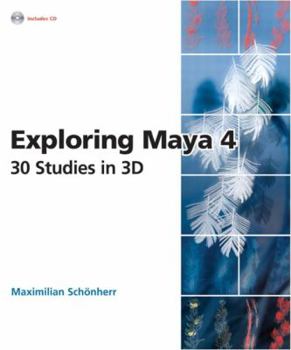
Exploring Maya 4: 30 Studies in 3D

This title provides a practical, project-based approach to Maya 4, using hands-on, working tutorials. Author Maximilian Schonherr highlights ways to achieve specific projects and tasks in Maya. Each... This description may be from another edition of this product.
Format:Paperback
Language:English
ISBN:0201742160
ISBN13:9780201742169
Release Date:November 2001
Publisher:Pearson Education
Length:192 Pages
Weight:1.05 lbs.
Dimensions:9.0" x 0.4" x 7.5"
Customer Reviews
5 ratings
Excellent Book!
Published by Thriftbooks.com User , 23 years ago
After seeing some of the negative reviews posted, I felt compelled to add my own experience with the book. This is easily one of the best 3d Books of any kind I've ever purchased. Those unhappy with the book are missing the whole point. The author is not trying to present tutorials that are an end in themselves. Those are a dime a dozen on the web. Instead he focuses on theory and the hows and why's so one can take that knowlege and create on their own. I enjoyed this approach and I will be looking foward to the author's next work.
Great tips in this book
Published by Thriftbooks.com User , 24 years ago
This is not the book to learn how to use Maya. Rather, it is extremely handy to learn solutions on problems which you may encounter during your projects. Think of this as a notebook of someone's project problems and solutions. Don't compare this book with instructional manuals - apples and oranges. I was hesitant on getting it since the reviews here contain some negative comment on its simplicity. Now I am glad to have purchased it and am grateful for its simplicity.
Great Book
Published by Thriftbooks.com User , 24 years ago
Oh my....he forgot to put the how to make my bad models look good , or how to easily model the human head tutorial. guys sorry to break it to you but there is no easy way to model a head , car etc. your best bet is to practice. No matter how many books you read you wont master it until you practice. ok this was for the two appereantly newbie guys who gave one star ratings.back to the book : As the writer said in his post this is not another book that teaches the basics. Instead it gives you fresh perspective of what maya is capable of with simple examples. How farther you take those examples and apply them to your own work is up to you.overall i recommend this book to anybody who wants to learn more about maya.
How this book came about (a letter from the author)
Published by Thriftbooks.com User , 24 years ago
Hello, I _had_ to rate this book to write this message here ;)I'm the author of this book. It's my first book in English-a translation of my second German book on Maya. The first book was written for newcomers and introduced not only the interface of Maya but also topics like the aesthetics of high-end 3D animation, the depth of logical nodes, and the basics of character animation and dynamics. It is very comprehensive and 600 pages strong. The new book has only 200 pages and was developed while I taught 3D animation using Maya 4 to students at the University of Aachen and the German Film Academy in Ludwigsburg who were all familiar with the basics of the software but not with much more. So, please don't expect from this book any instructions about how to use the Hotbox, create a Loft, or render a sequence of pictures for NTSC.My intention as an author and a teacher was to explore as much of the complexity of Maya 4 as possible using rather brief, practical, and extremely different tutorials called "studies". None of these studies took the students longer than an hour to complete, but most of the studies lured them even deeper into the matter, so that eventually much more complex modelings or animations were created. After finishing all 30 studies, the students had a good overview of what's possible in the software.I also found that they kept returning to the book during other projects of their own. The reason for this constant reference seems to be the fact that the book was not written from the angle of the tools but from questions coming from real life. So, when you animate a character that has to grab a pen, you might remember Study # 8, "Steering the Bike (With a Little Distraction)." When you have to quickly model a complete character, you might want to take a look at Study # 10, "Knobbly Man." When you have to animate an explosion, Study # 17, "Erupting Volcano" might help you. And if you want to mix animation phases, you might want to check the index which gives you several entries about nonlinear animation, clips, poses, and the Trax Editor. Of course, digital painting in 2D and 3D and the Paint Effects play an important role, too; just look at the studies "Wild Things" with hybrid plants, "The Shadow of the Trees," "Swim Ring with Love," or the animation of the Chinese character Ji in Study # 30.I hope you enjoy reading the book as much as I enjoyed writing and translating it!
not for the couch potato
Published by Thriftbooks.com User , 24 years ago
How do I make an environment sky? How do I make a "green screen -or a blue screen", for that matter or how do I make a landscape? Yes, silly enough for a seasoned Maya user but not for the one who's been through too many a frustration to find these solutions through tinkering and going through so called "Mastering" type of Maya manuals that apparently have a lot to offer but when you're just struggling to barely get off the ground they just keep you from soaring. But here comes this little book, barely a few pages with as little text as is neccessary and, my God! in color!, now here my heart takes a jump and, man! am I ever glad that this "little" book is just so great, that it does so deliver!!! A year ago I saw "The Sphere" film which has quite a cool intro done by Imaginary Forces. At the time I was starting on After Effects and not only had I some material to work on (find out how it was done, the text effects mainly) but also material to research with: the Meyer's AE in Production book which is close to the bible, not only for it's invaluable amount of info but also for the way it's been written and the graphic layout of the book itself. Six months ago I opened a Maya demo for the first time having provided myself with 3 well known manuals as an investment looking forward to emulate some 3d stuff that had inspired me to try Maya and almost 4 months followed in which I almost threw everything in the garbage. But when I cooled down and thought about it all came down to the documentation, to the manuals. It was a situation pretty much like in school where not all teachers are actually "communicators" I bought this book a week ago, and even when each chapter may be carried out in about an hour I took 2 days for ch. 29, the Magic Lens and 4 days for ch. 24, Wild Things. This book is for the tinkerer, for the one that needs to quickly understand a basic concept with a basic yet practical example and then use these tools to experiment further. I wouldn't recomend it for the non-imaginative mind, the straightforward thinker, this is not a "direct" book.I used the idea of the Magic Lens lesson with different lens shapes, sizes, distances and combination of 2, 3 and 5 glasses emulating the positions and shapes of different lenses on my 35 mm SLR camera and, man! I could have spent a month rendering different results; then changed type, even replaced typography for objects... And now for wild things, Paint Effects had never been introduced (to me) through bibliography in such a simple manner as 30 studies in 3D has: 4 days into it and with such a simple lesson here I am expanding, taking the painting idea in 2D and enhancing a texture here or a sky there, taking the 3D painting concept and exploring the concept of painting a realistic landscape, taking the Environment Sky and testing for optimal settings, taking the Depth of Field concept that up until now, I don't know why I could never understand and now it's all so clear, experimenting with creative
Copyright © 2026 Thriftbooks.com
Terms of Use | Privacy Policy | Do Not Sell/Share My Personal Information | Cookie Policy | Cookie Preferences | Accessibility Statement
ThriftBooks ® and the ThriftBooks ® logo are registered trademarks of Thrift Books Global, LLC
ThriftBooks ® and the ThriftBooks ® logo are registered trademarks of Thrift Books Global, LLC
